
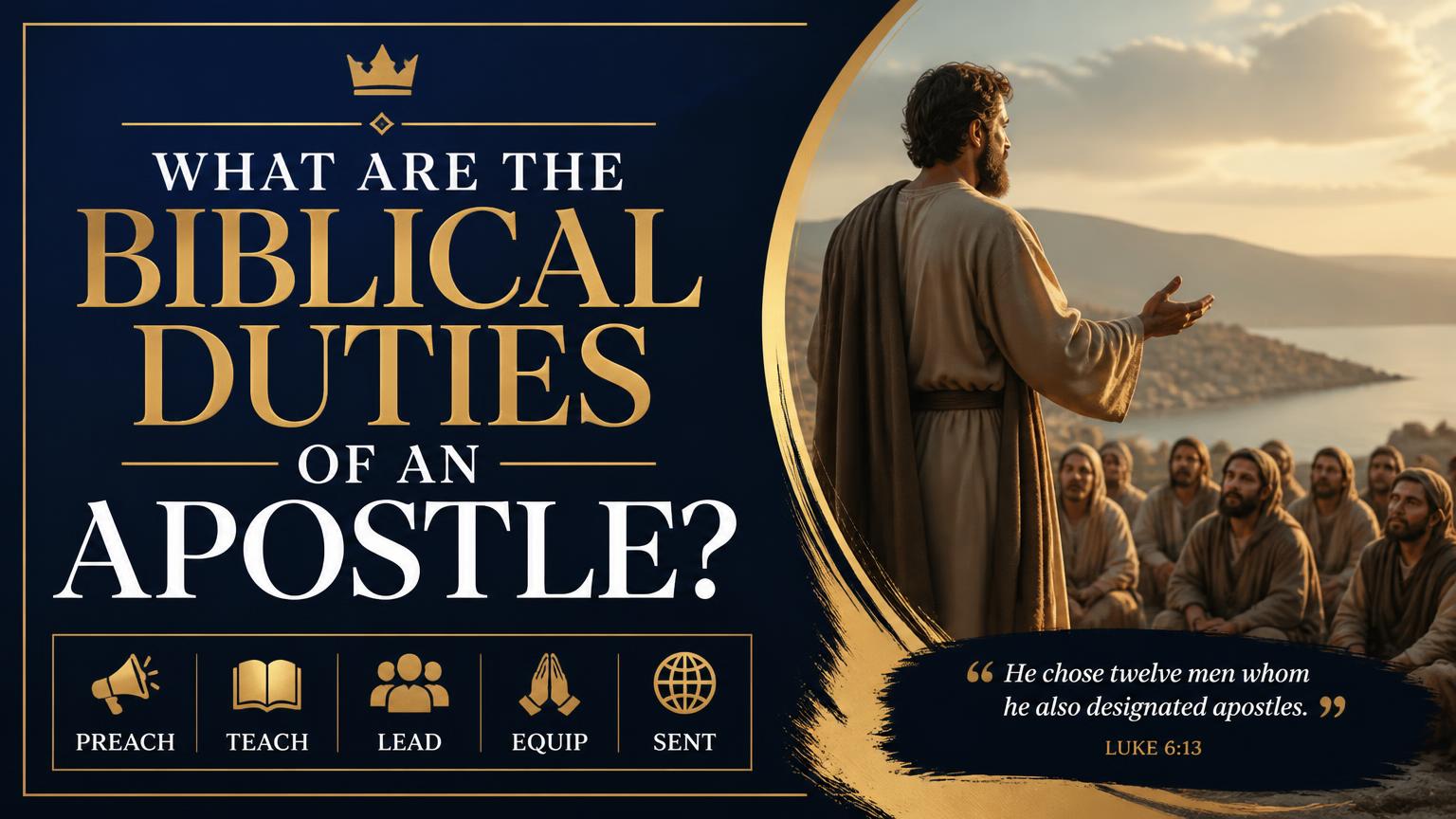
An apostle in the New Testament was a person sent by Jesus Christ with special authority to bear witness to His resurrection, proclaim the gospel, teach sound doctrine, establish churches, appoint leaders, and strengthen the people of God. Apostles exercised authority for building up the church, not for personal status or control (2 Corinthians 10:8).
The term can refer broadly to a messenger or delegate, but the apostles commissioned directly by Christ—especially the Twelve and Paul—held a unique foundational role in the early church.
What Are the Biblical Duties of an Apostle?
Bear Authoritative Witness to Jesus Christ
A central duty of an apostle was to testify that Jesus is the risen Lord. When the apostles selected Matthias, Peter identified an eyewitness to Jesus’ ministry and resurrection as essential: the replacement had to have accompanied Jesus and become “a witness with us of his resurrection” (Acts 1:21–22).
The apostles did not merely repeat religious ideas. They announced what they had seen and received from Christ. Jesus told the disciples that they would be His witnesses “in Jerusalem and in all Judea and Samaria, and to the end of the earth” (Acts 1:8).
Paul’s apostleship followed a distinct pattern. He had encountered the risen Christ and was personally commissioned to proclaim Him, which is why he could say, “Am I not an apostle? Have I not seen Jesus our Lord?” (1 Corinthians 9:1). He also emphasized that his apostleship came through Jesus Christ, not through human appointment (Galatians 1:1).
This witness had lasting importance because the apostles’ testimony became part of the church’s foundation. Ephesians 2:20 describes the household of God as built on “the foundation of the apostles and prophets,” with Christ as the cornerstone.
Proclaim the Gospel and Make Disciples
Jesus appointed the Twelve “so that they might be with him and he might send them out to preach” (Mark 3:14). Their mission was therefore both relational and active: they were formed by living with Christ and then sent to announce His kingdom.
After His resurrection, Jesus commanded His disciples to make disciples of all nations, baptize them, and teach them to obey everything He had commanded (Matthew 28:19–20). The apostles carried out this commission through preaching, evangelism, missionary travel, and instruction.
Paul described his own assignment as receiving “grace and apostleship” to bring about “the obedience of faith among all the nations” (Romans 1:5). Apostolic proclamation was not simply an invitation to make a private decision. It called people to repentance, faith in Christ, incorporation into His church, and a life shaped by His teaching.
Teach and Guard Apostolic Doctrine
The apostles were responsible for preserving and explaining the message they had received from Jesus. The first believers devoted themselves to “the apostles’ teaching and the fellowship, to the breaking of bread and the prayers” (Acts 2:42). Apostolic teaching gave the church its content, boundaries, and shared confession.
This responsibility included several related tasks:
- Explaining the meaning of Jesus’ death and resurrection
- Teaching the relationship between faith, grace, obedience, and holy living
- Clarifying how Gentile believers were included in God’s people
- Correcting false gospels and destructive doctrines
- Passing on instructions concerning worship, relationships, leadership, and church conduct
Acts 15 illustrates the apostles’ role in resolving a major doctrinal dispute. The question was whether Gentile converts had to be circumcised and follow the law of Moses. The apostles and elders examined the issue together, appealed to God’s work among the Gentiles, and issued guidance that preserved the truth of the gospel while protecting the unity of the church.
Paul also instructed churches to hold firmly to the traditions and teaching they had received (1 Corinthians 11:2; 2 Thessalonians 2:15). Apostolic authority was therefore tied to the truth of Christ, not to personal originality.
Establish and Strengthen Churches
Apostles carried the gospel into new regions and helped form local congregations. Paul and Barnabas preached in cities throughout Asia Minor, returned to strengthen the disciples, and helped organize the churches they had planted (Acts 14:21–23).
Paul used the image of a skilled builder to describe his work in Corinth: “Like a skilled master builder I laid a foundation” (1 Corinthians 3:10). The foundation was not a personality cult. It was the gospel of Jesus Christ, upon which local believers were to build faithfully.
Establishing a church involved more than preaching an initial sermon. Apostles helped believers understand the faith, develop patterns of worship and fellowship, resolve disputes, care for one another, and remain faithful under pressure. They also maintained relationships with churches after leaving them, writing letters, sending coworkers, and visiting when possible.
Appoint, Equip, and Oversee Leaders
Apostles helped churches develop responsible local leadership. Acts 14:23 records Paul and Barnabas appointing elders in the churches they had established. Paul later instructed Titus to appoint elders in the cities of Crete (Titus 1:5).
This does not mean apostles replaced local shepherds or exercised unlimited personal control. Rather, they helped churches recognize qualified leaders and taught those leaders how to serve. Local elders were expected to shepherd their own congregations, while apostolic workers provided foundational teaching, broader coordination, and correction when necessary.
Apostolic oversight also included discipline. Paul confronted serious sin in Corinth and instructed the church to respond in a way that protected the congregation and aimed at restoration (1 Corinthians 5; 2 Corinthians 2:5–8). He described his authority as given by the Lord “for building up and not for tearing down” (2 Corinthians 10:8).
That purpose provides an important boundary: biblical authority exists to strengthen people in Christ, not to magnify the leader who exercises it.
Pray and Depend on the Holy Spirit
The apostles treated prayer and ministry of the Word as central responsibilities. In Acts 6:4, they explained that they would devote themselves “to prayer and to the ministry of the word.” This was not a rejection of practical service. It was a recognition that the church’s spiritual life depended on God’s power and truth.
The apostles also relied on the Holy Spirit for direction. The expansion of the mission, the appointment of workers, and the response to new situations required more than organizational skill. The book of Acts repeatedly presents the Spirit as directing the church’s mission and empowering its witness.
This dependence also guarded the apostles from presenting the gospel as a message of human wisdom. Paul told the Corinthians that his preaching rested on the demonstration of the Spirit and God’s power rather than persuasive technique alone (1 Corinthians 2:4–5).
Confirm the Mission Through Signs and Wonders
The New Testament associates the apostolic mission with signs, wonders, and mighty works. Paul referred to these as “the signs of a true apostle” accomplished among the Corinthians (2 Corinthians 12:12). Acts also records healings, deliverances, and other miracles connected with apostolic witness.
These works served the gospel rather than functioning as independent displays of power. They confirmed the apostles’ message and directed attention to Jesus. They were not a mechanism for personal fame, guaranteed prosperity, or spiritual entertainment.
Miracles were also not the only evidence of apostolic faithfulness. The New Testament gives substantial attention to truth, character, endurance, love, and sacrificial service. Signs without fidelity to Christ would not validate a false message.
Endure Suffering and Serve Sacrificially
Apostles were expected to endure hardship for the sake of the gospel. Paul described apostles as exposed to danger, dishonor, hunger, persecution, and weakness (1 Corinthians 4:9–13; 2 Corinthians 11:23–28). Their suffering did not earn salvation, but it demonstrated the cost of faithfully carrying out their commission.
Their leadership also had a distinctly servant-shaped character. Paul compared his care for believers to that of a nursing mother and an exhorting father (1 Thessalonians 2:7–12). He worked for the good of the churches rather than using them for financial or social advantage.
Jesus had already warned His disciples that authority among His followers must differ from worldly domination. The greatest must become a servant (Mark 10:42–45). Apostolic ministry therefore combined authority with humility, conviction with patience, and courage with personal sacrifice.
What Qualified Someone to Be an Apostle?
The New Testament does not present apostleship as simply another title for an influential Christian leader. Several features distinguish the principal apostles.
A Direct Commission From Christ
An apostle was fundamentally a “sent one.” The Twelve were appointed by Jesus during His earthly ministry (Mark 3:13–19). Paul was commissioned by the risen Christ to carry the gospel to the Gentiles (Acts 9:15; Galatians 1:15–16).
Human recognition mattered in the life of the church, but apostolic authority ultimately rested on Christ’s commission. A person could not make himself an apostle merely by claiming spiritual influence.
A Special Witness to the Resurrection
The Twelve had been with Jesus and were witnesses of His resurrection. Paul’s calling was unusual but genuine: he saw the risen Lord and was appointed to proclaim Him. This explains why the apostles had a foundational role that ordinary church leaders did not share.
At the same time, the New Testament uses apostle in a broader sense for certain messengers or delegates. Epaphroditus is called a messenger—or “apostle”—of the Philippian church (Philippians 2:25), and 2 Corinthians 8:23 refers to representatives of the churches. Thus, the word can describe a commissioned messenger in a general sense, while also referring to the unique apostolic office in the early church.
How Apostles Differ From Other Church Leaders
Apostles, prophets, evangelists, pastors, teachers, and elders all serve the church, but the New Testament does not treat their roles as identical. Ephesians 4:11 lists several forms of ministry, while 1 Peter 5:1–4 emphasizes the shepherding work of elders.
An apostle’s distinctive responsibility was broad and foundational: proclaiming Christ as an authoritative witness, establishing churches, guarding doctrine across congregations, and helping organize the growing Christian movement. An elder ordinarily shepherded a particular local church. An evangelist focused especially on announcing the gospel. A teacher explained and applied Christian truth.
These roles could overlap. Paul evangelized, taught, planted churches, and exercised pastoral concern. But overlap does not erase the distinctions among callings.
Do the Biblical Duties of an Apostle Continue Today?
Christian traditions differ over whether the apostolic office described in the New Testament continues in the same form. The clearest agreement is about the duties themselves: the church must remain centered on the apostles’ testimony to Christ, the gospel must be proclaimed, doctrine must be guarded, churches must be strengthened, and leaders must serve humbly.
What does not follow is that every influential Christian leader may claim authority equal to the apostles or add new doctrine with binding authority over the entire church. The New Testament measures all teaching by the revealed gospel and calls believers to remain faithful to it (Galatians 1:8–9; Jude 3).
Churches may use the word apostolic to describe missionary work, church planting, or continuity with apostolic teaching. Those uses should be distinguished from claiming the unique authority of the apostles who witnessed the risen Christ and laid the church’s foundational testimony.
The biblical duties of an apostle centered on being sent by Christ, witnessing to His resurrection, proclaiming and protecting the gospel, establishing and strengthening churches, developing faithful leaders, and serving through prayer, endurance, and humility. Apostolic authority was never an excuse for domination; it existed to build the church on Jesus Christ and preserve the truth entrusted to His people.