
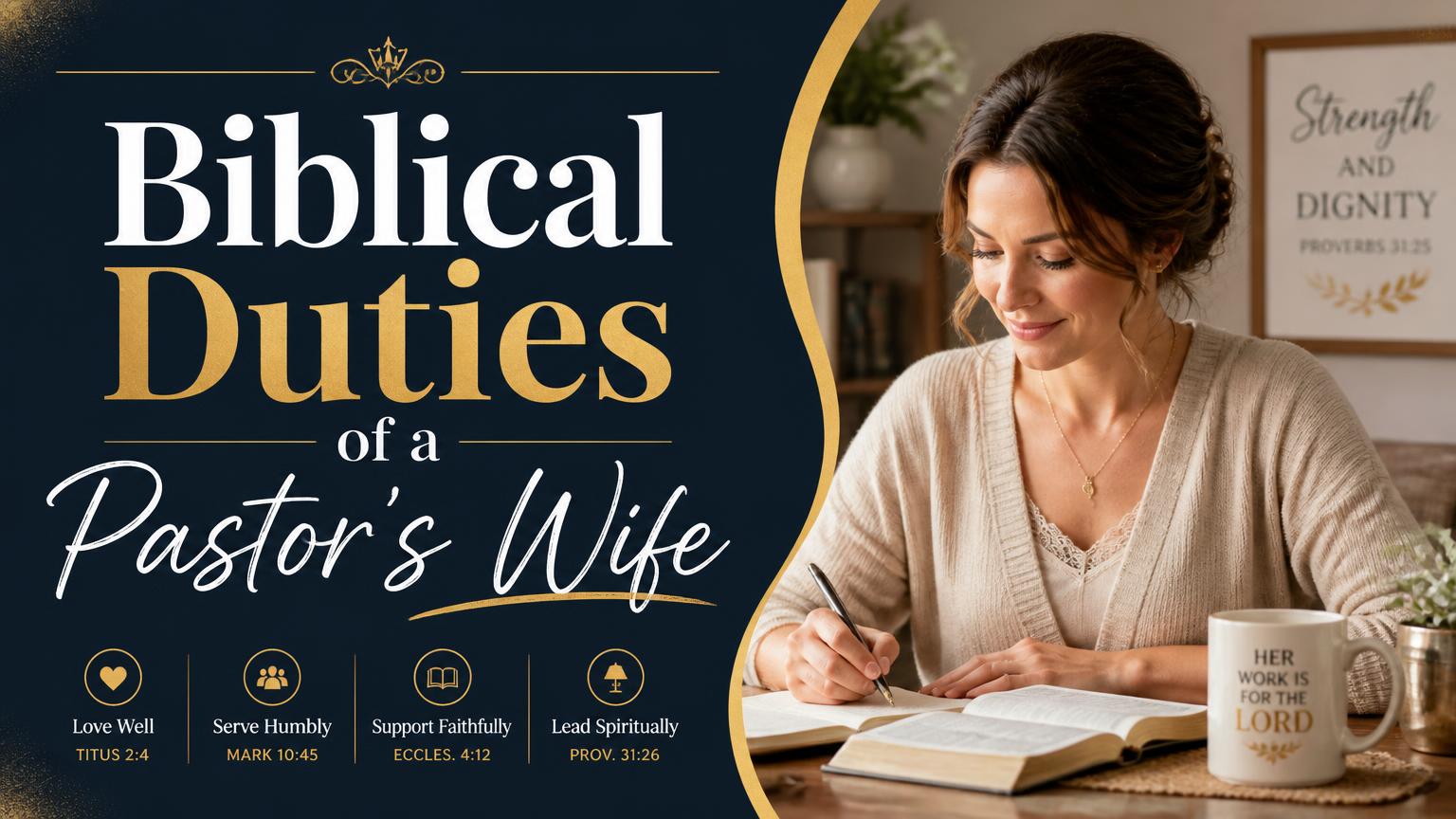
A pastor’s wife does not receive a separate biblical office simply by marrying a pastor. Scripture gives no universal job description titled “pastor’s wife.” Instead, she is first a disciple of Jesus, then a wife and household member, and a Christian who should serve according to her gifts, convictions, and circumstances. Her relationship to the church may create unique opportunities and pressures, but it does not erase her personal calling, boundaries, or freedom in Christ.
What Are the Biblical Duties of a Pastor’s Wife?
The biblical responsibilities of a pastor’s wife are best understood as Christian responsibilities applied within the particular context of pastoral marriage. They include spiritual faithfulness, strengthening the marriage, caring wisely for the household, practicing hospitality, using personal gifts, and protecting integrity. None of these requires her to become a second pastor or fulfill every ministry need in the church.
Live First as a Disciple of Christ
A pastor’s wife’s primary duty is the same as every Christian’s: to know, follow, and honor Christ. Her identity is not ultimately “the pastor’s wife,” but a person redeemed and called by God.
That means growing in faith, prayer, wisdom, love, holiness, and service. The fruit of the Spirit in Galatians 5:22–23 matters more than public visibility or ministry performance. She is not required to appear spiritually impressive; she is called to pursue genuine faithfulness.
Her public conduct may affect how people perceive the pastoral household, but this should not turn her into a religious symbol who is never allowed weakness or honest struggle. Christian maturity includes repentance, teachability, humility, and dependence on God—not an image of perfection.
Strengthen the Marriage without Becoming the Pastor
A pastor’s wife should seek the good of her marriage through love, honesty, prayer, encouragement, and wise counsel. Ephesians 5:21–33 describes marriage in terms of mutual submission and sacrificial love, with a particularly serious command for the husband to love his wife as Christ loved the church. First Corinthians 7:3–5 also presents marriage as involving mutual responsibilities rather than one-sided demands.
Supporting a pastor can include:
- praying for him and with him;
- listening to ministry concerns;
- offering honest, private counsel;
- encouraging rest and appropriate priorities;
- sharing decisions that affect the household;
- helping him recognize when a situation requires outside counsel.
Support does not mean agreeing with every decision, absorbing every crisis, or becoming responsible for his emotional and spiritual health. A wise wife may respectfully challenge her husband, identify unhealthy patterns, and insist that family needs receive serious attention. Submission in marriage is not a command to endorse sin, tolerate abuse, or surrender thoughtful judgment.
Neither does her support require her to perform pastoral work. She may assist with ministry, but she is not automatically responsible for sermon preparation, counseling, administration, visitation, or constant availability.
Care for the Household with Wisdom
The qualifications for an overseer in 1 Timothy 3:1–7 and Titus 1:5–9 include the ability to manage one’s household well. These passages address the character and leadership of the man holding the office; they do not create a separate list of duties for his wife. Nevertheless, the health of a pastor’s household remains relevant because ministry leadership should not be built on the neglect of a spouse or children.
A pastor’s wife may help cultivate a household marked by love, truth, order, hospitality, and spiritual health. That could involve raising children, managing a home, sharing financial and practical responsibilities, or contributing income through employment. The Bible does not prescribe one domestic arrangement for every pastoral family.
Children of pastors should be taught faith and character, but they should not be treated as public evidence that the pastor’s ministry is succeeding. Nor should a pastor’s wife be blamed for every difficulty involving a child. Families need guidance and accountability, but they also need privacy, patience, and ordinary room to grow.
Practice Hospitality and Service
Hospitality is repeatedly connected with Christian maturity and pastoral leadership. Romans 12:13 calls believers to practice hospitality, 1 Peter 4:9 commands Christians to show it without grumbling, and 1 Timothy 3:2 identifies hospitality as a qualification for an overseer.
A pastor’s wife may therefore serve by welcoming people, sharing meals, making newcomers feel included, or helping create a home where people experience care. Hospitality is more than entertaining impressive guests. It can mean noticing the isolated person, making room for someone in need, or offering a safe and gracious presence.
This responsibility belongs to the household, not exclusively to the wife. Hospitality also has limits. A biblical welcome does not require unlimited access to the home, neglect of children, financial irresponsibility, or exposure to unsafe people. Wise hospitality combines generosity with discernment.
Use Spiritual Gifts without Assuming a Church Office
The New Testament teaches that believers receive different gifts for service. Romans 12:3–8, 1 Corinthians 12, and 1 Peter 4:10–11 all emphasize variety within the body of Christ. A pastor’s wife may teach, organize, encourage, show mercy, lead, evangelize, provide hospitality, serve children, counsel wisely, or contribute in other ways.
Her gifts should be recognized as her own—not merely as extensions of her husband’s ministry. Priscilla, for example, participated with Aquila in explaining the way of God more accurately to Apollos in Acts 18:24–26. Their example shows that a married couple could serve together while Scripture still distinguishes individuals and responsibilities.
At the same time, marriage to a pastor does not automatically make a woman an elder, preacher, church employee, or ministry director. Churches differ in their understanding of women’s teaching and leadership roles, and those differences should be handled honestly from the relevant biblical texts and the church’s stated convictions. Whatever a congregation’s polity, a pastor’s wife should serve because of God’s calling and her gifts—not merely because people assume she comes with the pastor’s position.
Protect Integrity, Confidentiality, and Boundaries
A pastor’s wife often hears information because of her proximity to ministry. She should resist gossip, protect appropriate confidences, speak truthfully, and avoid using private knowledge to influence church relationships. Ephesians 4:25 calls Christians to put away falsehood, while Proverbs repeatedly connects wisdom with restraint in speech.
She also has a responsibility to help preserve healthy boundaries in the pastoral household. That may mean declining some invitations, limiting after-hours interruptions, refusing inappropriate emotional dependence, or directing complex problems to qualified leaders and professionals. Boundaries are not a rejection of service. They can protect the marriage, children, congregation, and people seeking help.
Confidentiality requires wisdom rather than secrecy. Serious threats such as abuse, danger, exploitation, or criminal conduct should not be concealed under the language of protecting privacy. In such situations, appropriate pastoral, legal, or professional help may be necessary.
What Scripture Does Not Require of a Pastor’s Wife
Several common expectations are cultural traditions rather than direct biblical commands.
She Is Not Automatically a Church Officer
The New Testament qualifications for elders and overseers appear in 1 Timothy 3 and Titus 1. They describe the person who holds the office, not a co-office held by the spouse. First Timothy 3:11 refers to “women likewise,” but interpreters differ over whether this means deacons’ wives or women serving as deacons. The verse does not provide an explicit job description for pastors’ wives.
A woman does not become a pastor, elder, or church employee by marriage. If she holds a ministry office, that should be based on her own calling, gifts, and the church’s biblical convictions—not her husband’s title.
She Is Not Required to Copy Another Pastor’s Wife
Some pastor’s wives lead women’s ministries; others work outside the home, care for children, study, provide hospitality, teach, serve quietly, or participate in ministry in several of these ways. Scripture gives believers principles for faithfulness, not a single lifestyle template.
Comparing one pastor’s wife with another often confuses preference with obedience. A church may invite her to serve, but it should not assume that every ministry another pastor’s wife performs is required of her.
She Is Not Required to Be Constantly Available
A pastor’s wife is not automatically on call for every hospital visit, counseling request, social event, meal, or church project. Jesus Himself withdrew for prayer and rest, and Christian service must be ordered by love and wisdom rather than by pressure.
Availability should be negotiated within the marriage and clarified with church leadership. The pastor’s family needs regular time that is not treated as church property.
She Is Not Required to Project Perfection
A pastor’s wife may be expected to dress, speak, parent, socialize, and respond in ways that satisfy everyone. That expectation is impossible and has no sound biblical foundation. Christian leaders and their households should display integrity, but integrity is not flawless performance.
A healthy church allows the pastor’s wife to be a growing believer rather than demanding that she become an idealized example for every woman in the congregation.
Distinguishing Biblical Duty From Cultural Expectation
The phrase “pastor’s wife” describes a relationship, not a biblical office. This distinction matters because churches can unintentionally assign unpaid labor, public visibility, or emotional responsibility based solely on marriage.
A biblical expectation should arise from a clear principle such as faithfulness, hospitality, service, or marital love. A cultural expectation may sound spiritual while actually reflecting local custom: “A pastor’s wife must lead the women’s group,” “She must attend every event,” or “She must always agree with her husband publicly.” Such statements require examination rather than automatic acceptance.
The wife’s consent, gifts, health, family responsibilities, and convictions should be considered. A church that honors her should ask how it can support her—not simply what additional work it can obtain from her.
How Churches Should Support a Pastor’s Wife
A congregation can honor the pastor’s wife by:
- clarifying which responsibilities belong to the pastor and which are voluntary;
- refusing to treat her as unpaid staff;
- respecting her privacy and family time;
- avoiding gossip and unrealistic comparisons;
- allowing her to serve according to her own gifts;
- providing pastoral care for her as a church member;
- addressing conflict directly rather than expecting her to manage it;
- recognizing that her marriage and family need protection.
The church should also remember that a pastor’s wife may carry unique burdens without having formal authority to resolve them. She may hear criticism about her husband, absorb congregational expectations, or feel responsible for everyone’s spiritual well-being. She needs prayer, friendship, truth, and practical care—not merely praise for being supportive.
Conclusion
The biblical duties of a pastor’s wife are not a fixed ministry job description. She is called first to faithful discipleship, then to love and strengthen her marriage, care wisely for her household, practice hospitality, use her gifts, and maintain integrity. She may serve prominently or quietly, alongside her husband or in a distinct vocation. Marriage to a pastor creates a significant relationship to ministry, but it does not make her a pastor, remove her boundaries, or require her to meet every expectation a church places on her.