
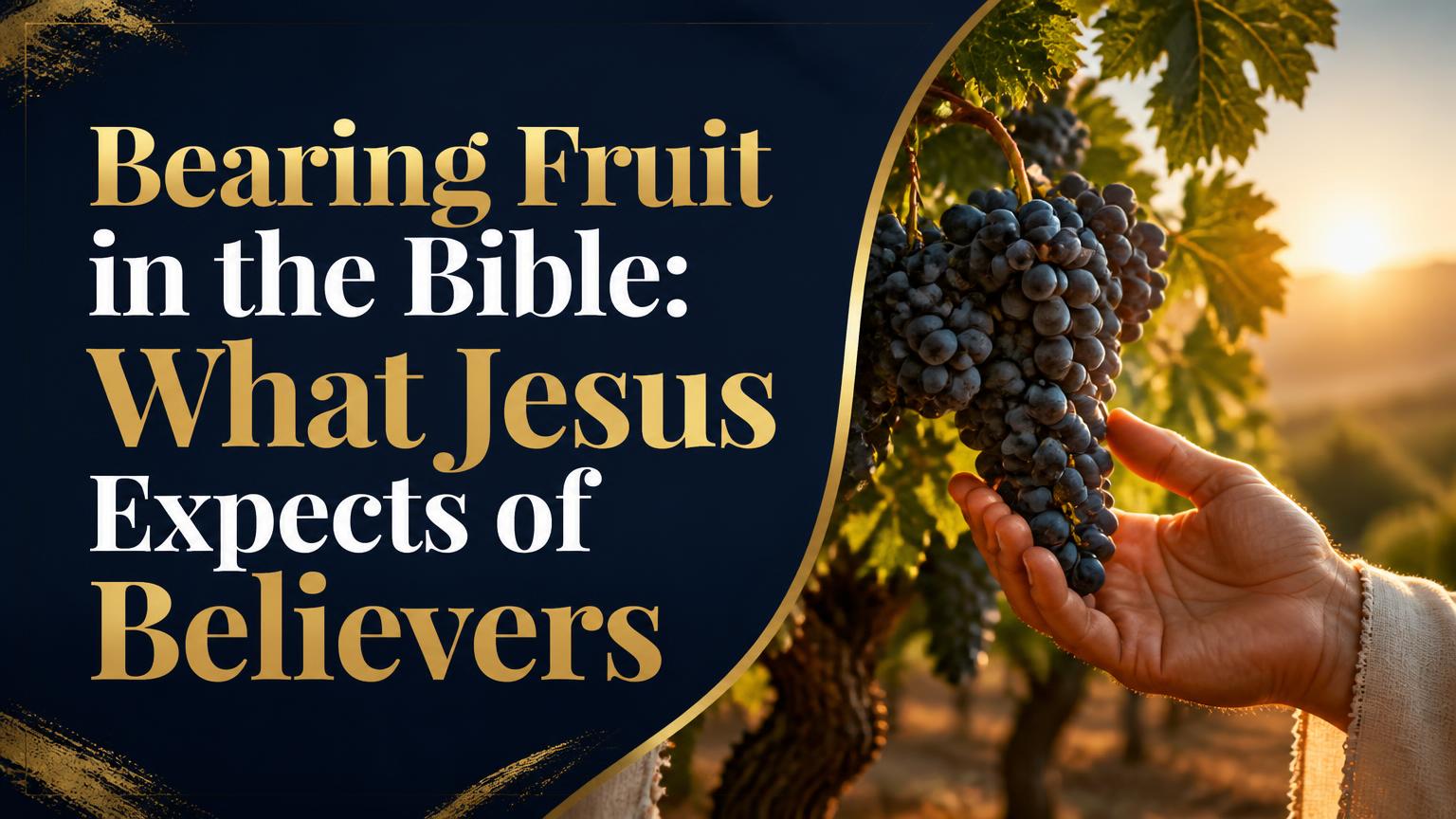
A search for “bear fruit” in the Bible leads to a central Christian theme: genuine faith produces a visible, growing life shaped by God. Jesus uses fruit to describe the evidence of a person’s spiritual condition, the result of remaining connected to him, and the practical outcome of obedience. Biblical fruit is not a way to earn salvation or impress God. It is the outcome of God’s life and work in believers, expressed through character, actions, perseverance, love, service, and faithful witness.
Bear Fruit in the Bible: What It Means for Believers
To bear fruit in the Bible means to produce the outward results God intends from an inward relationship with him. The image comes from agriculture: a healthy tree produces fruit according to its nature, and a living branch receives nourishment from the vine. In the same way, believers are expected to display spiritual life through their conduct.
Fruit Means Visible Evidence of Spiritual Life
Fruit refers to observable patterns that reveal what is taking place within a person. Jesus used this principle when warning his disciples about false prophets:
“Therefore, by their fruits you will know them.” — Matthew 7:20 (WEBU)
This does not mean that Christians must be flawless before their faith is genuine. It means that a person’s consistent character, choices, teaching, and conduct eventually reveal the direction of that person’s life. Occasional failure does not disprove spiritual life, but a settled pattern of rebellion, deceit, hatred, or refusal to repent should not be dismissed as spiritually insignificant.
Fruit therefore provides evidence rather than a performance score. It must be evaluated over time, with humility and in light of God’s revealed standards. Christians should examine their own lives carefully, while avoiding the temptation to make quick judgments based on appearance, popularity, wealth, or religious vocabulary.
Fruit Comes From Remaining in Christ
Jesus presents himself as the source of spiritual fruit, not merely as an example for believers to imitate through willpower:
“I am the vine. You are the branches. He who remains in me, and I in him, bears much fruit, for apart from me you can do nothing.” — John 15:5 (WEBU)
A branch does not manufacture life independently. It bears fruit because it remains connected to the vine. Likewise, Christian fruit grows from continuing dependence on Christ through faith, prayer, obedience, repentance, and attention to his teaching.
Remaining in Christ is active, not passive. It involves trusting him when obedience is costly, returning to him after failure, allowing his words to correct personal desires, and relying on the Holy Spirit rather than self-confidence. Activity without communion with Christ may produce religious busyness, but it cannot produce the kind of spiritual fruit Jesus describes.
Fruit Includes Character, Conduct, and Witness
The most direct biblical description of spiritual fruit concerns character produced by the Holy Spirit:
“But the fruit of the Spirit is love, joy, peace, patience, kindness, goodness, faith, gentleness, and self-control. Against such things there is no law.” — Galatians 5:22-23 (WEBU)
These qualities describe more than private emotions. Love affects how believers treat difficult people. Patience shapes responses to delay and frustration. Goodness appears in ethical decisions, generosity, and practical service. Self-control governs speech, desires, habits, and power.
The Bible also connects fruit with good works, obedience, generosity, praise, and the spread of the gospel. Paul prayed that believers would walk in a way that pleases the Lord and bear fruit in every good work, as described in Colossians 1:10. In some passages, fruit can also describe people benefiting from Christian ministry or coming to faith. These forms of fruit should not be separated from character: Christian service is healthiest when it flows from a life being transformed by God.
Fruit Grows Through Perseverance and Pruning
Fruit normally develops gradually. A tree may be alive before its fruit is visible, and early fruit may be small or immature. Similarly, Christians may experience real spiritual growth while still struggling with fear, anger, temptation, or inconsistency. The relevant question is whether the person is turning toward Christ and growing in obedience.
Jesus also describes the Father’s work of pruning fruitful branches in John 15. Pruning removes what is unproductive so that greater fruit can develop. In Christian experience, this may involve conviction, correction, disciplined habits, surrendered ambitions, or painful changes in priorities. Difficulty by itself is not proof of spiritual maturity, but God can use hardship, Scripture, and wise correction to expose shallow motives and strengthen faithful character.
From Inner Life to Outward Fruit
Biblical fruit follows a meaningful progression. Relationship with Christ produces a changed inner life; the Holy Spirit shapes that life; and the resulting character appears in actions and relationships. This is why external religious activity cannot be the whole measure of fruitfulness. A person may be active, eloquent, or publicly successful while remaining proud, cruel, dishonest, or spiritually disconnected.
Good works are still essential. The New Testament describes believers as created in Christ Jesus for good works and calls them to serve others generously. Yet good works are the expression of grace, not a replacement for grace. They demonstrate the reality of faith when they arise from love for God and neighbor rather than from a desire to earn acceptance.
Fruit also has a communal dimension. Patience, forgiveness, generosity, hospitality, truthfulness, and reconciliation become visible in relationships. A believer’s fruit is therefore not limited to private devotion. It affects a family, church, workplace, neighborhood, and anyone who encounters that person. Spiritual maturity becomes credible when biblical convictions are embodied in ordinary decisions.
What Bearing Fruit Does Not Mean
Bearing fruit does not mean achieving constant success, receiving public recognition, building a large ministry, or producing measurable results by human standards. Jesus’ teaching does not identify fruitfulness with fame, wealth, influence, or numerical growth. A quiet act of faithfulness may be more pleasing to God than an impressive public accomplishment. Likewise, a ministry can appear successful while the character of its leaders or participants contradicts the message they proclaim.
Bearing fruit also does not mean earning salvation. The New Testament presents salvation as God’s gracious work, received through faith, while also teaching that saving faith produces a changed life. Fruit is therefore evidence and outcome, not payment. This distinction guards against two opposite errors: trying to obtain God’s acceptance through performance, and claiming faith while refusing the repentance and obedience that faith produces.
Nor does fruit mean instant perfection. Christian growth includes confession, correction, renewed obedience, and gradual transformation. A believer should take persistent sin seriously without concluding that every struggle proves spiritual death. The proper response to failure is neither denial nor despair, but honest repentance and renewed dependence on Christ.
How to Cultivate Biblical Fruit
Fruit cannot be manufactured by adopting a religious appearance, but believers can cultivate the conditions in which spiritual growth flourishes. The first is continued dependence on Christ. Prayer, Scripture, worship, fellowship, and obedience are not methods for manipulating God; they are ordinary ways believers remain attentive and responsive to him.
The second is cooperation with the Spirit’s correction. Galatians contrasts the fruit of the Spirit with the works of the flesh, showing that fruitfulness requires refusing patterns that oppose God’s character. This includes confronting bitterness, sexual immorality, dishonesty, envy, uncontrolled anger, pride, and selfish ambition. Growth often becomes visible when a believer responds differently to the same temptation than in the past.
The third is faithful action in ordinary responsibilities. Serving someone who cannot repay, speaking truth without cruelty, keeping a promise, forgiving an offender, resisting gossip, welcoming a stranger, and caring for the vulnerable are all settings in which biblical fruit becomes concrete. The goal is not to create an impressive spiritual image but to let love for God shape real decisions.
Finally, fruitfulness requires patience. Some results may not be visible immediately, and believers cannot control how others respond to faithful witness. Their responsibility is to remain faithful, pursue holiness, serve with love, and leave the ultimate growth to God. This prevents discouragement when obedience seems unnoticed and prevents pride when ministry appears effective.
Why Fruit Matters in Christian Discernment
The biblical image of fruit helps Christians evaluate both themselves and religious claims. Teaching should be tested by Scripture, and character should be considered alongside gifts, words, and achievements. Strong communication, supernatural claims, institutional position, or apparent success cannot substitute for truth and godly conduct.
Self-examination should be specific rather than vague. Instead of asking only whether one feels religious, a believer can ask whether love is becoming more consistent, whether repentance is more immediate, whether speech is more truthful, whether relationships show greater patience, and whether obedience continues when no reward is visible. These questions do not turn Christianity into a checklist. They help reveal whether dependence on Christ is producing practical transformation.
Fruit also gives hope. Because fruit comes from the vine, spiritual growth does not depend entirely on personal strength. Believers are called to abide, obey, repent, and persevere, while God supplies life and growth. Weak beginnings do not make faithful growth impossible, and past failure does not prevent renewed fruitfulness when a person returns to Christ.
Conclusion
In the Bible, to bear fruit means for a believer’s relationship with Christ to produce visible evidence in character, conduct, obedience, service, and faithful witness. Jesus teaches that fruit comes from remaining in him, while Paul explains that the Holy Spirit produces qualities such as love, joy, peace, patience, kindness, goodness, faith, gentleness, and self-control.
Fruit is not a way to purchase salvation, prove personal superiority, or measure ministry by popularity. It is the gradual outward result of God’s inward work. The clearest test is not perfection or prominence, but a continuing direction of repentance, dependence, love, and obedience. A fruitful Christian life stays connected to Christ and increasingly reflects his character in ordinary life.