
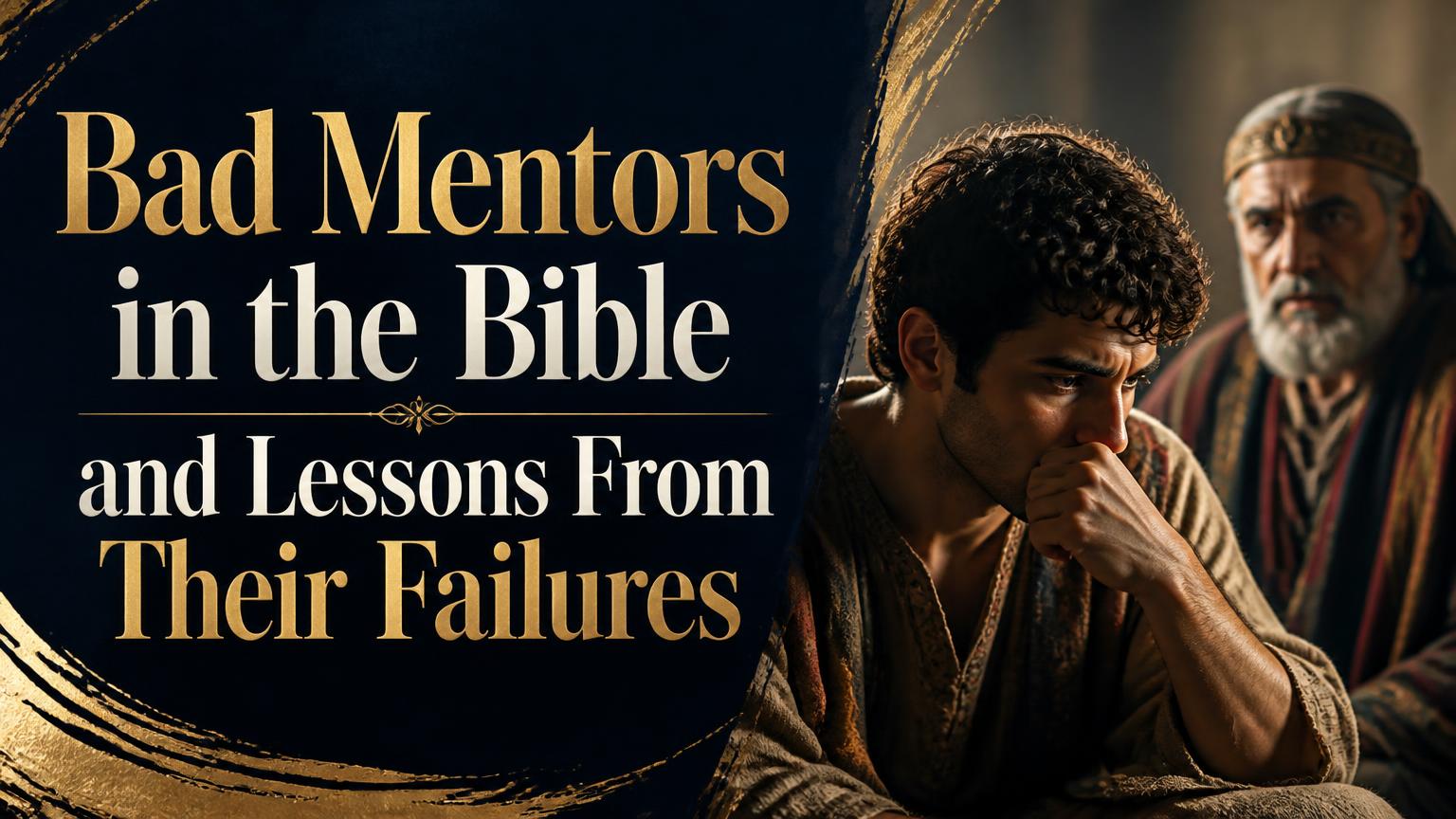
Mentoring in the Bible is usually shown through relationships between leaders, teachers, parents, rulers, and disciples rather than through a formal mentoring program. Scripture presents both faithful guides and influential people whose pride, hypocrisy, fear, or moral compromise damaged those under their influence. Strictly speaking, not every biblical figure commonly called a “bad mentor” held that exact role. Some were advisers, spiritual leaders, or older authorities whose example shaped others. That distinction matters because the Bible evaluates both what leaders teach and what their lives make acceptable.
Bad Mentors in the Bible
The clearest examples include Eli’s failure to restrain his sons, Saul’s transformation from leader into rival, Rehoboam’s rejection of wise counsel, Herodias’s corrupt influence over her daughter, and religious teachers who possessed biblical knowledge without practicing righteousness. These accounts do not suggest that every flawed leader was entirely useless or that every follower was merely a victim. Instead, they show how influence works—and how people must evaluate guidance by character, truth, humility, and accountability.
Eli: A Teacher Who Failed to Confront Corruption
Eli served as Israel’s priest and supervised Samuel while Samuel ministered at the tabernacle. Eli did one important thing well: when Samuel heard God calling him, Eli eventually helped him recognize the voice and respond, “Speak, LORD, for your servant hears” (1 Samuel 3:8–10). His example shows that a flawed leader may still communicate genuine spiritual insight.
Yet Eli failed seriously as a spiritual overseer and father. His sons, Hophni and Phinehas, abused their priestly position, exploited worshipers, and treated the Lord’s offering with contempt (1 Samuel 2:12–17, 22–25). Eli rebuked them, but God’s judgment states that he knew about their wrongdoing and did not restrain them (1 Samuel 3:13). The lesson is not merely “correct people more strongly.” It is that private instruction without meaningful accountability allows corruption to continue. A mentor who teaches truth but protects misconduct creates confusion between spiritual language and spiritual faithfulness.
Saul: When Leadership Turns Into Rivalry
Saul was not David’s formal mentor in the modern sense, but he was David’s king, commander, and older authority. David entered Saul’s service, achieved military success, and became publicly respected. Instead of developing David’s abilities for Israel’s good, Saul allowed insecurity to turn their relationship into competition. After the women celebrated David more than Saul, the king became jealous and repeatedly sought David’s life (1 Samuel 18:6–11).
Saul’s failure illustrates how a mentor can misuse authority when a student’s growth feels threatening. Healthy leadership helps another person become capable without demanding personal dependence or superiority. Saul did the opposite: he treated David’s gifts as an attack on his own status. His conduct also shows that a mentor’s emotional instability can make guidance unsafe. A person who alternates between approval, suspicion, manipulation, and hostility may be unable to celebrate another person’s success honestly.
Rehoboam’s Advisers: Confidence Without Wisdom
Rehoboam’s advisers in 1 Kings 12 represent a failure of counsel rather than a formal mentoring relationship. When the people asked for relief from the heavy burden imposed under Solomon, the older advisers urged Rehoboam to serve the people and speak kindly to them. Rehoboam rejected that wisdom and followed the younger men who advised him to increase the people’s burden and answer them harshly.
The problem was not simply that the advisers were young. Scripture does not equate age with wisdom or youth with foolishness. The deeper problem was that Rehoboam chose counsel that fed his desire for authority and ignored counsel that required humble service. His advisers reinforced a destructive understanding of leadership: power must be displayed through severity. The resulting division of the kingdom shows that bad guidance can produce consequences far beyond a single decision. Mentors and advisers become dangerous when they confirm pride instead of correcting it.
Herodias: Influence Used to Encourage Revenge
Herodias provides an example of corrupt personal influence within a family. After Herod promised her daughter a reward, the daughter asked her mother what to request. Herodias directed her to demand the head of John the Baptist (Mark 6:21–28). The passage portrays an older family member using influence to turn a public opportunity into an act of revenge.
This account warns that mentoring does not require a classroom, pulpit, or official title. Parents and relatives shape moral judgment through the advice they give in moments of pressure. Herodias did not guide her daughter toward restraint, justice, or courage. She used her influence to pursue a personal grudge through another person. A bad mentor may therefore sound decisive and confident while teaching someone to confuse retaliation with strength.
False Religious Guides: Knowledge Without Integrity
Jesus repeatedly confronted religious leaders who taught publicly but failed to embody what they required from others. In Matthew 23, he described scribes and Pharisees who placed heavy burdens on people while refusing to carry them themselves. He also warned against leaders who were “blind guides” (Matthew 15:14). These statements should not be turned into a condemnation of every Pharisee; the Gospels also portray individuals within that movement who asked sincere questions or showed openness. Jesus’ criticism targeted hypocrisy, spiritual pride, and the misuse of authority.
This is one of the Bible’s strongest warnings about religious mentoring. A teacher may know Scripture, use respected language, and occupy a recognized position while still directing people away from God through hypocrisy. Biblical instruction is not measured only by accuracy in isolated statements. It must also be joined to repentance, mercy, justice, and obedience. A mentor who teaches others to appear righteous rather than become righteous produces religious performance instead of spiritual maturity.
What These Failures Have in Common
Bad mentors in the Bible often possess influence without the character needed to use it safely. Eli knew enough to identify wrongdoing but failed to enforce accountability. Saul had authority and military experience but allowed jealousy to govern his treatment of David. Rehoboam’s advisers offered confidence without wisdom, while Herodias used influence to advance resentment. The false religious guides condemned conduct they tolerated in themselves. In each case, the central danger was a separation between authority and moral responsibility.
These accounts also reveal that harmful mentoring often operates indirectly. A mentor may not command a person to commit a specific sin. Instead, the mentor may normalize pride, reward flattery, excuse misconduct, suppress correction, or present revenge as justice. Over time, the learner absorbs not only spoken lessons but also the leader’s assumptions about power, success, truth, and other people. That is why Scripture emphasizes both teaching and example. Paul could tell believers to imitate him only insofar as he imitated Christ (1 Corinthians 11:1); the standard was not personality or status but conformity to Jesus.
Lessons for Choosing and Responding to Mentors
Judge Character Before Charisma
A compelling personality, impressive knowledge, or visible success does not prove that someone is a safe guide. Jesus taught that people are recognized by their fruit (Matthew 7:15–20). For a potential mentor, examine how the person treats people who cannot increase their status, responds to correction, handles money and power, speaks about absent people, and behaves when personal preferences are challenged.
This does not demand perfection. Faithful mentors can fail, apologize, and grow. The crucial distinction is whether failure leads to repentance and restoration or to denial, blame, and continued harm. Character is demonstrated over time, especially under pressure.
Test Counsel Against Scripture and Wise Community
The Bible never instructs believers to surrender judgment blindly to a leader. The Bereans were commended for examining teaching against Scripture (Acts 17:11), and Proverbs repeatedly connects wisdom with receiving correction and seeking multiple counselors. A mentor’s advice should therefore be evaluated by biblical truth, sound moral reasoning, and its likely fruit.
This safeguard is especially important when counsel isolates a person from trusted relationships, demands secrecy, discourages questions, or treats disagreement as disloyalty. A mentor who cannot tolerate examination is asking for control rather than offering wisdom. Good guidance welcomes truth-testing because it is concerned with the learner’s maturity, not the mentor’s unquestioned dominance.
Keep Accountability and Boundaries
Respect for a mentor does not require absolute dependence. Healthy spiritual guidance leaves room for prayer, Scripture, other mature voices, and responsible personal judgment. Boundaries are particularly necessary when a mentor has authority over employment, finances, ministry, education, or personal decisions. Influence becomes dangerous when one person controls access, approval, identity, and belonging all at once.
When a mentor’s conduct becomes abusive, manipulative, sexually inappropriate, financially exploitative, or persistently dishonest, the biblical response is not to protect the person’s reputation at the expense of the vulnerable. Seek help from trustworthy leaders or appropriate authorities, preserve necessary evidence, and create distance when safety requires it. Forgiveness does not eliminate the need for accountability or wise limits.
A Biblical Standard for Good Mentoring
The contrast to bad mentoring is not flawless performance but Christ-shaped leadership. Jesus corrected His disciples, yet He also served them, taught patiently, and prepared them to act faithfully without His physical presence. He used authority to form people rather than to possess them. His model combines truth with humility, correction with compassion, and responsibility with sacrifice.
Paul’s instructions to leaders in the church reflect the same standard. An overseer must be above reproach, self-controlled, hospitable, able to teach, and not domineering (1 Timothy 3:1–7; 1 Peter 5:2–3). These qualifications connect competence with character. A person may be gifted enough to attract followers and still be unfit to guide them. Christian mentoring should produce greater dependence on God, deeper love for truth, increased maturity, and the ability to serve others—not permanent dependence on the mentor.
Conclusion: Learn From Failure Without Copying It
The bad mentors and influential leaders in the Bible teach a consistent lesson: guidance is evaluated by both its content and its fruit. Eli’s partial faithfulness did not excuse his failure to restrain corruption. Saul’s authority did not justify jealousy. Rehoboam’s confidence did not make foolish counsel wise, and religious knowledge without obedience became a source of spiritual harm. These examples also caution readers not to label every imperfect leader as entirely worthless; biblical discernment recognizes genuine strengths while refusing to excuse destructive patterns.
Choose mentors who welcome truth, demonstrate humility, accept correction, and direct attention toward God rather than themselves. Listen respectfully, but test counsel through Scripture, wise community, observable character, and its effect on your life. The safest mentor is not the person who demands unquestioned loyalty, but the one whose teaching and example help others become truthful, responsible, mature, and increasingly faithful to Christ.