
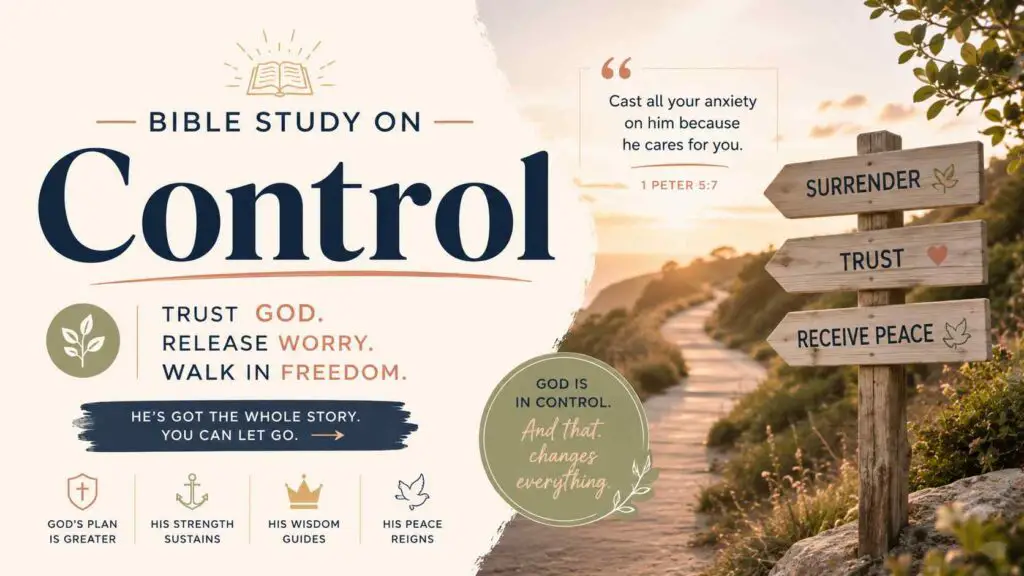
Control is something you deal with every day, whether you realize it or not. You may try to control your schedule, your relationships, your future, your emotions, or even how others respond to you. Studies in psychology have shown that people naturally seek control because uncertainty often creates stress and anxiety. When life feels unpredictable, the desire to take charge becomes even stronger.
However, the constant need for control can also lead to fear, frustration, strained relationships, burnout, and spiritual exhaustion. The more tightly you hold onto everything, the heavier life can feel. Many people quietly struggle with worry because they believe everything depends on them. This pressure can slowly rob you of peace and joy.
One important observation about control is that it often grows from fear—fear of failure, rejection, disappointment, or the unknown. You may find yourself overthinking situations, trying to manage outcomes, or becoming discouraged when things do not go according to plan. This is a deeply human struggle that affects both your heart and your faith.
You have probably experienced moments where you wanted answers immediately, wished people would change, or hoped circumstances would unfold exactly the way you planned. Yet despite your efforts, some things remained beyond your reach.
This Bible study guide will help you understand what God says about control, how it affects your life, and how you can surrender your worries and desires to Him. Through Scripture, you can discover that true peace does not come from controlling everything—it comes from trusting the One who is already in control.
What You Will Learn from This Bible Study Guide on Control
- You will understand why the desire for control is a common human struggle.
- You will learn what the Bible says about surrendering control to God.
- You will discover how fear and anxiety are often connected to control.
- You will see examples of biblical characters who struggled with control and uncertainty.
- You will learn practical ways to trust God in difficult situations.
- You will understand how control can affect your relationships, emotions, and spiritual growth.
- You will discover how faith brings peace when life feels uncertain.
- You will learn how prayer and obedience help you release control to God.
Before beginning this Bible study, take a moment to ask God for wisdom and understanding.
Short Prayer for Guidance
Heavenly Father,
Help me understand Your truth as I study Your Word today. Teach me how to trust You more deeply and surrender the areas of my life where I struggle to let go. Give me wisdom to apply these lessons in my daily life and strengthen my faith through this study. Thank You for Your guidance, love, and patience with me.
Amen
What Does the Bible Say About Control?
The Bible teaches that while you may make plans and decisions, ultimate control belongs to God. Scripture repeatedly reminds you to trust Him rather than relying solely on your own understanding or strength.
“Trust in the Lord with all thine heart; and lean not unto thine own understanding.” — Proverbs 3:5 (KJV)
This verse teaches that your understanding is limited, but God’s wisdom is perfect. When you try to control every outcome, you may unintentionally place more confidence in yourself than in God. Trusting Him requires surrender.
“A man’s heart deviseth his way: but the Lord directeth his steps.” — Proverbs 16:9 (KJV)
You are encouraged to plan wisely, but this passage reminds you that God ultimately guides your path. Even when life changes unexpectedly, God is still working through every circumstance.
“Casting all your care upon him; for he careth for you.” — 1 Peter 5:7 (KJV)
God does not want you to carry the burden of control alone. This verse invites you to release your anxieties, fears, and worries to Him because He deeply cares for your life.
“Be still, and know that I am God.” — Psalm 46:10 (KJV)
Sometimes your greatest spiritual challenge is learning to stop striving and remember who God is. Being still means trusting His authority even when situations feel uncertain.
“Therefore I say unto you, Take no thought for your life… your heavenly Father knoweth that ye have need of all these things.” — Matthew 6:25,32 (KJV)
Jesus taught that worry cannot add anything meaningful to your life. God already knows your needs, and He calls you to trust His provision instead of living in constant anxiety.
The Bible consistently teaches that control belongs to God, not to human beings. What does the Bible say about control? It teaches that you are called to trust God’s wisdom, surrender your fears, and rely on His guidance instead of trying to control every part of life on your own.
Biblical Characters who Experienced Control
#1. Abraham — Genesis 16:1–4
Context
God promised Abraham that he would become the father of many nations, yet years passed without Abraham and Sarah having a child. As time went on, waiting became difficult and emotionally painful. The delay tested their patience, faith, and trust in God’s timing.
Sarah eventually encouraged Abraham to have a child through Hagar, her servant. This decision came from a desire to force God’s promise into fulfillment through human effort. Instead of waiting on God, they attempted to control the outcome themselves.
Abraham’s Resolve
Although Abraham initially failed by taking matters into his own hands, God remained faithful to His promise. Over time, Abraham learned that God’s plans cannot be rushed or manipulated through human control. Isaac was eventually born according to God’s timing, not Abraham’s effort.
Abraham’s story reveals how easy it is to act out of impatience when circumstances seem uncertain. Yet it also demonstrates God’s grace toward imperfect people who struggle to trust Him completely. Abraham eventually grew in faith and became an example of trusting God despite impossible situations.
What Can We Learn from Abraham’s Example
- Trying to force outcomes can create unnecessary pain and complications.
- Waiting on God requires patience and faith.
- God’s promises do not depend on human control.
- God remains faithful even when your faith struggles.
#2. Martha — Luke 10:38–42
Context
Martha welcomed Jesus into her home and became overwhelmed with preparations and responsibilities. While her sister Mary sat listening to Jesus, Martha became frustrated because she felt everything depended on her efforts.
Her desire to manage everything caused stress, distraction, and irritation. Instead of enjoying Jesus’ presence, Martha became consumed by tasks and expectations.
Martha’s Resolve
Jesus gently corrected Martha by reminding her that she was worried and troubled about many things. He pointed out that Mary had chosen what truly mattered. Martha’s struggle was not simply about serving—it was about carrying unnecessary burdens and trying to control everything around her.
This passage teaches that your desire for control can distract you from intimacy with God. Sometimes you become so focused on responsibilities and outcomes that you forget to rest in God’s presence and trust Him.
What Can We Learn from Martha’s Example
- Anxiety often grows when you try to control too much.
- Time with God is more important than constant striving.
- You do not have to carry every burden alone.
- Peace comes from focusing on God rather than pressure.
#3. Jonah — Jonah 1–4
Context
God commanded Jonah to go to Nineveh and preach repentance, but Jonah resisted because he wanted events to unfold according to his own desires. He disliked the people of Nineveh and did not want them to receive God’s mercy.
Jonah attempted to escape God’s direction by fleeing in the opposite direction. His resistance created chaos not only in his own life but also for those around him.
Jonah’s Resolve
Even after obeying God, Jonah struggled emotionally when God showed compassion to Nineveh. Jonah wanted justice according to his standards, but God revealed His greater mercy and wisdom.
Jonah’s story highlights how control can appear in subtle ways, including wanting people, circumstances, or outcomes to align with your personal expectations instead of God’s will.
What Can We Learn from Jonah’s Example
- You cannot run from God’s plans.
- Control often comes from pride or selfish desires.
- God’s wisdom is greater than your understanding.
- Surrendering to God leads to growth and transformation.
How Does Control Affect Us?
#1. Control Can Increase Anxiety and Fear
“And which of you by taking thought can add one cubit unto his stature?” — Matthew 6:27 (KJV)
When you try to control every situation, your mind can become overwhelmed with worry about the future. You may constantly think about worst-case scenarios or feel pressure to prevent problems before they happen. This mental burden can create emotional exhaustion.
Control often feeds anxiety because life is naturally uncertain. The more you attempt to manage everything yourself, the more fearful you may become when situations fall outside your influence. God calls you to trust Him instead of carrying impossible burdens.
#2. Control Can Damage Relationships
“Let nothing be done through strife or vainglory; but in lowliness of mind let each esteem other better than themselves.” — Philippians 2:3 (KJV)
A controlling attitude can create tension in your relationships. You may struggle to trust others, become overly critical, or expect people to meet your standards perfectly. Over time, this can lead to frustration and emotional distance.
Healthy relationships require humility, patience, and mutual trust. When you release the need to control others, you create room for grace, understanding, and healthier communication.
#3. Control Can Weaken Your Faith
“For we walk by faith, not by sight.” — 2 Corinthians 5:7 (KJV)
Faith requires trust in what you cannot fully see or predict. When you insist on controlling everything, it becomes difficult to fully rely on God’s direction and timing.
You may find yourself depending more on your plans than on prayer. Yet spiritual growth often happens when you surrender uncertainty to God and choose faith over fear.
#4. Control Can Lead to Pride
“Pride goeth before destruction, and an haughty spirit before a fall.” — Proverbs 16:18 (KJV)
Sometimes the desire for control comes from believing you know what is best in every situation. Pride can make it difficult to listen, receive correction, or trust God’s greater wisdom.
When life does not go according to your plans, pride may lead to anger or disappointment. Humility helps you recognize that God’s understanding far exceeds your own.
#5. Control Can Prevent Peace
“Thou wilt keep him in perfect peace, whose mind is stayed on thee.” — Isaiah 26:3 (KJV)
Constant striving and overthinking can steal your peace. You may feel restless because you are carrying responsibilities God never intended for you to hold alone.
True peace comes when you rest in God’s sovereignty. Even in uncertainty, you can experience calmness when your heart trusts Him completely.
#6. Control Can Cause Spiritual Exhaustion
“Come unto me, all ye that labour and are heavy laden, and I will give you rest.” — Matthew 11:28 (KJV)
Trying to control every detail of life can leave you emotionally and spiritually drained. You may feel responsible for outcomes that are ultimately beyond your ability to manage.
Jesus invites you to release those heavy burdens to Him. When you surrender control, you begin to experience spiritual renewal and deeper dependence on God’s strength.
How We Can Biblically Deal With Control
#1. Pray Honestly About Your Fears
Control is often connected to hidden fears and anxieties. One of the most powerful ways to deal with control is through honest prayer. God already knows what worries you, but He invites you to bring those concerns directly to Him. Instead of pretending everything is fine, openly tell Him where you struggle to trust.
“Be careful for nothing; but in every thing by prayer and supplication with thanksgiving let your requests be made known unto God.” — Philippians 4:6 (KJV)
Prayer shifts your focus from your limitations to God’s power. As you pray consistently, your heart slowly learns to trust God more deeply instead of relying only on your own understanding.
#2. Learn to Trust God’s Timing
Many struggles with control come from impatience. You may want immediate answers, quick results, or certainty about the future. However, God often works through waiting seasons to strengthen your faith and character.
Waiting does not mean God has forgotten you. Delays can prepare you spiritually for what lies ahead. Trusting God’s timing means believing He sees the full picture even when you cannot.
“To every thing there is a season, and a time to every purpose under the heaven.” — Ecclesiastes 3:1 (KJV)
As you surrender your timeline to God, you develop patience, endurance, and greater peace.
#3. Focus on Obedience Instead of Outcomes
You cannot control every result, but you can choose obedience. God never asks you to manage every outcome perfectly. He simply calls you to faithfully follow Him one step at a time.
Many frustrations come from trying to predict or manipulate the future. Instead of obsessing over results, focus on doing what God asks today. Leave the consequences in His hands.
This mindset frees you from unnecessary pressure. Obedience brings peace because your responsibility is faithfulness, not complete control over circumstances.
#4. Spend Daily Time in God’s Word
Scripture renews your perspective and reminds you who is truly in control. When your thoughts become overwhelmed with fear or worry, God’s Word anchors your heart in truth.
“Thy word is a lamp unto my feet, and a light unto my path.” — Psalm 119:105 (KJV)
Reading the Bible consistently helps you replace anxious thinking with faith-filled thinking. You begin to see God’s faithfulness throughout history and remember that He remains trustworthy today.
The more you fill your mind with Scripture, the easier it becomes to surrender fear and trust God with uncertainty.
#5. Practice Surrender Daily
Surrender is not a one-time decision. It is a daily choice to trust God with your thoughts, relationships, plans, and future. Some days this may feel easier than others, especially during stressful situations.
You can practice surrender by intentionally releasing worries to God whenever anxiety rises. Remind yourself that God is capable of handling what you cannot control.
Over time, surrender becomes a habit that strengthens your faith and reduces fear. God honors a heart that continually chooses trust over control.
#6. Remember God’s Faithfulness in the Past
One practical way to overcome control is by remembering how God has already guided and provided for you before. Reflecting on past victories strengthens your confidence for present challenges.
When you forget God’s faithfulness, fear can quickly take over. But remembering His past provision reminds you that He has never abandoned you.
Keeping a journal of answered prayers or moments of God’s guidance can help you trust Him during uncertain seasons. The same God who carried you before will continue to lead you now.
#7. Seek Wise Godly Counsel
Trying to handle everything alone can increase stress and confusion. God often provides wisdom and encouragement through mature believers who can guide and support you.
“Where no counsel is, the people fall: but in the multitude of counsellors there is safety.” — Proverbs 11:14 (KJV)
Wise counsel helps you gain perspective when emotions cloud your judgment. Trusted spiritual mentors can remind you of biblical truth and encourage you to trust God rather than fear uncertainty.
You were never meant to carry life’s burdens entirely by yourself.
#8. Rest in God’s Presence
Sometimes the healthiest spiritual response is simply to slow down and rest in God’s presence. Constant activity and overthinking can intensify the desire for control.
God invites you to pause, worship, pray, and remember that He is sovereign. Quiet moments with Him restore your soul and calm anxious thoughts.
As you spend time resting in God’s presence, your heart gradually learns that peace is found not in controlling life, but in trusting the One who holds your life securely.
Group Discussion Questions
- Why do you think people naturally struggle with control?
- What situations in your life tempt you to rely on yourself more than God?
- How does fear influence the desire for control?
- Which biblical character in this study do you relate to most and why?
- What does true surrender to God look like in everyday life?
- How can prayer help you release anxiety and control?
- What practical steps can help you trust God more consistently?
- How does remembering God’s faithfulness strengthen your faith?
- What are some signs that control is negatively affecting your relationships or spiritual life?
- How can your group encourage one another to trust God more deeply?
Prayer to Help Us Deal with Control
Dear God,
I come before You today recognizing that I often try to control situations, people, and outcomes instead of fully trusting You. Sometimes fear, anxiety, and uncertainty make it difficult for me to let go. Please forgive me for relying too much on my own understanding and not seeking You first. Teach me to surrender every worry, plan, and burden into Your hands.
Help me remember that You are faithful, wise, and completely trustworthy. Strengthen my heart when I feel anxious and give me peace when life feels uncertain. Teach me to wait patiently on Your timing and to walk by faith instead of fear. Fill me with humility, wisdom, and confidence in Your promises. Thank You for loving me, guiding me, and carrying burdens I cannot carry alone.
Amen
Closing Remarks
Control is a struggle that touches every area of your life, from your thoughts and emotions to your relationships and faith. Yet God never intended for you to carry the weight of controlling everything. Through this Bible study guide, you can see that true peace comes when you trust God completely, even when life feels uncertain. The more you surrender your fears and plans to Him, the more freedom and spiritual peace you can experience.
As you continue growing in faith, remember that God is already working even when you cannot see the full picture. Keep seeking Him through prayer, Scripture, and obedience. If you want to explore this topic further, begin studying Proverbs 3:5–6, Matthew 6:25–34, Psalm 46, and Philippians 4:6–7. These passages will help you deepen your trust in God and strengthen your faith as you learn to release control into His hands.