
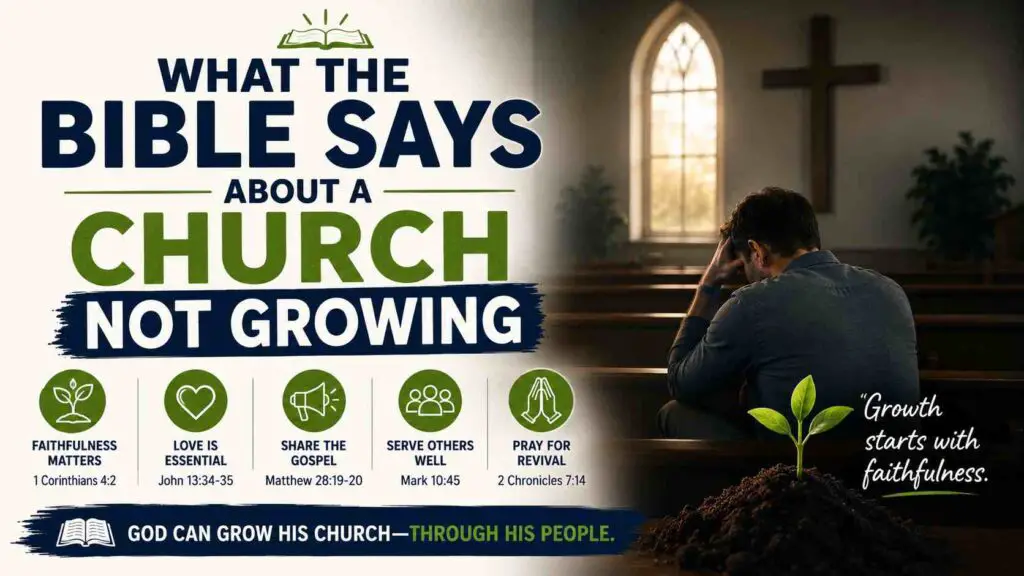
Church growth is a topic that concerns many pastors, ministry leaders, and believers. When a church is not growing, it can lead to discouragement, confusion, and questions about what may be wrong. While the Bible does not say that every faithful church will become large in numbers, it does reveal several spiritual reasons why a church may stagnate or decline.
Throughout Scripture, God emphasizes spiritual health, faithfulness, love, holiness, prayer, and obedience as essential qualities of a thriving church. A congregation may have beautiful buildings, busy programs, and strong traditions, yet still struggle spiritually if it drifts away from biblical principles.
Understanding what the Bible says about a church not growing can help leaders and believers examine their hearts, strengthen their ministries, and refocus on God’s purpose for the church.
What Does the Bible Say About a Church Not Growing?
The Bible teaches that church growth is ultimately God’s work, but it also shows that certain attitudes, behaviors, and spiritual conditions can hinder growth. Below are several biblical reasons why a church may not be growing.
#1. A Church May Lose Its First Love
One of the strongest warnings Jesus gave to a church was about losing its love for Him.
In the book of Book of Revelation, Jesus rebuked the church in Ephesus because they had abandoned the love they once had. Although they were active and doctrinally sound, their passion for God had faded.
“Yet I hold this against you: You have forsaken the love you had at first.” — Revelation 2:4
A church without genuine love for Christ often becomes cold, mechanical, and spiritually ineffective. True growth begins with a deep love for God.
#2. Spiritual Deadness Can Prevent Growth
Some churches appear successful outwardly while being spiritually lifeless inwardly.
Jesus told the church in Sardis:
“I know your deeds; you have a reputation of being alive, but you are dead.” — Revelation 3:1
A church can have activities, programs, and traditions while lacking the presence and power of God. Spiritual vitality is more important than appearances.
When a congregation neglects prayer, worship, repentance, and dependence on God, spiritual growth often declines.
#3. Sin Within the Church Hinders Growth
The Bible repeatedly warns that tolerated sin weakens God’s people.
In First Epistle to the Corinthians, Paul confronted the church for allowing immorality among believers. He compared sin to leaven spreading through dough.
“A little leaven leavens the whole lump.” — 1 Corinthians 5:6
Unrepented sin can damage unity, weaken witness, and hinder spiritual maturity. Churches that ignore holiness often struggle spiritually.
#4. False Teaching Can Damage a Church
Biblical truth is essential for healthy church growth.
Paul warned Timothy that many people would eventually reject sound doctrine and seek teachings that only pleased them.
“For the time will come when people will not put up with sound doctrine.” — 2 Timothy 4:3
A church that compromises biblical truth may attract temporary attention but will lose spiritual depth and long-term stability. Healthy growth is built on God’s Word.
#5. Lukewarm Faith Stops Spiritual Progress
Jesus strongly condemned spiritual complacency.
Speaking to the church in Laodicea, He said:
“Because you are lukewarm—neither hot nor cold—I am about to spit you out of my mouth.” — Revelation 3:16
A lukewarm church becomes comfortable, passive, and spiritually indifferent. Without passion for worship, evangelism, and discipleship, growth often stagnates.
#6. A Church That Stops Evangelizing Often Stops Growing
The early church grew because believers actively shared the gospel.
Jesus commanded His followers:
“Go therefore and make disciples of all nations.” — Gospel of Matthew 28:19
When churches become inward-focused and neglect outreach, growth often slows. Evangelism is not optional for the church; it is part of its mission.
#7. Prayerlessness Weakens the Church
Prayer was central to the early church.
In Acts of the Apostles, believers devoted themselves to prayer before powerful ministry breakthroughs occurred.
“They all joined together constantly in prayer.” — Acts 1:14
A church that relies only on human strategies and neglects prayer may struggle spiritually. Lasting growth requires dependence on God.
#8. Division and Conflict Hurt Church Growth
Disunity can destroy the health of a congregation.
Jesus taught:
“If a house is divided against itself, that house cannot stand.” — Gospel of Mark 3:25
Arguments, jealousy, gossip, and factions create an unhealthy environment. People are often discouraged from remaining in a divided church.
Biblical unity strengthens the church’s witness and ministry effectiveness.
#9. Poor Leadership Can Lead to Decline
The Bible places great responsibility on church leaders.
Paul instructed elders to carefully shepherd God’s people:
“Keep watch over yourselves and all the flock.” — Acts 20:28
Leadership marked by pride, neglect, corruption, or lack of vision can hinder a church’s growth. Godly leadership should guide the church with humility, wisdom, and faithfulness.
#10. Neglecting God’s Word Leads to Weakness
Scripture is essential for spiritual maturity.
Paul wrote:
“All Scripture is God-breathed and is useful for teaching…” — Second Epistle to Timothy 3:16
A church that moves away from biblical preaching and teaching often becomes spiritually weak. Strong churches are built on truth, discipleship, and obedience to God’s Word.
#11. Pride and Self-Reliance Can Block God’s Blessing
Some churches depend more on reputation, wealth, or human ability than on God.
Jesus warned the church in Laodicea that they believed they were spiritually rich when they were actually poor.
Pride can blind a church to its true spiritual condition. Humility and repentance are necessary for renewal.
#12. A Lack of Unity in Purpose Can Slow Growth
The early believers were united in mission and purpose.
“All the believers were one in heart and mind.” — Acts 4:32
When churches lose focus or become divided over secondary issues, momentum often fades. A shared commitment to worship, discipleship, and evangelism strengthens the church.
#13. Fear of Change or Outreach Can Lead to Stagnation
Some churches become too comfortable with routine and resist reaching new people.
In the early church, persecution scattered believers and caused the gospel to spread into new regions.
“Those who had been scattered preached the word wherever they went.” — Acts 8:4
Churches that refuse to step outside their comfort zones may struggle to grow.
#14. The Church Must Depend on the Holy Spirit
True spiritual growth cannot be manufactured by human effort alone.
God declared in Book of Zechariah:
“Not by might nor by power, but by my Spirit.” — Zechariah 4:6
Programs and strategies may help organize ministry, but genuine transformation comes through the Holy Spirit.
#15. Neglecting Compassion Weakens the Church’s Witness
The Bible teaches that caring for others reflects genuine faith.
James wrote:
“Religion that God our Father accepts as pure and faultless is this: to look after orphans and widows…” — Epistle of James 1:27
A church that ignores the hurting, needy, and broken may lose credibility in its community. Compassion and service are important parts of Christian ministry.
Closing Thoughts
The Bible shows that church growth is not simply about numbers, buildings, or popularity. God cares deeply about the spiritual condition of His people. A church may stop growing because of spiritual complacency, division, sin, lack of prayer, weak leadership, or neglect of God’s mission.
At the same time, Scripture offers hope. Churches can experience renewal when they return to biblical truth, prayer, love, holiness, and dependence on the Holy Spirit.
Healthy churches are built on faithful discipleship, genuine worship, compassionate ministry, and a commitment to sharing the gospel. While growth ultimately comes from God, believers are called to remain faithful and obedient to His Word.
“And the Lord added to their number daily those who were being saved.” — Acts 2:47