
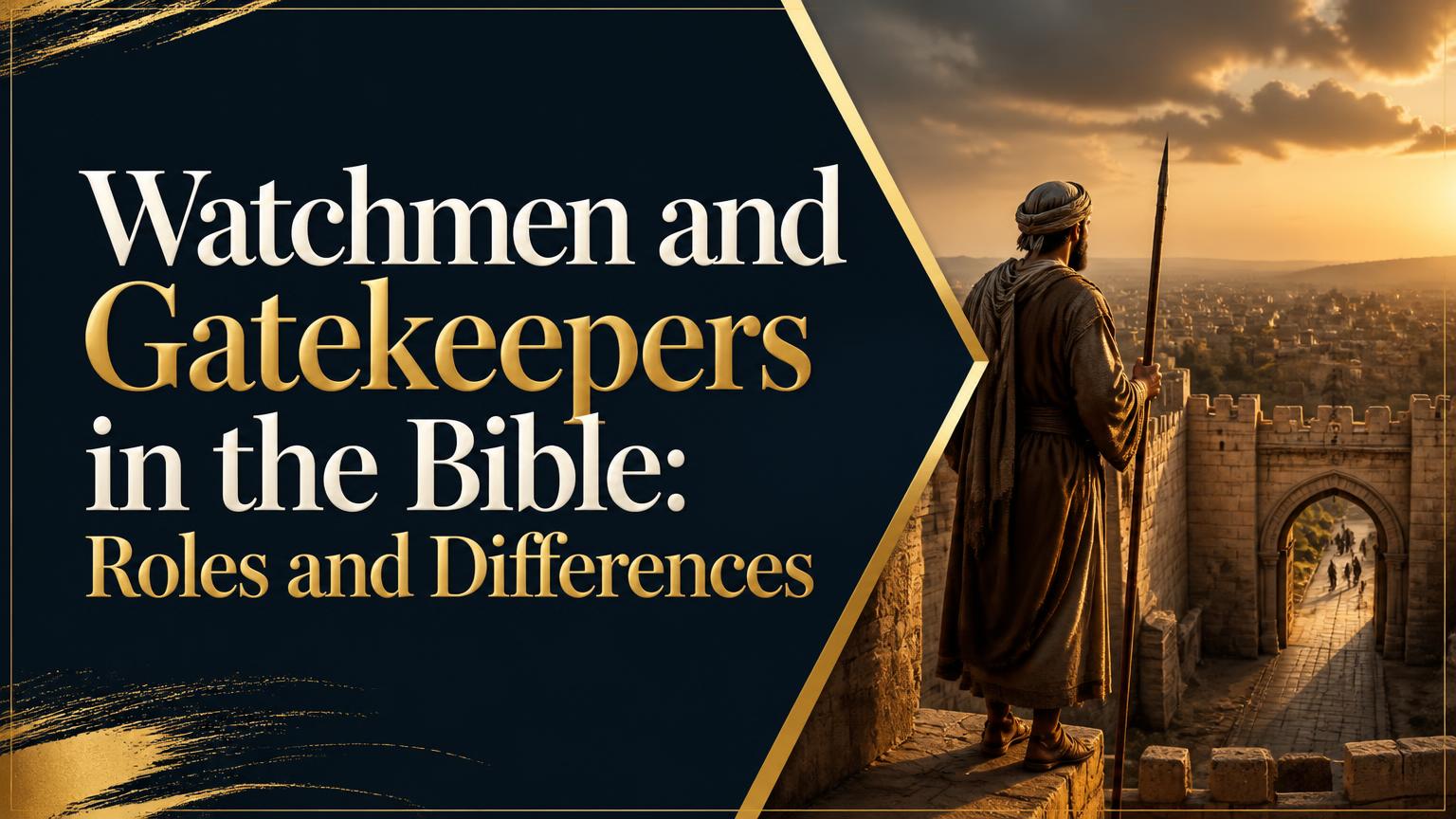
The Bible presents watchmen and gatekeepers as servants entrusted with protection, vigilance, and responsibility, but they were not identical roles. A watchman primarily observed what was approaching and warned others of danger, while a gatekeeper guarded an entrance, regulated access, and helped protect a sacred or communal space. These responsibilities could overlap, yet Scripture usually associates watchmen with alertness and proclamation and gatekeepers with stewardship, order, and controlled access.
What Are Watchmen and Gatekeepers in the Bible?
A watchman was stationed to observe a city, army, or spiritual condition and communicate what he saw. A gatekeeper was assigned to guard an entrance, manage access, and protect the people, worship space, or resources within. The distinction is therefore less about how vigilant each person was and more about the assignment each person received.
The watchman’s central question was, “What is coming, and who must be warned?” The gatekeeper’s central question was, “Who or what may enter, and how must this place be protected?” Both roles required faithfulness, but their immediate duties and forms of accountability differed.
The Watchman as Sentinel and Spiritual Messenger
In its most literal sense, a watchman stood on a city wall or elevated position to look for approaching enemies, messengers, or travelers. Because a city’s safety could depend on early warning, the watchman had to remain attentive rather than become distracted or sleep through his assignment. Accounts such as the watchman’s report in 2 Samuel 18:24-27 illustrate this ordinary military and civic function.
The prophets later used the watchman as a powerful metaphor for spiritual responsibility. God tells Ezekiel, “I have made you a watchman for the house of Israel” (Ezekiel 3:17; see also Ezekiel 33:1-9). Ezekiel’s task was to hear God’s word, warn the wicked, and speak faithfully. If he refused to warn people, he would be accountable for his silence; if he warned them and they refused to turn, the responsibility would rest with them.
This passage does not mean that every religious leader may claim unquestionable authority or predict events with certainty. It describes a specific prophetic commission in which God gave Ezekiel a message and held him responsible for delivering it accurately. The lasting principle is that spiritual responsibility includes truthful warning, not merely encouragement or approval.
The Gatekeeper as Guardian of Access and Worship
Gatekeepers guarded entrances and controlled movement into places that required protection. In the tabernacle and later the temple, Levites served at the gates. First Chronicles 9:19-27 describes gatekeepers who guarded the entrances, watched the temple chambers, and maintained assigned duties. First Chronicles 26 provides further organization of these families and responsibilities.
Their work involved more than standing beside a doorway. Gatekeepers helped preserve order in worship, protected sacred areas from unauthorized entry, and in some cases supervised storerooms and temple treasures. Second Chronicles 23:19 says that gatekeepers were placed at the gates of the Lord’s house so that no one ceremonially unclean could enter. Their service supported the holiness and proper functioning of the sanctuary.
Gatekeeping also appears in broader community settings. Nehemiah 7:1-3 describes the appointment of gatekeepers after Jerusalem’s wall was rebuilt. The gates were not to be opened until the sun was hot, and guards were assigned to stand watch. Here the task combined physical security, timing, organization, and communal trust.
Their Main Differences in Assignment and Authority
The clearest difference is the direction of responsibility. Watchmen looked outward toward what might be approaching; gatekeepers guarded a boundary and managed what crossed it. A watchman’s work was primarily observational and communicative. A gatekeeper’s work was primarily protective, administrative, and custodial.
Their messages also differed. A watchman announced danger, movement, or significant developments. A gatekeeper enforced standards concerning entry and protected what had been entrusted to him. A watchman might sound an alarm without personally stopping the threat. A gatekeeper might deny access, secure a door, or protect people and property directly.
| Role | Primary Assignment | Typical Setting | Main Responsibility |
|---|---|---|---|
| Watchman | Observe and warn | City wall, battlefield, prophetic ministry | Detecting and communicating danger or change |
| Gatekeeper | Guard and regulate access | Temple, city gate, storeroom | Protecting entrances, people, worship, and resources |
The roles could overlap in a fortified city. Someone guarding a gate might also watch for approaching enemies, and a watchman might be positioned near a gate. Nevertheless, the biblical emphasis remains different: watchmen are associated with warning, while gatekeepers are associated with guarding and ordered access.
Why These Roles Are Often Connected
Both watchmen and gatekeepers represent faithful stewardship under responsibility. Neither role permits passivity. The watchman must remain alert enough to recognize a threat, and the gatekeeper must remain trustworthy enough to protect what lies within. Both serve others rather than themselves.
The connection becomes especially strong in spiritual application. Churches and Christian leaders may be called to remain alert to false teaching, moral danger, suffering, or opportunities for ministry. Yet the analogy should be applied carefully. The Bible does not authorize every believer to become a self-appointed judge of other people’s motives or a controller of access to God. Christ is the mediator of salvation, and biblical discernment must remain governed by Scripture, humility, truth, and love.
Watchmen in Israel’s Prophetic Tradition
The watchman image develops from military vigilance into a description of prophetic accountability. Prophets did not merely forecast the future; they confronted present disobedience, interpreted events in light of God’s covenant, and called people to repent. The image emphasizes the seriousness of communicating a divine warning faithfully.
Watchmen Warn Before Judgment
Jeremiah 6:17 says that God appointed watchmen who told the people to listen for the sound of the trumpet. The trumpet symbolized an approaching threat and demanded a response. The problem was not that the warning lacked clarity; the people refused to listen.
Ezekiel 33 gives the image its fullest explanation. A watchman who sees the sword coming and blows the trumpet has fulfilled his duty to warn. Those who hear but refuse to respond remain responsible for their decision. The passage therefore holds two responsibilities together: leaders must not conceal danger, and hearers must not treat warning as irrelevant.
This principle corrects two opposite errors. A leader cannot excuse silence by saying that people may reject the message anyway. At the same time, people cannot transfer all responsibility to the messenger after receiving a clear and faithful warning.
Watchmen Also Wait and Pray
Isaiah 62:6-7 describes watchmen on Jerusalem’s walls who never remain silent and who remind the Lord of His promises. These watchmen are not portrayed only as alarm-raisers. They also persist in intercession, seeking God’s purposes for the city.
Habakkuk 2:1 similarly describes the prophet standing at his watchpost and waiting for God’s answer. Waiting is not inactivity in this context. It is a posture of attentive dependence: the prophet watches, listens, receives God’s word, and then communicates it. Biblical watchfulness therefore includes observation, prayer, patience, and faithful speech.
Watchmen Are Accountable for Faithful Speech
The watchman metaphor concerns obedience, not personal status. Ezekiel was responsible for delivering the message God gave him, not for guaranteeing that everyone would accept it. This distinction matters because biblical ministry is measured first by faithfulness to truth, not by universal approval or visible success.
It also limits careless uses of the phrase “watchman.” A person who strongly suspects something is not automatically a prophetic watchman, and a warning is not made authoritative merely by attaching spiritual language to it. Scripture’s watchman passages emphasize hearing from God, speaking truthfully, accepting accountability, and seeking the good of those being warned.
Gatekeepers, Levites, and the Protection of Sacred Space
Gatekeeping was especially prominent in Israel’s worship system because the tabernacle and temple were not ordinary public buildings. They were designated places of worship with boundaries, procedures, vessels, treasures, and responsibilities. Gatekeepers helped preserve the order required for that worship.
Gatekeepers Served as Levites and Temple Guardians
The gatekeepers named in 1 Chronicles 9 and 26 belonged primarily to Levitical families assigned to temple service. Their duties included guarding entrances, staying near the temple chambers, opening and closing areas, and protecting supplies. Their service was practical, but it supported the holiness of worship.
Psalm 84:10 values even the position of a doorkeeper in God’s house, portraying humble service in the sanctuary as better than dwelling among the wicked. The point is not that a gatekeeper held a lesser spiritual value. It is that apparently ordinary work could become honorable when performed in service to God.
Gatekeeping Involved Discernment and Trust
A gatekeeper had to distinguish appropriate from inappropriate access. In the temple, that could involve ceremonial cleanliness, authorized service, protection of holy objects, or adherence to assigned procedures. In Jerusalem, it involved protecting the city and controlling when entrances were opened.
This does not make gatekeepers arbitrary rulers. Their authority was delegated and bounded by God’s law and the responsibilities of the community. Biblical gatekeeping was stewardship, not personal ownership. The gatekeeper protected what belonged to God or the people; he did not treat the assignment as a means of self-importance.
Gatekeeping Is Different From Spiritual Elitism
Modern Christians sometimes use “gatekeeper” negatively for someone who controls access to a church, ministry, doctrine, or social group for personal power. That criticism may be appropriate when people manipulate access or exclude others unjustly, but it should not erase the legitimate biblical idea of responsible guardianship.
Scripture values both holiness and welcome. Temple boundaries protected sacred worship, while God’s covenant also established care for the outsider, the poor, and the vulnerable. Christian leaders therefore need discernment without pride: they should guard truth and people from harm while avoiding barriers that God Himself has not established.
What These Roles Teach Christian Readers Today
The biblical roles of watchmen and gatekeepers offer principles for responsibility, but they should not be turned into a claim that modern Christians hold identical offices to Israel’s prophets or temple servants. The New Testament presents different gifts and forms of leadership, and any modern application must remain accountable to the whole teaching of Scripture.
Watchfulness Means Alertness, Truth, and Prayer
Jesus repeatedly called His disciples to stay awake spiritually. In Mark 13:33-37, the doorkeeper is told to keep watch because the master may return unexpectedly. The image joins watchfulness with readiness and faithful service rather than speculation about dates or hidden predictions.
Christians are also told to be sober and alert in passages such as 1 Peter 5:8, while leaders are charged to guard sound teaching and care for people. Applied properly, watchfulness means recognizing temptation, testing teaching, noticing suffering, praying consistently, and speaking truth with courage and humility.
Gatekeeping Means Faithful Stewardship
Christian communities must make responsible decisions about teaching, leadership, safeguarding, worship, finances, and participation in ministry. These decisions resemble gatekeeping because they involve protecting people and managing entrusted resources. They should be based on biblical integrity, competence, transparency, and the good of the community.
At the same time, gatekeeping must not become needless control. Jesus welcomed repentant sinners, confronted hypocritical barriers, and treated vulnerable people with dignity. Christian stewardship guards what is holy without confusing human preferences with God’s commands.
Both Roles Require Humility and Accountability
A watchman who enjoys alarming people can become reckless, while a gatekeeper who enjoys exclusion can become controlling. The biblical pattern challenges both distortions. Faithful service requires accurate judgment, willingness to be corrected, and concern for those affected by one’s decisions.
The roles also remind churches that visible and invisible work both matter. Public preaching may resemble watchman-like warning, while careful administration, hospitality, safeguarding, and practical service may resemble gatekeeping. Neither is automatically more spiritual. The value lies in faithful obedience to the responsibility God has actually given.
Watchmen and Gatekeepers in the Bible: The Essential Distinction
Watchmen and gatekeepers shared a commitment to vigilance, protection, and service, but their central assignments were different. Watchmen observed what was approaching, received or recognized significant developments, and warned others. Gatekeepers guarded boundaries, regulated access, protected sacred spaces or resources, and maintained order. A person might perform both tasks in a city or sanctuary, but the biblical images should not be treated as interchangeable.
Their modern spiritual application also requires restraint. Scripture supports alertness, truthful warning, prayer, wise protection, and responsible stewardship. It does not support self-appointed authority, sensational predictions, manipulation, or exclusion for personal power. Properly understood, these roles call God’s people to notice danger, protect what has been entrusted to them, communicate faithfully, and serve with humility rather than control.