
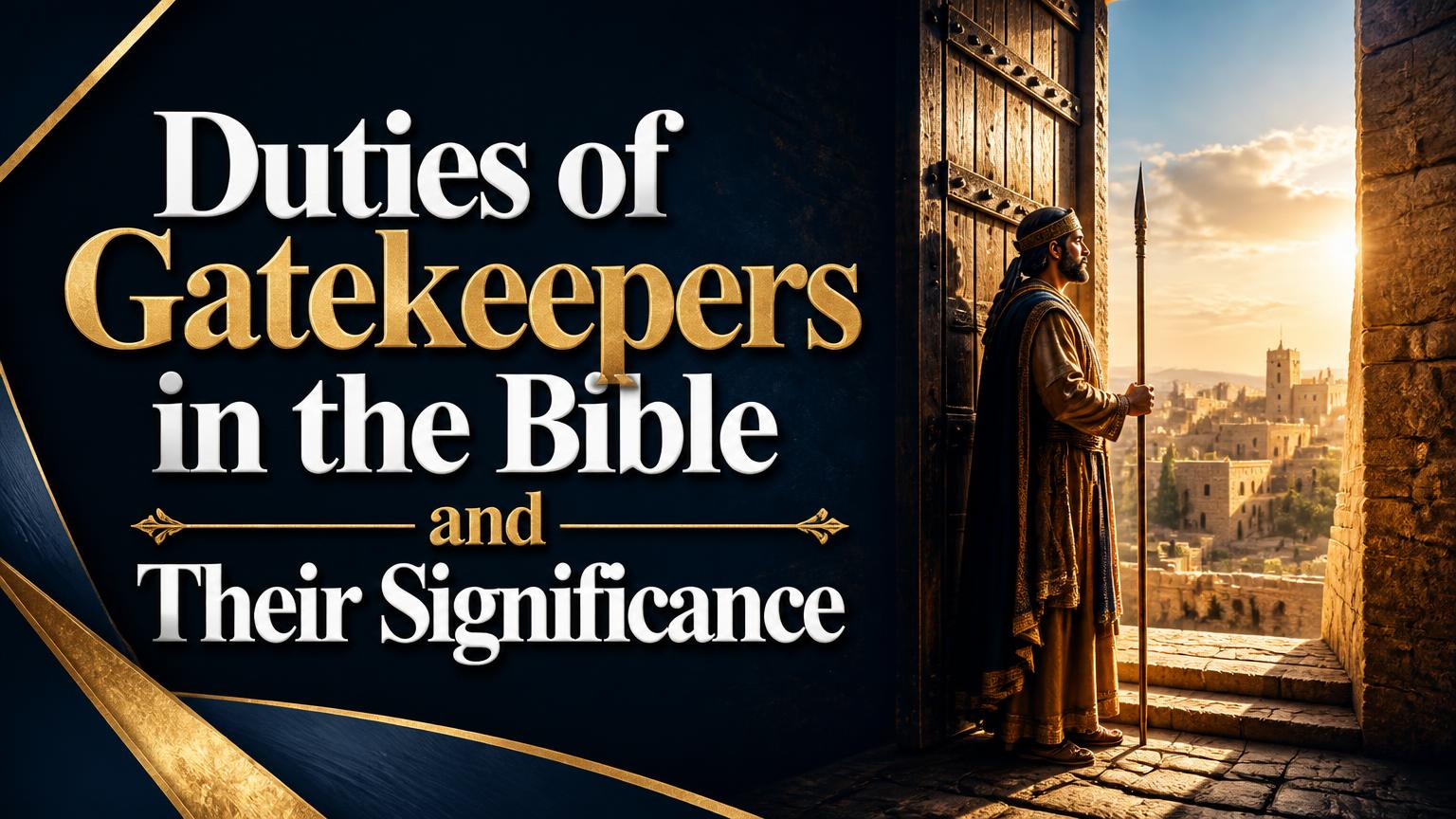
Gatekeepers in the Bible were entrusted with protecting the entrances, order, worship, and resources connected with the tabernacle and temple. Their work was more than standing at a doorway. They controlled access to sacred areas, assisted with the orderly movement of worshipers and offerings, guarded temple treasures, and served according to assigned divisions and schedules. Although their duties were practical, Scripture presents them as a respected Levitical ministry requiring reliability, obedience, and vigilance.
What Were the Duties of Gatekeepers in the Bible?
The primary duties of gatekeepers involved guarding the entrances to God’s sanctuary and overseeing access to the areas associated with worship. Their responsibilities developed from the tabernacle period into the temple service established under David and continued in various forms after the exile.
Guarding the Entrances to the Sanctuary
Gatekeepers watched the doors and thresholds of the tabernacle and temple. First Chronicles 9:19 describes Shallum and his relatives as “keepers of the threshold of the tent,” while 1 Chronicles 26 records organized divisions responsible for different temple gates. Their presence helped ensure that access to sacred areas followed the requirements God had given Israel.
This did not mean that every worshiper was forbidden from approaching the temple. Rather, the gatekeepers helped distinguish between areas, people, and activities that were permitted and those that were not. They supported the priests by preventing disorder, unauthorized entry, and conduct inconsistent with the holiness of the sanctuary.
Controlling Proper Access
The gatekeepers helped regulate who could enter particular parts of the worship complex and when. In 2 Chronicles 23:19, priests and Levites were appointed to guard the gates of the house of the Lord so that no one ceremonially unclean could enter. This illustrates an important dimension of their work: they protected the conditions required for worship rather than simply defending a physical building.
Their role therefore combined security with religious responsibility. They had to understand the boundaries of the sanctuary and cooperate with the priests who administered sacrifices and other forms of worship. Gatekeeping was concerned with protecting holy space from misuse, not with personal power or arbitrary exclusion.
Guarding Temple Treasures and Storehouses
Some gatekeepers were assigned responsibility for the temple treasuries and chambers. First Chronicles 9:26–28 explains that certain Levites had charge of the chambers and treasures of the house of God, and that some watched over the vessels used in worship. They counted items when they were brought in and took them out, indicating a role involving accountability and careful administration.
These stores could include vessels, offerings, provisions, and materials dedicated to temple service. Because sacred resources could be valuable and easily misused, trustworthy oversight was essential. The gatekeepers’ work connected spiritual faithfulness with practical stewardship: guarding worship also meant guarding the resources that made worship possible.
Opening and Closing the Gates
Gatekeepers were responsible for opening the temple doors in the morning and closing them after the day’s activities. First Chronicles 9:27 says they spent the night around the house of God because they were responsible for guarding it and opening it each morning.
This routine required consistency. Their service was not limited to dramatic moments or public ceremonies. Much of it involved repeated, often unnoticed actions performed at the correct time. The biblical picture challenges the assumption that significance depends on visibility. A gatekeeper served faithfully by maintaining a dependable pattern that others could rely upon.
Serving in Assigned Divisions and Watches
Gatekeepers served according to organized groups, family responsibilities, and scheduled divisions. First Chronicles 26 lists gatekeepers connected with families such as the Korahites and Merarites and describes their assignments by lot. The organization allowed the temple service to continue without depending on one individual’s availability.
The use of divisions and watches also promoted fairness and order. Different families received particular responsibilities, while leaders coordinated the work. First Chronicles 9:25 indicates that relatives came from their villages to serve for set periods. The arrangement shows that worship administration required planning, shared responsibility, and continuity across generations.
Supporting Orderly Worship
Gatekeepers were not the priests who offered sacrifices, but their service supported the priests and the wider worship of Israel. By protecting entrances, maintaining order, and overseeing temple property, they helped create an environment in which worship could be conducted according to God’s commands.
Their ministry demonstrates that biblical worship depended on many forms of service. Priests, musicians, singers, administrators, guards, and other Levites had distinct roles. The gatekeepers’ responsibilities were especially important because disorder at the entrance or negligence with sacred property could disrupt the entire community’s worship.
Who Were the Biblical Gatekeepers?
The gatekeepers were primarily Levites assigned to service at the tabernacle and temple. They were not normally described as a separate priestly class with authority to perform sacrifices. Instead, they served within the broader Levitical structure under the direction of priests and appointed leaders.
First Chronicles 9 identifies the gatekeepers as members of particular Levitical families, including the Korahites and Merarites. First Chronicles 26 gives further family lists and assignments during the organization of temple service associated with David. These genealogical details communicate more than historical information: they show that the work was established, recognized, and entrusted to designated households.
Some gatekeepers also lived in Jerusalem or came from surrounding villages for periods of service. Nehemiah 11:19 mentions the gatekeepers in the postexilic community, while Nehemiah 12:45 connects priests and Levites with guarding responsibilities and the orderly performance of worship. The role continued because the restored community still needed structured oversight of the temple and its practices.
Why Gatekeeping Required Trustworthiness
Gatekeeping involved access, property, timing, and sacred responsibility. A careless gatekeeper could allow unauthorized entry, mishandle temple vessels, fail to protect stored offerings, or neglect an assigned watch. For that reason, the role required more than physical strength. It demanded reliability, attention, and respect for God’s instructions.
The responsibilities also involved representing the holiness of the sanctuary to the worshiping community. Gatekeepers had to apply boundaries consistently rather than according to favoritism. Their task was not to invent their own standards but to uphold the standards associated with the temple’s worship.
This helps explain why Scripture records their names and family divisions. The biblical text treats apparently ordinary service as worthy of remembrance when it is performed faithfully. The gatekeepers’ ministry was a public trust, even when much of the work occurred outside the attention given to priests, singers, or national leaders.
Gatekeepers in Biblical Imagery and Christian Application
The Bible sometimes uses gatekeeping language symbolically, but the literal temple office should be distinguished from later spiritual applications. Psalm 84:10 expresses the desire to be “a doorkeeper in the house of my God,” emphasizing humble nearness to God over status elsewhere. The verse is poetic rather than a complete description of the Levitical job.
Jesus also refers to a doorkeeper in Mark 13:34. In that parable, the doorkeeper must stay awake because the master may return unexpectedly. The emphasis is watchfulness and readiness, not a direct continuation of the temple gatekeeper’s office. Similarly, John 10 uses the imagery of a doorkeeper in teaching about the shepherd and the sheep; it should not be treated as a detailed description of temple administration.
Watchfulness Without Suspicion
The biblical image can encourage alertness to spiritual responsibility. Christians are called to remain watchful, resist false teaching, and guard the integrity of their conduct. Yet watchfulness does not justify treating every person with suspicion or claiming authority over people that God has not given.
A faithful spiritual application preserves the original moral principle: protect what has been entrusted to you, remain attentive, and act according to God’s truth. It should not turn a humble ministry of service into a license for control, exclusion, or harsh judgment.
Stewardship of People and Resources
Church leaders and members may apply the gatekeeper principle to the stewardship of worship spaces, finances, teaching, hospitality, safeguarding, and ministry responsibilities. The connection is one of principle rather than direct institutional equivalence. New Testament churches are not instructed to recreate the Levitical temple system, because Christian worship is centered on Christ rather than on the Jerusalem temple.
Nevertheless, the need for trustworthy stewardship remains. First Corinthians 4:2 states that those entrusted with responsibilities must be found faithful. That principle aligns with the biblical portrayal of gatekeepers, whose service required careful handling of resources and dependable care for the community’s worship.
Humble Service Matters to God
Gatekeepers illustrate how Scripture values hidden and supporting work. Their names appear in records that also mention priests, singers, and other prominent servants, showing that the biblical account does not treat practical ministry as spiritually insignificant.
Their example can encourage people who maintain facilities, welcome others, protect vulnerable individuals, manage resources, organize worship, or quietly carry responsibilities that receive little public recognition. The value of such work does not depend on applause. Its significance comes from faithfulness to God and service to the people entrusted to one’s care.
How Gatekeepers Differed From Priests and Watchmen
Gatekeepers, priests, and watchmen could all be associated with protection or temple activity, but they were not identical roles. Priests presented sacrifices, taught aspects of the law, and carried out duties specifically assigned to the priesthood. Gatekeepers were Levites responsible primarily for access, order, thresholds, and certain temple stores.
Watchmen, meanwhile, could refer more broadly to people guarding a city, military position, wall, or building. The temple gatekeepers performed a specialized form of watch duty, but not every biblical watchman was a temple servant. Prophetic language also uses “watchman” symbolically for people responsible for warning others, as in Ezekiel 3:17. That prophetic office should not be confused with the Levitical gatekeeping ministry.
The distinction matters because “gatekeeper” can otherwise become a vague label for anyone who protects something. In the biblical setting, the term refers most specifically to an organized Levitical responsibility connected with sacred entrances, temple order, and stewardship.
What the Duties of Gatekeepers Teach Today
The duties of gatekeepers in the Bible reveal that faithful ministry includes protection, accountability, preparation, and consistency. They guarded sacred entrances, watched over valuable resources, followed assigned schedules, and supported the worship of the whole community. Their work was practical, but it served a theological purpose: preserving reverence and order in the place associated with God’s presence.
For Christians, the lasting lesson is not to reproduce the temple office mechanically but to imitate its faithfulness. People entrusted with leadership, resources, teaching, hospitality, security, or pastoral care should serve without favoritism, remain alert to genuine danger, and exercise authority with humility. Gatekeeping is honorable when it protects people and responsibilities according to God’s purposes; it becomes distorted when it seeks control for its own sake.
Conclusion
The gatekeepers in the Bible were Levites who guarded the entrances of the tabernacle and temple, regulated access, protected sacred vessels and treasures, opened and closed the gates, and served in organized shifts. Their work supported the priests and helped preserve the order and holiness required for Israel’s worship. Scripture presents them as trusted servants, not merely guards stationed at a doorway.
Their significance extends beyond the ancient temple because they show that quiet responsibilities can carry genuine spiritual weight. Faithful gatekeeping involves vigilance, stewardship, accountability, and humility. Applied wisely today, the principle encourages believers to protect what God has entrusted to them without confusing responsible care with controlling others.