
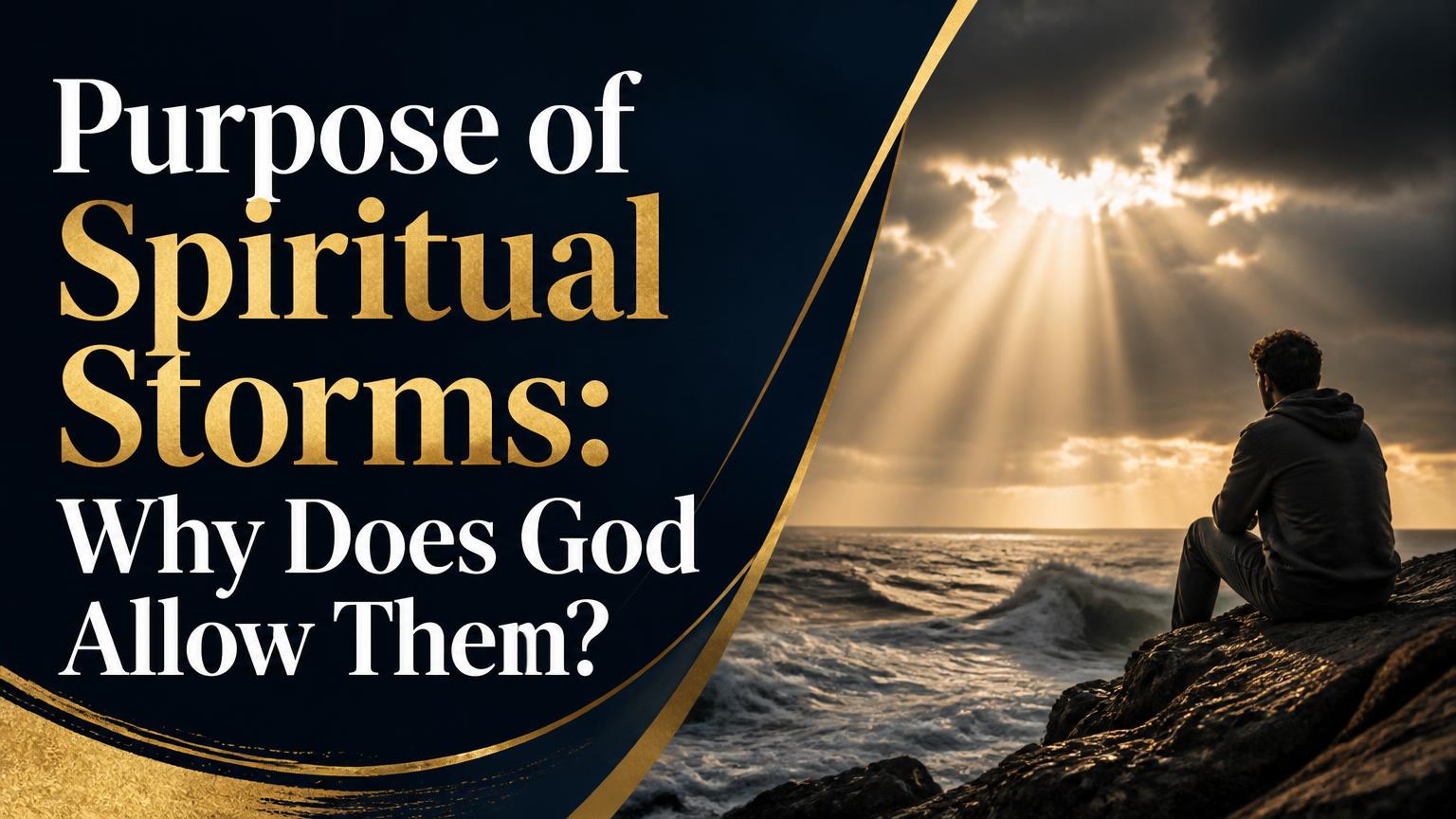
Spiritual storms are seasons of intense difficulty that test a person’s faith, expose inner fears, and create uncertainty about God’s presence or purposes. The expression is a Christian metaphor rather than a fixed biblical phrase, but Scripture repeatedly describes believers facing suffering, temptation, persecution, doubt, loss, and apparent silence from God. These experiences do not always mean that someone has sinned or lacks faith. Often, their purpose becomes visible through the character, dependence, wisdom, compassion, and hope developed while the believer trusts God in the middle of difficulty.
What Is the Purpose of Spiritual Storms?
The purpose of spiritual storms is not always to punish. In Scripture, God may use adversity to refine faith, deepen dependence, correct destructive paths, prepare people for service, reveal what they trust, or display His sustaining grace. Yet Christians should not assume that every painful event has one easily identifiable explanation. Some suffering results from human sin, natural conditions, injustice, or the brokenness of creation. God can bring redemption from these circumstances without being the author of evil.
Spiritual Storms Test and Strengthen Faith
A storm reveals whether faith rests only on favorable circumstances or on God Himself. James 1:2–4 connects trials with the testing of faith, endurance, maturity, and spiritual completeness. This does not mean Christians must enjoy suffering or pretend that pain is insignificant. It means that steadfast trust can grow through hardship because adversity confronts shallow assumptions and teaches believers to depend on God more honestly.
The disciples’ storm on the Sea of Galilee illustrates this process in Mark 4:35–41. Jesus was with them, yet the storm still came. Their fear exposed how limited their understanding of His authority was. When Jesus calmed the wind, the event did more than remove danger; it revealed something about His identity. A spiritual storm may therefore become a setting in which faith moves from inherited belief toward tested confidence.
Storms Teach Dependence Rather Than Self-Sufficiency
Difficulty often exposes the limits of control. Plans fail, health changes, relationships fracture, and familiar sources of security become unreliable. These experiences can drive a person toward prayer, Scripture, wise community, and a more realistic understanding of human weakness.
Paul describes such an experience in 2 Corinthians 1:8–9, where severe pressure taught him not to rely on himself but on God, who raises the dead. The lesson was not that human effort has no value. Rather, Paul learned that ministry and survival cannot ultimately rest on personal strength. Dependence is not passivity; it is the decision to act faithfully while recognizing that outcomes remain in God’s hands.
Storms Can Expose False Foundations
Jesus’ illustration of the wise and foolish builders in Matthew 7:24–27 shows why storms matter. Both houses face rain, floods, and winds, but only one remains standing because it was built on obedience to Christ’s words. The storm does not create the foundation; it reveals it.
In the same way, crisis can expose whether a person’s identity depends primarily on achievement, approval, wealth, comfort, control, or spiritual reputation. This exposure can be painful, but it also creates an opportunity for repentance and reordering. A revealed weakness is not necessarily a final failure. It can become the place where a more durable foundation is established.
God Can Use Storms to Prepare and Equip His People
Some trials develop capacities that cannot be learned through theory alone. A person who has experienced grief may become more patient with mourners. Someone who has endured uncertainty may offer wiser encouragement to those facing an unstable future. A believer who has wrestled honestly with doubt may learn to distinguish genuine faith from simplistic answers.
This does not make suffering good in itself, and it does not justify causing or romanticizing harm. The point is that God can redeem an experience by using it to form compassion, discernment, courage, and readiness for service. Joseph’s words in Genesis 50:20 capture this distinction: human beings intended harm, but God worked through the same events for preservation and good.
Storms May Reveal God’s Presence in a Different Way
Many Christians expect God’s presence to appear through immediate rescue, clear direction, or emotional peace. Sometimes He does provide those gifts. At other times, His presence is experienced through endurance, comfort, timely help, a faithful community, or strength sufficient for one more day.
Psalm 23 does not promise that the believer avoids the valley; it describes God as present while the believer walks through it. Likewise, Jesus’ presence with the disciples in Mark 4 did not prevent the storm from occurring. This does not mean that God is indifferent to suffering. It means that divine presence cannot be measured only by whether circumstances change quickly.
Why Does God Allow Spiritual Storms?
The question of why God allows suffering involves both divine sovereignty and the reality of a fallen world. Christianity does not teach that every hardship is a direct punishment sent for a specific sin. Jesus rejected that kind of automatic conclusion in situations discussed in John 9:1–3 and Luke 13:1–5. At the same time, Scripture does teach that God remains able to work within circumstances He does not morally approve.
James 1:13 states that God does not tempt anyone with evil. This guards against blaming God for sinful choices or treating cruelty as His direct intention. Human decisions, social injustice, natural processes, and spiritual opposition can all contribute to suffering. The biblical account is therefore more careful than the claim that God personally sends every storm for a simple lesson.
God’s permission is also not the same as moral approval. A parent may permit a mature child to face the consequences of a decision without approving the decision itself. In a far greater and more complex way, God may allow temporary conditions within His providence while opposing the evil involved and working toward redemption. Romans 8:28 promises that God works for good for those who love Him; it does not say that every event is good, painless, or immediately understandable.
The book of Job illustrates this tension. Job’s suffering cannot be explained by the assumption that he must have committed an unusually serious sin. The narrative challenges simplistic explanations and gives room for lament, confusion, and reverent questions. Christians may trust God’s character without claiming to know the hidden reason for every tragedy.
What Spiritual Storms Do Not Necessarily Mean
A spiritual storm does not automatically mean that God is angry, that a person lacks faith, or that prayer has failed. Scripture includes faithful people who suffered while obeying God. Paul endured imprisonment, beatings, danger, and rejection. The apostles faced persecution, and Jesus Himself experienced anguish, injustice, and abandonment. Faithfulness may sometimes lead into difficulty rather than around it.
Nor does a peaceful life prove exceptional spiritual maturity. Jesus’ warning about the two builders assumes that storms come to both houses. External comfort cannot provide a complete measure of spiritual health, just as hardship cannot by itself prove divine displeasure.
A storm also does not mean that Christians should refuse practical help. Trusting God can include seeking medical care, reporting abuse, obtaining financial or legal assistance, asking trusted believers for support, and setting wise boundaries. Spiritual interpretation should never be used to pressure someone to remain in danger or tolerate exploitation. God’s care may come through ordinary means, courageous action, and the protection offered by a healthy community.
How Should Christians Respond to Spiritual Storms?
Bring Honest Lament to God
Biblical faith makes room for grief, protest, confusion, and unanswered questions. Many psalms ask how long suffering will continue or why God seems distant. Lament is not the opposite of faith; it is pain turned toward God rather than away from Him. It acknowledges that circumstances are not as they should be while continuing to address the One who can hear and act.
A believer does not need to manufacture cheerful words in order to pray faithfully. Honest prayer may include fear, anger, repentance, requests for rescue, and renewed trust. Lament prevents suffering from being buried beneath religious clichés and allows God’s comfort to meet the real experience.
Seek Wisdom Before Assigning a Cause
When hardship begins, people often ask whether it came from personal sin, spiritual attack, divine discipline, or ordinary circumstances. Sometimes Scripture gives enough clarity to identify a cause; often it does not. Christians should examine their lives honestly without assuming guilt for everything painful.
Galatians 6:1 calls believers to restore those caught in sin gently, while James 1:5 encourages prayer for wisdom. Wise discernment considers facts, patterns, counsel, Scripture, and the fruit produced by an interpretation. If a proposed explanation creates pride, condemnation, fear, or indifference toward suffering people, it should be questioned.
Remain Connected to the Body of Christ
Isolation magnifies fear and makes distorted conclusions more persuasive. Galatians 6:2 tells believers to carry one another’s burdens, and Romans 12:15 calls Christians to weep with those who weep. Support may involve prayer, practical assistance, patient listening, correction, or simply faithful presence.
Community does not eliminate the need for personal responsibility, and not every adviser is wise. A healthy church does not force quick explanations or treat vulnerability as weakness. It helps people endure truthfully, protects the vulnerable, and points sufferers toward Christ rather than toward dependence on a particular leader.
Continue Faithful Obedience in Small Ways
A storm can make long-term vision difficult. In such seasons, obedience may consist of ordinary actions: praying honestly, telling the truth, accepting needed help, refusing revenge, keeping appropriate commitments, resting, and caring for the body. These actions do not earn God’s favor. They express trust while the larger outcome remains uncertain.
Hebrews 12:1–3 directs believers to persevere by looking to Jesus, who endured suffering without abandoning His mission. The passage does not minimize pain; it places pain within a larger pattern of faithful endurance. Small acts of obedience can preserve stability when dramatic answers have not yet arrived.
How Can Believers Distinguish a Spiritual Storm From Spiritual Warfare?
The Bible recognizes spiritual opposition. Ephesians 6:10–18 describes a struggle involving spiritual forces and calls Christians to truth, righteousness, faith, salvation, Scripture, and prayer. However, not every difficulty should be labeled demonic. Illness, grief, exhaustion, poor decisions, oppression, and social problems may have ordinary or human causes, even when spiritual realities also matter.
The distinction matters because an inaccurate label can lead to harmful responses. Someone who needs medical treatment may be told only to pray. Someone facing abuse may be urged to endure rather than seek protection. Someone experiencing depression may be blamed for weak faith. Biblical spiritual discernment holds prayer and practical wisdom together.
The central question is not always, “Who caused this storm?” It may be, “How can I respond faithfully, resist evil, receive appropriate help, and remain open to what God is forming in me?” That approach takes spiritual opposition seriously without turning every hardship into speculation.
What Is the Christian Hope Beyond the Storm?
Christian hope does not depend on the promise that every earthly storm will end quickly. Some prayers for healing receive immediate answers; others involve long treatment, gradual recovery, or no explanation before death. Scripture promises God’s presence now and final restoration in the future. Revelation 21:4 points toward a day when death, mourning, crying, and pain will no longer define human existence.
That future hope changes the meaning of present endurance without making present suffering unimportant. Romans 8:18–25 connects Christian hope with the renewal of creation, not with denial of the world’s groaning. Believers can grieve deeply while expecting that evil and death will not have the final word.
The purpose of a spiritual storm may remain partly hidden. What can be known is that hardship is not proof of God’s absence, and suffering need not be wasted. Through prayer, truth, community, wise action, and perseverance, believers may encounter God’s sustaining grace, develop tested character, and become more able to serve others. The goal is not to explain every storm but to remain faithful within it, trusting that God can redeem what He does not endorse and ultimately bring His people into lasting peace.