
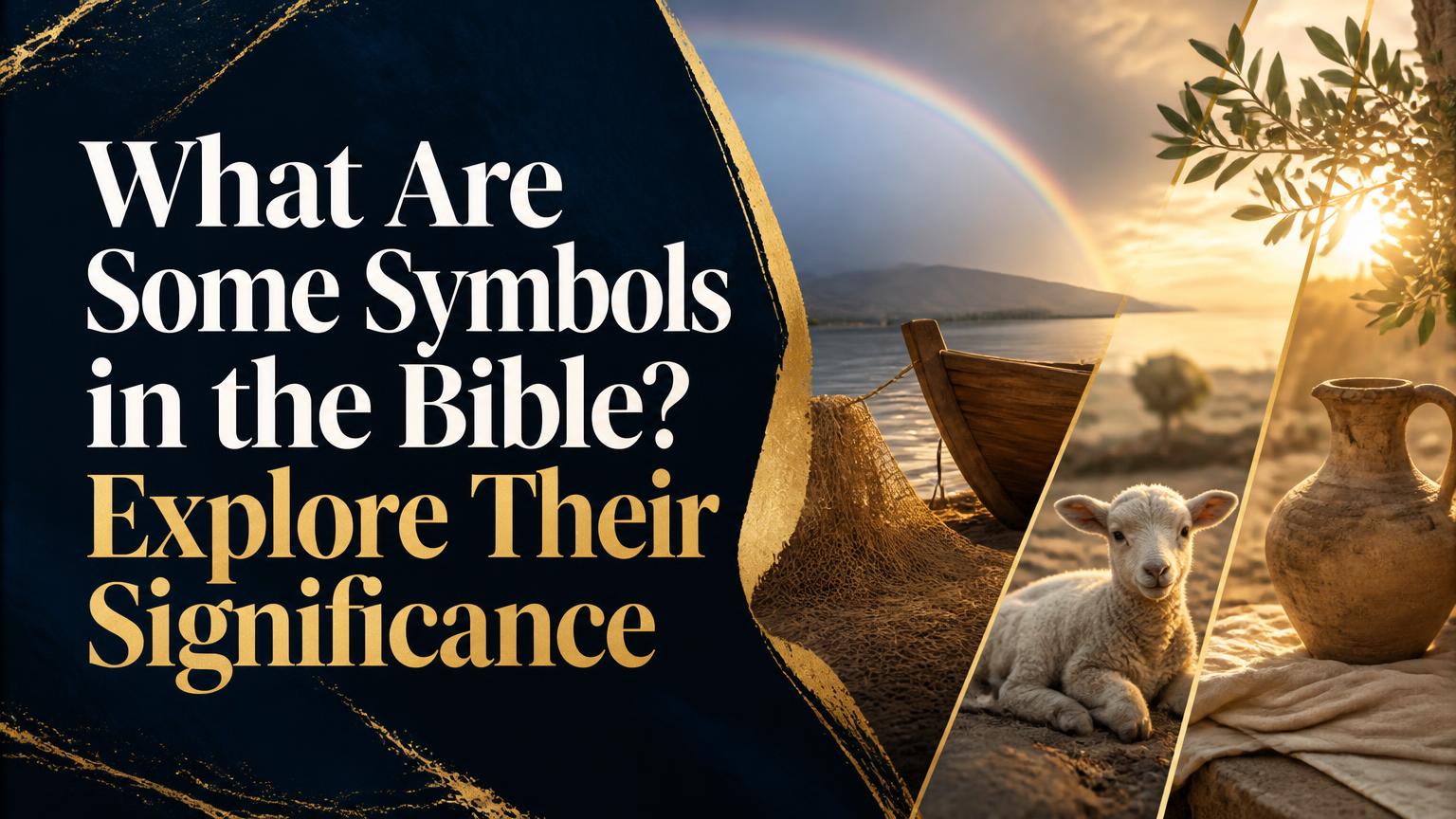
The Bible uses symbols to communicate spiritual truths through familiar people, objects, numbers, colors, animals, events, and natural images. Light can represent God’s revelation, water can suggest cleansing or life, and a shepherd can portray God’s care for His people. However, biblical symbols do not function as a rigid code in which every image always has one meaning. Their significance depends on the passage, its wider biblical context, and the way Scripture itself develops the image.
What Are Some Symbols in the Bible?
Light, Darkness, and Lamps
Light commonly represents God’s presence, truth, holiness, guidance, and salvation. God’s creation of light in Genesis 1 establishes it as a fundamental sign of order and life. Psalm 119:105 describes God’s word as “a lamp” that guides a person’s path, while Jesus calls Himself “the light of the world” in John 8:12. His followers are also called to shine as lights in the world (Matthew 5:14–16).
Darkness can symbolize sin, ignorance, danger, judgment, grief, or separation from God. Yet the meaning depends on context; darkness is not always a simple symbol of moral evil. In the creation account, darkness exists before God brings order through light. The contrast between light and darkness becomes especially clear in John’s Gospel, where light represents Christ and darkness describes humanity’s resistance to truth.
Water, Bread, and Wine
Water has several related meanings in the Bible. It sustains physical life, represents cleansing, and can signify God’s judgment or overwhelming danger. The flood demonstrates water as an instrument of judgment, while the Israelites’ passage through the Red Sea connects water with deliverance. Baptism uses water as a visible sign associated with repentance, cleansing, death to an old way of life, and entrance into a new life with Christ.
Bread often symbolizes nourishment and God’s provision. The manna in the wilderness showed Israel’s dependence on God, and Jesus later identifies Himself as “the bread of life” in John 6. Bread and wine also appear in the Last Supper, where Jesus connects them with His body and blood and with the new covenant (Luke 22:19–20). Their significance is therefore both physical and theological: God sustains His people and establishes fellowship through His saving work.
Shepherds, Sheep, and Lambs
Shepherd imagery communicates guidance, protection, provision, and responsible leadership. Psalm 23 portrays the Lord as a shepherd who provides pasture, restores the soul, leads through danger, and remains present in the darkest valley. Jesus applies the image to Himself in John 10, emphasizing that the good shepherd knows His sheep and lays down His life for them.
Sheep can represent God’s people, particularly their dependence and vulnerability, but the image can also highlight their tendency to wander. Lambs carry additional meaning. Passover centered on a lamb whose blood marked Israel’s deliverance from judgment (Exodus 12). John the Baptist calls Jesus “the Lamb of God” (John 1:29), connecting Him with sacrificial deliverance. Revelation develops the image further, presenting the Lamb as both sacrificed and victorious.
Trees, Seeds, Vines, and Fruit
Trees often signify life, blessing, stability, or access to God’s provision. The tree of life appears in Eden and again in the renewed creation described in Revelation 22, linking the beginning and end of the biblical story. Psalm 1 compares a person who delights in God’s instruction to a fruitful tree planted beside water, suggesting that spiritual stability comes from deeply rooted faithfulness.
Seeds and fruit illustrate growth and visible results. In Matthew 13, Jesus uses seed to explain how God’s kingdom is received, opposed, or allowed to grow in different kinds of hearts. In John 15, the vine and branches represent a continuing relationship with Christ, while fruit signifies the outward result of that connection. Galatians 5:22–23 uses “the fruit of the Spirit” for qualities produced by the Holy Spirit in a believer’s life. The image emphasizes that inner spiritual reality eventually becomes visible in conduct.
Numbers, Colors, and Precious Stones
Certain numbers have recurring symbolic associations, although the Bible does not treat every number as a hidden message. Seven often appears in contexts of completeness, as in the seven days of creation and the repeated sevens in Revelation. Twelve is associated with the people of God through the twelve tribes of Israel and the twelve apostles. Forty frequently marks a significant period of testing, preparation, or transition, as seen in the flood, Israel’s wilderness years, and Jesus’ temptation in the wilderness.
Colors also acquire meaning through context. White may suggest purity, victory, or righteousness; scarlet can be associated with blood, sin, royalty, or wealth; and purple often relates to authority or status. Precious stones appear in the priestly garments of Exodus 28 and in the imagery of the heavenly city in Revelation 21. They can communicate beauty, honor, holiness, identity, and the value of belonging to God. These associations are patterns, not universal definitions that override each passage’s meaning.
Serpents, Dragons, and Other Creatures
Animals in biblical symbolism often retain qualities associated with them in ordinary life. A serpent may represent danger, deception, or evil because of Genesis 3. Revelation 12 explicitly identifies the dragon as “that ancient serpent,” connecting the image with Satan. Yet the serpent does not always carry a negative meaning. In Numbers 21, God uses a bronze serpent as the means through which repentant Israelites receive healing. Jesus refers to that event in John 3:14–15 as a picture connected with His crucifixion.
Other creatures also carry varied meanings. A dove can signify peace, innocence, or the Holy Spirit, especially at Jesus’ baptism. An eagle may suggest strength, swiftness, or God’s care, while lions can represent both dangerous enemies and royal authority. The lesson is significant: a symbol’s meaning comes from its literary and theological setting, not from a simplistic list of fixed definitions.
Rainbows, Stones, and Covenant Signs
The rainbow becomes a sign of God’s covenant with Noah after the flood (Genesis 9:12–17). It represents God’s promise not to destroy the earth with another flood, so its biblical significance is tied to covenant faithfulness and divine mercy. The symbol does not mean that judgment has disappeared; rather, it points to God’s promise within a world that still experiences sin and suffering.
Stones also serve as physical reminders of spiritual events. After Israel crosses the Jordan, twelve stones are set up as a memorial so future generations will ask what they mean (Joshua 4:1–7). The stones preserve communal memory: God acted, His people were delivered, and the story must be taught. In this way, some biblical symbols are not abstract ideas but teaching tools that connect visible objects with remembered acts of God.
Why Does the Bible Use Symbols?
Symbols make spiritual realities concrete. Human beings understand invisible ideas more readily when they are connected to tangible experiences such as walking through darkness, drinking water, eating bread, tending sheep, planting seed, or passing through a storm. Biblical writers use these ordinary realities to explain divine action, human dependence, moral failure, covenant commitment, judgment, hope, and redemption.
Symbols also allow one image to develop across many books of the Bible. The lamb begins in the context of sacrifice and Passover, becomes associated with Christ’s death, and appears in Revelation as the victorious Lamb. This development creates connections between different parts of Scripture without reducing them to identical meanings. A symbol may carry a central theme while gaining additional significance as the biblical story progresses.
The Bible’s symbolic language also communicates through poetry, prophecy, narrative, wisdom literature, and apocalyptic visions. A tree in a psalm does not function in precisely the same way as a tree in Revelation. A number in a historical account may simply record quantity, while the same number in a prophetic vision may contribute to a symbolic pattern. Genre and context therefore matter as much as the image itself.
How to Interpret Biblical Symbols Responsibly
Read the Immediate Context First
The surrounding verses usually provide the strongest clue to a symbol’s meaning. Ask what the image is doing in the passage: Is it describing God’s character, warning against sin, explaining salvation, portraying judgment, or expressing hope? In some cases, the Bible interprets the symbol directly. Revelation 1 explains several features of John’s vision, and Jesus frequently explains His parables to His disciples.
A symbol should not be assigned a meaning merely because it appears elsewhere with that association. Water may represent life in one passage and judgment in another. A lion may portray Christ’s royal authority in one setting and a threatening enemy in another. Immediate context prevents interpretations from becoming detached from the actual text.
Compare Related Passages Without Erasing Their Differences
Recurring images should be studied across Scripture because later passages often echo earlier ones. Comparing Genesis 3, Numbers 21, John 3, and Revelation 12 helps reveal how serpent imagery develops. Reading Psalm 23 alongside John 10 clarifies how Jesus presents Himself as the shepherd promised and portrayed in Israel’s Scriptures.
Comparison must still respect differences in genre and purpose. A prophetic vision, a historical narrative, and a poem may use the same image differently. The goal is not to force every passage into one definition but to identify the themes that Scripture genuinely develops.
Distinguish Biblical Meaning From Speculation
Some interpretations are strongly grounded because Scripture explains them directly or repeats them consistently. Other interpretations are possible but uncertain. This distinction is especially important with numbers, colors, dreams, and apocalyptic details. Not every mention of seven proves a hidden reference to completeness, and not every color carries a fixed theological message.
Responsible interpretation asks whether the proposed meaning fits the passage, agrees with the broader teaching of Scripture, and avoids relying on imaginative associations alone. Biblical symbols point readers toward God’s truth; they are not designed to encourage superstition, fortune-telling, or secret knowledge detached from the text.
Symbols, Metaphors, and Types Are Related but Not Identical
A metaphor compares one thing to another, as when Jesus says, “I am the door” in John 10:9. A symbol is a concrete image, object, action, or sign that points beyond itself to a larger meaning. A type is a person, event, or institution that foreshadows a later and greater fulfillment; Christians commonly understand the Passover, the temple, and aspects of Israel’s kingship in this way.
These categories can overlap, but they should not be treated as interchangeable. Calling every biblical image a “type” may impose a later theological pattern where the text does not clearly provide one. Careful reading identifies what the passage actually claims, what later Scripture explicitly develops, and what remains a reasonable theological inference.
Conclusion
Some of the Bible’s most important symbols include light and darkness, water, bread and wine, shepherds and lambs, trees and fruit, numbers, colors, stones, serpents, and covenant signs. Their meanings arise from the relationship between the image, its immediate passage, and the wider biblical story. The same symbol can carry different meanings in different contexts, so readers should avoid treating biblical imagery as a rigid dictionary or codebook. The best interpretation combines careful attention to the text, comparison with related passages, awareness of literary genre, and humility about what Scripture does and does not explicitly explain.