
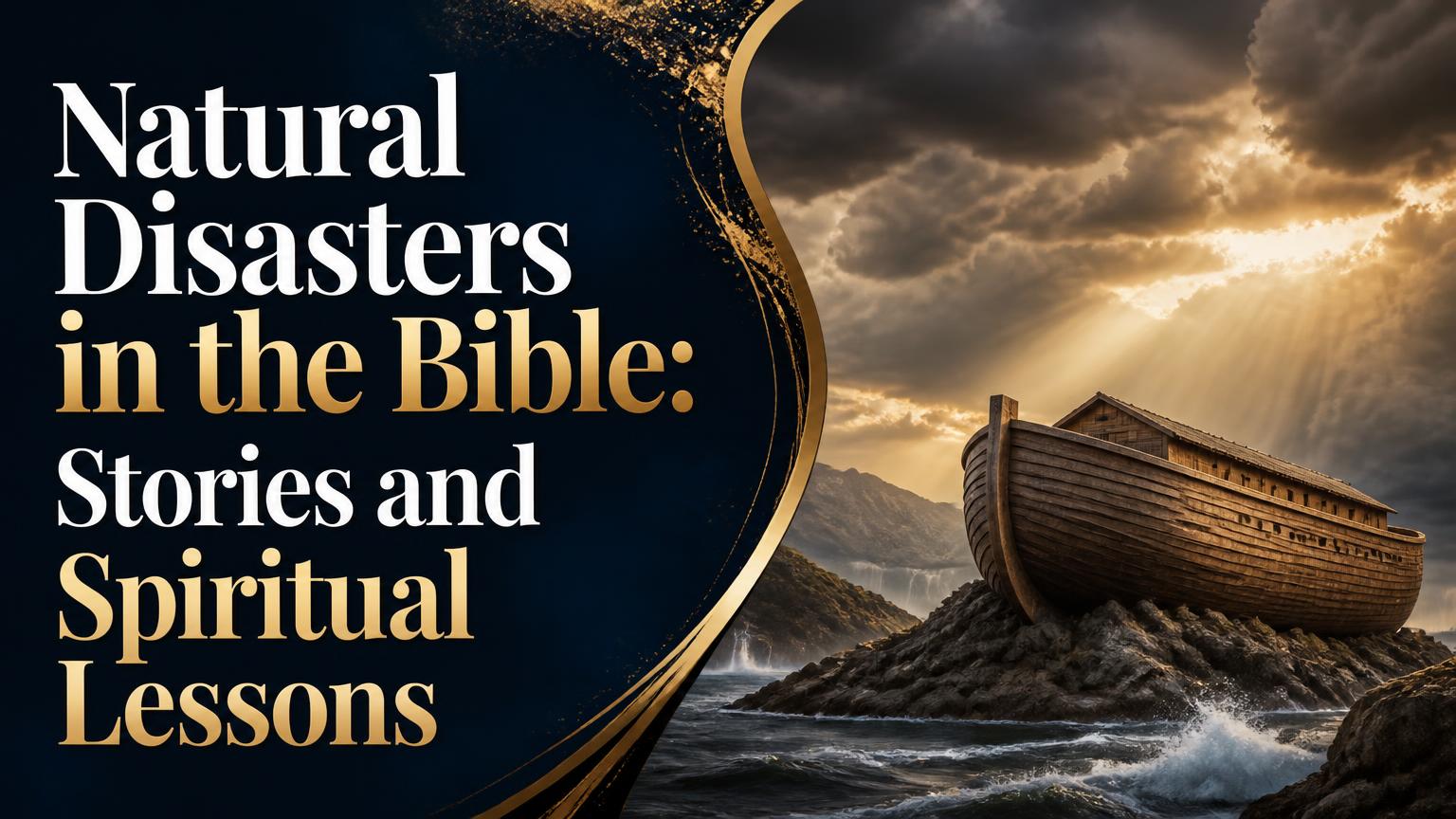
Natural disasters in the Bible are presented through stories of floods, storms, droughts, famines, locusts, hail, and earthquakes. These accounts do more than describe destructive events: they explore human vulnerability, divine judgment, repentance, rescue, faith, and hope. Yet the Bible does not permit a simplistic conclusion that every disaster directly proves the victims’ guilt. Its narratives hold together two truths: creation is affected by sin and disorder, while individual suffering cannot automatically be explained as personal punishment.
Natural Disasters in the Bible: Stories and Spiritual Lessons
The Bible uses disaster narratives to reveal something about God, humanity, and life in a broken world. Some events are explicitly described as acts of divine judgment; others test faith, expose human limitations, or become settings for deliverance. The important question is not merely what happened, but what the biblical writer says the event means.
The Great Flood: Judgment, Rescue, and Covenant
Genesis 6–9 describes a worldwide flood as judgment on widespread violence and corruption. Noah and his family are preserved because Noah responds faithfully to God’s command to build the ark. After the waters recede, God establishes a covenant with Noah and gives the rainbow as its sign.
The flood story therefore contains both severe judgment and gracious preservation. It warns that human violence matters to God, but it also emphasizes that judgment is not the final word. God’s covenant establishes a promise concerning the future of the earth. The account should not be used to claim that every modern flood is a direct punishment for the sins of those affected. Its theological purpose is broader: it portrays the seriousness of evil, the possibility of obedience, and God’s commitment to sustain creation.
Storms at Sea: Fear, Faith, and Jesus’ Authority
Several biblical narratives use dangerous seas to portray human helplessness. In Jonah 1, a violent storm exposes Jonah’s attempt to flee from God. In Mark 4:35–41, Jesus and his disciples cross the Sea of Galilee when a storm threatens their boat. Jesus calms the sea, and the disciples ask, “Who then is this? Even the wind and the sea obey him?”
The two stories are not identical. Jonah’s storm is connected directly to his disobedience, while the disciples’ storm is not presented as punishment for their sin. Together, they show that storms can reveal spiritual realities without having the same cause in every situation. Mark’s account especially teaches that faith does not mean believers will never face danger. It means that Christ’s authority remains greater than the circumstances that make them afraid.
Elijah’s Drought: Idolatry, Dependence, and Renewal
In 1 Kings 17–18, a prolonged drought occurs during the reign of Ahab. The narrative connects the drought with Israel’s worship of Baal and presents it as a challenge to the claim that Baal controlled rain and fertility. Elijah announces the drought, depends on God for provision, confronts the prophets of Baal on Mount Carmel, and later prays for rain.
This story has a specific covenantal and historical setting. It should not be turned into a general rule that drought always indicates idolatry or that a particular person’s prayer can control weather on demand. Its central issue is allegiance: Israel must decide whether to worship the Lord or follow a competing religious power. The return of rain represents both material relief and spiritual restoration, showing how the Bible connects physical provision with dependence on God.
Hail, Locusts, and Darkness in Egypt: Signs of Judgment
The plagues in Exodus 7–12 include hail, locusts, darkness, and other devastating phenomena. The text presents them as signs through which God confronts Pharaoh, judges Egypt’s oppression of Israel, and demonstrates that Egypt’s gods cannot protect the nation. The Passover provides a contrasting image of deliverance for Israel.
These events should not be classified too quickly as ordinary natural disasters. The biblical account intentionally presents them as extraordinary signs within a larger act of redemption. Some phenomena may resemble events known in the natural world, but Exodus emphasizes their timing, sequence, severity, and theological purpose. The main lesson is not that disasters are tools humans can interpret with certainty. It is that political power is accountable to God and that liberation can come through divine action when human authority refuses justice.
Earthquakes: Presence, Judgment, and Liberation
Earthquakes appear at several important moments. Mount Sinai shakes when God gives the law (Exodus 19:18). An earthquake accompanies Jesus’ death in Matthew 27:51, and another appears at the resurrection in Matthew 28:2. In Acts 16:25–26, an earthquake opens the prison doors for Paul and Silas.
The symbolism varies according to the passage. At Sinai, the earthquake conveys divine holiness and majesty. At the crucifixion and resurrection, it marks events of decisive importance in the Christian story. In Acts, it becomes an instrument of liberation. These accounts do not suggest that every earthquake has an obvious spiritual message, but they show how biblical writers may interpret shaking earth as a sign that ordinary human arrangements are not ultimate.
Famine and Locusts: Loss, Repentance, and Compassion
Famine appears throughout Scripture, often in connection with drought, crop failure, war, or economic disruption. Naomi leaves Bethlehem during a famine in Ruth 1:1, while Joseph’s story in Genesis 41 describes a regional famine and an administrative response to anticipated scarcity. Joel 1 portrays a devastating locust invasion that destroys crops and threatens the community’s food supply.
Joel calls the people to lament and return to God, but the book also points toward communal restoration and renewed blessing. Biblical responses to famine include repentance, practical preparation, generosity, and care for the vulnerable. The story of Joseph shows the value of wise planning, while laws concerning gleaning and provisions for the poor show that disaster response is also a matter of justice. Spiritual reflection should therefore lead to concrete compassion rather than blame.
What Natural Disasters Do—and Do Not—Mean in the Bible
Biblical disaster stories resist two opposite errors. One error treats every disaster as meaningless; the other assumes that every victim can be identified as specially guilty. Scripture gives examples of direct judgment, but it also gives examples of righteous people who suffer and communities harmed by events without a stated explanation.
Disaster Is Not Always Proof of Personal Sin
Job’s friends repeatedly argue that Job’s suffering must be the result of hidden wrongdoing. The book rejects their confident explanation. Job suffers despite being described as upright, and the conclusion challenges simplistic attempts to match every tragedy with a specific sin.
Jesus makes a related point in Luke 13:1–5 when he refers to Galileans killed by Pilate and people killed when the tower of Siloam fell. He does not say those victims were worse sinners than everyone else. Instead, he uses the events to confront the living with the urgency of repentance. The distinction matters: a disaster may awaken moral seriousness without giving observers permission to condemn its victims.
Divine Sovereignty Does Not Eliminate Human Responsibility
The Bible affirms God’s sovereignty over creation, but it also commands people to protect, serve, and restore one another. When famine threatens, Joseph organizes food storage. When Jerusalem faces hardship, the early churches collect aid for believers in need (Acts 11:27–30). Jesus identifies care for the hungry, thirsty, sick, and displaced with practical faithfulness in Matthew 25:31–46.
This means theological reflection cannot replace emergency assistance. Prayer, generosity, evacuation, medical care, rebuilding, and wise public policy can all be expressions of love of neighbor. A belief in divine providence should not produce passivity or fatalism. It should strengthen compassion and responsibility.
Apocalyptic Disaster Language Requires Careful Interpretation
Books such as Daniel, Joel, Matthew 24, and Revelation use earthquakes, darkness, cosmic disturbances, plagues, and other disaster imagery. Some passages refer to future judgment; others use prophetic symbolism drawn from earlier biblical language. Christians differ over how particular apocalyptic texts should be interpreted.
A responsible reading therefore considers genre, context, symbolism, and the passage’s original purpose. It is unwise to identify every earthquake, eclipse, pandemic, or storm as the precise fulfillment of a prophetic prediction. Biblical prophecy calls people to faithfulness and watchfulness, but it does not authorize confident date-setting or sensational claims based on current events.
How Christians Can Respond to Disasters
The biblical response begins with lament. Scripture contains prayers that openly describe fear, grief, confusion, and loss, including many psalms. Lament is not unbelief; it brings suffering honestly before God and refuses to pretend that destruction is harmless. The Psalms also connect lament with hope, remembering God’s character when circumstances seem unstable.
A second response is practical love. Christians are called to feed the hungry, welcome the displaced, visit the suffering, share resources, and protect people who are especially vulnerable. Galatians 6:2 describes bearing one another’s burdens, while Hebrews 13:2 and Romans 12:13 commend hospitality and generosity. These commands make disaster response a moral obligation, not merely an opportunity for religious discussion.
A third response is humility. People may ask why a disaster occurred, but they should distinguish what Scripture clearly teaches from what they are merely guessing about a particular event. Faith can affirm God’s presence without claiming to know every hidden purpose. This humility protects grieving people from shallow accusations and directs attention toward mercy, truth, and faithful action.
Conclusion
Natural disasters in the Bible include floods, storms, droughts, famines, locusts, hail, and earthquakes, but their meanings are not uniform. Some function as explicit judgments; others reveal human weakness, invite repentance, display divine authority, or become occasions for rescue. Scripture does not support the claim that every disaster is punishment for the victims’ personal sins. Its consistent call is to take evil seriously, trust God humbly, refuse unjust blame, and respond with compassion. For Christians, the proper response joins lament with hope and spiritual reflection with practical care for those who suffer.