
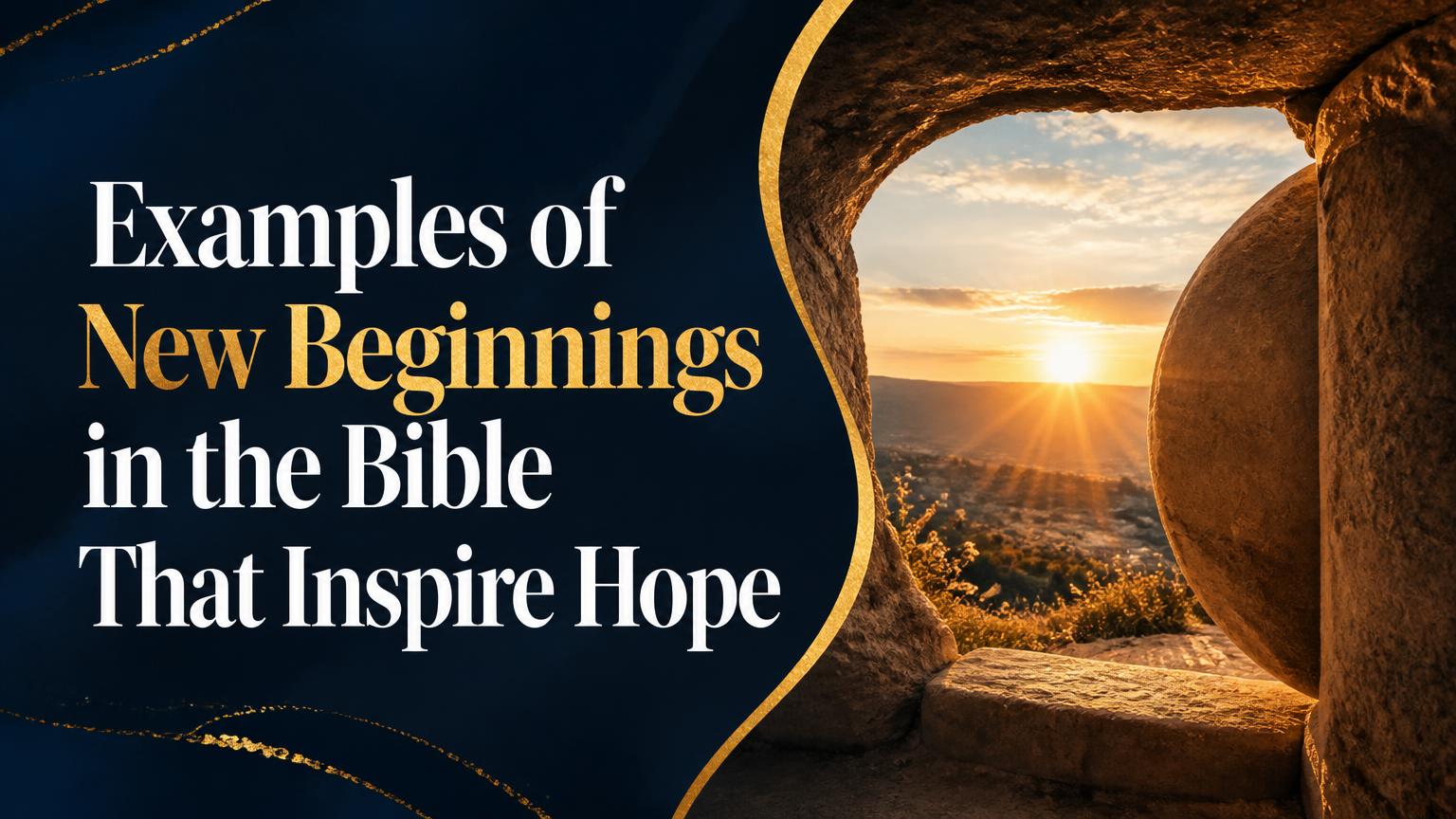
The Bible presents new beginnings as more than fresh circumstances. They are moments when God creates, calls, rescues, forgives, restores, or gives life where human beings see only loss. Some biblical examples involve an entire people, while others focus on one person receiving a new identity or direction. Together, these accounts show that a new beginning may follow failure, grief, judgment, oppression, waiting, or spiritual blindness—and that hope often grows through faithful steps rather than instant transformation.
Examples of New Beginnings in the Bible
The Bible’s examples range from the creation of the world to personal conversion and the promise of a renewed creation. They reveal several ways God brings renewal: by making something new, establishing a covenant, delivering people from bondage, welcoming the repentant, and raising what appeared to be permanently lost.
Creation Brings Order Out of Emptiness
Genesis 1–2 provides the Bible’s first and most comprehensive picture of a new beginning. God creates the heavens and the earth, brings light into darkness, separates and orders the waters, fills the world with life, and creates humanity in his image. Creation is not a repair project performed by a powerless deity; it is the purposeful act of God bringing order, goodness, and life into existence.
This account gives later biblical promises of renewal their foundation. The God who created the world is able to restore what has been damaged. Human hope is therefore connected to God’s creative power, not merely to favorable circumstances.
Noah and His Family Begin Again After the Flood
After the flood, Noah and his family leave the ark and enter a changed world. God establishes a covenant with Noah, promises not to destroy the earth by a flood again, and places the rainbow as a sign of that promise (Genesis 8:15–9:17). This is a new beginning for Noah’s family and, in the biblical narrative, for humanity’s continuing life on the earth.
The story does not claim that human sin has disappeared. Noah’s later failure shows that a changed environment does not automatically produce a changed heart. Yet the covenant demonstrates God’s commitment to preserve life and sustain creation. Hope here rests on divine patience and promise, even when human beings remain imperfect.
Abraham and Sarah Receive a New Future
God calls Abram to leave his homeland and promises to make him a great nation and a blessing to the families of the earth (Genesis 12:1–3). His new beginning involves relocation, uncertainty, and a life organized around a promise he cannot yet see fulfilled. God later changes his name to Abraham and Sarai’s name to Sarah, marking a new identity connected to the covenant.
The birth of Isaac in their old age shows that the promised future depends on God rather than human strength or timing (Genesis 17; 21). Abraham and Sarah’s story encourages people who believe their most meaningful years or opportunities have already passed. Scripture does not present their journey as easy or immediate, but it shows that waiting does not mean God has abandoned his purpose.
Israel Is Delivered From Slavery
The exodus marks a national new beginning. The Israelites move from slavery in Egypt toward freedom, covenant, worship, and life as a distinct people under God’s direction (Exodus 12–14). Their deliverance is not merely a change of location. God gives them a new identity: they are no longer defined only as Pharaoh’s labor force but as a people belonging to him.
The Passover also connects rescue with remembrance. Israel is instructed to mark the event through worship so that future generations will know how God acted. The account offers hope to oppressed people while also showing that freedom begins a demanding journey. Leaving Egypt happens quickly; learning to trust God in the wilderness takes much longer.
Ruth Finds Belonging After Bereavement
Ruth’s new beginning grows out of severe loss. After becoming widowed, Ruth leaves Moab with her mother-in-law Naomi and enters Bethlehem, where she is both a foreigner and a woman without obvious economic security. Her loyalty to Naomi—“Your people shall be my people, and your God my God” (Ruth 1:16)—leads her into an unfamiliar community and a new relationship with Israel’s God.
Through protection, diligent work, and Boaz’s redemption, Ruth receives security and a family. Her story does not erase her grief or her past; it incorporates them into a new future. Ruth becomes the mother of Obed, the grandfather of David, and is later included in Jesus’ genealogy (Matthew 1:5). The narrative shows how faithfulness in ordinary decisions can open the way to restoration.
Israel Returns From Exile
The return from Babylonian exile gives Israel another major new beginning. Jerusalem, the temple, and the community had suffered destruction, but groups of exiles eventually returned and began rebuilding (Ezra 1–6; Nehemiah 1–6). Their work included restoring worship, rebuilding the city walls, teaching the law, and reestablishing communal life.
This restoration was neither instant nor effortless. The returned community faced opposition, discouragement, internal injustice, and the painful awareness that the rebuilt temple did not match the former glory in every respect. Their experience corrects the idea that a new beginning must feel impressive from the start. Sometimes renewal looks like repairing foundations, recovering faithful practices, and continuing despite incomplete results.
Jesus Teaches the Need for New Birth
Jesus tells Nicodemus that a person must be “born again” or “born from above” to see the kingdom of God (John 3:1–8). The language describes spiritual renewal produced by the Holy Spirit, not simply improved behavior or a change in social circumstances. A person may be religious, educated, and morally respected while still needing God to give new spiritual life.
Jesus’ teaching shifts the subject from external opportunity to inward transformation. Christian new beginnings are therefore not limited to moving, changing careers, or recovering from a difficult season. They include repentance, faith, and the Spirit’s work of creating a new relationship with God.
The Prodigal Son Is Welcomed Home
In Jesus’ parable of the lost son, a younger son abandons his family, wastes his inheritance, and eventually returns in disgrace (Luke 15:11–32). His return begins with honest recognition: he admits his failure and goes home without demanding restoration to his former status. The father responds with compassion, embraces him, and celebrates his return.
The parable emphasizes God’s willingness to receive the repentant, but it does not portray sin as insignificant. The son’s choices caused real damage, and the older brother’s resentment reveals that restoration can be difficult for others to accept. The new beginning comes through confession and mercy, not through pretending that the past never happened.
Paul Receives a New Calling
Saul of Tarsus actively opposed the followers of Jesus before encountering Christ on the road to Damascus (Acts 9:1–19). His conversion changes both his allegiance and his mission. He moves from persecuting the church to proclaiming the gospel, eventually becoming known as Paul and serving among the most influential early Christian missionaries.
Paul’s story demonstrates that a new beginning can involve a radically redirected life. It also shows that grace does not mean every consequence disappears immediately. Paul had to receive help from Christians who feared him, and his later ministry involved suffering, opposition, and hardship. His past became part of his testimony, but it no longer controlled the direction of his life.
Jesus’ Resurrection Opens the Way to New Creation
The resurrection of Jesus is the central Christian example of a new beginning. After his crucifixion and burial, Jesus rises from the dead, appearing to his disciples and commissioning them to bear witness (Matthew 28; John 20; 1 Corinthians 15). The resurrection is not merely a hopeful metaphor for emotional recovery; the New Testament presents it as God’s victory over death.
Because Christ is raised, believers are described as new creations in Christ (2 Corinthians 5:17), and the Bible ends with the promise of a renewed heaven and earth (Revelation 21:1–5). Christian hope therefore reaches beyond temporary improvement. It anticipates the complete renewal of human life and creation while also beginning in the present through reconciliation with God.
What Biblical New Beginnings Have in Common
The stories differ in setting and scale, but several consistent principles connect them. Biblical renewal is neither simple optimism nor a promise that every difficult circumstance will change quickly.
God Often Initiates the New Beginning
In creation, the exodus, Abraham’s calling, Jesus’ ministry, and Paul’s conversion, God acts before people can manufacture a solution. This does not make human response irrelevant. Abraham must leave, Israel must walk forward, Ruth must remain faithful, and Paul must accept a new mission. Yet the possibility of renewal begins with God’s initiative.
This pattern protects biblical hope from becoming self-help advice. A new beginning is not based only on willpower or positive thinking. It is a response to God’s grace, promise, calling, or intervention.
Renewal Includes Both Grace and Response
The prodigal son is received because the father is merciful, but the son still has to return home. Ruth is helped by God’s providence, yet she also works faithfully and accepts wise guidance. Israel is delivered from Egypt, but the people must trust God through the wilderness.
These accounts hold together two truths that are often separated. People cannot earn God’s grace, but grace calls for a response. Repentance, obedience, courage, patience, and practical action are common features of biblical new beginnings.
A New Beginning Does Not Erase Every Consequence
The Bible does not teach that a fresh start removes all memories, responsibilities, or hardships. David’s repentance did not undo every result of his sin. Paul’s conversion did not prevent suffering. The returned exiles still faced opposition, and the disciples continued living in a world marked by death and injustice.
A biblical new beginning changes a person’s relationship with God and direction in life, even when circumstances remain difficult. This distinction matters because it prevents disappointment when healing or restoration develops gradually.
New Life Is Connected to Community
Most biblical renewals involve relationships. Ruth finds a place among God’s people. The Israelites become a covenant community. Paul is received by the church. The prodigal son returns to a household, even though the family must work through resentment and reconciliation.
This communal dimension challenges the idea that a new beginning is purely private. Support, accountability, forgiveness, worship, and service often help sustain the change God has begun. Personal renewal can also affect families, churches, and wider communities.
How These Examples Can Shape Christian Hope
Biblical examples of new beginnings are not formulas guaranteeing a particular result. They offer a framework for understanding how God may work through endings, failures, waiting, and restoration.
Bring the Past Into the Light
The biblical characters who experience renewal do not benefit from pretending that nothing happened. The prodigal son acknowledges his failure, Paul recognizes his opposition to the church, and Israel’s restoration follows a period in which the nation must face its unfaithfulness. Honest confession makes room for responsible change.
For a Christian seeking a new beginning, this may involve naming grief, admitting sin, seeking forgiveness, accepting help, or recognizing that a previous season has ended. Avoiding the truth can preserve appearances while preventing genuine healing.
Take the Faithful Next Step
Most new beginnings begin with an ordinary act of obedience: Abraham leaves, Ruth stays with Naomi, Israel walks through the sea, the returned exiles rebuild, and Paul receives baptism and begins learning from other believers. Scripture often presents renewal as a path rather than a single emotional moment.
The next step may be reconciliation, prayer, wise counsel, participation in a church community, practical work, or a necessary boundary. Small faithful actions do not control God’s timing, but they help a person live in response to the hope God provides.
Expect Growth Rather Than Instant Perfection
The Bible’s renewed people remain capable of fear, doubt, conflict, and failure. New life is real, but maturity develops over time. This is especially clear in the disciples, who encounter the risen Jesus yet still need instruction and courage before serving publicly.
Hope becomes more durable when it is based on God’s continuing faithfulness rather than on the expectation of constant emotional confidence. A difficult day does not prove that the new beginning was false. It may be part of learning to live within the new identity and direction God has given.
Conclusion
Examples of new beginnings in the Bible include creation, Noah’s covenant, Abraham’s calling, Israel’s exodus, Ruth’s restoration, the return from exile, spiritual rebirth, repentance, Paul’s conversion, and Jesus’ resurrection. These accounts show that God can bring life out of emptiness, direction out of confusion, and restoration out of failure. They also provide an important qualification: biblical renewal does not always remove consequences or produce immediate comfort.
The deepest Christian hope rests in Jesus Christ, whose resurrection makes new creation possible and whose grace welcomes people into transformed life. A new beginning may start with repentance, a difficult act of faith, or a quiet step toward obedience. Its strength comes not from denying the past but from trusting that God can redeem it and lead people into a faithful future.