
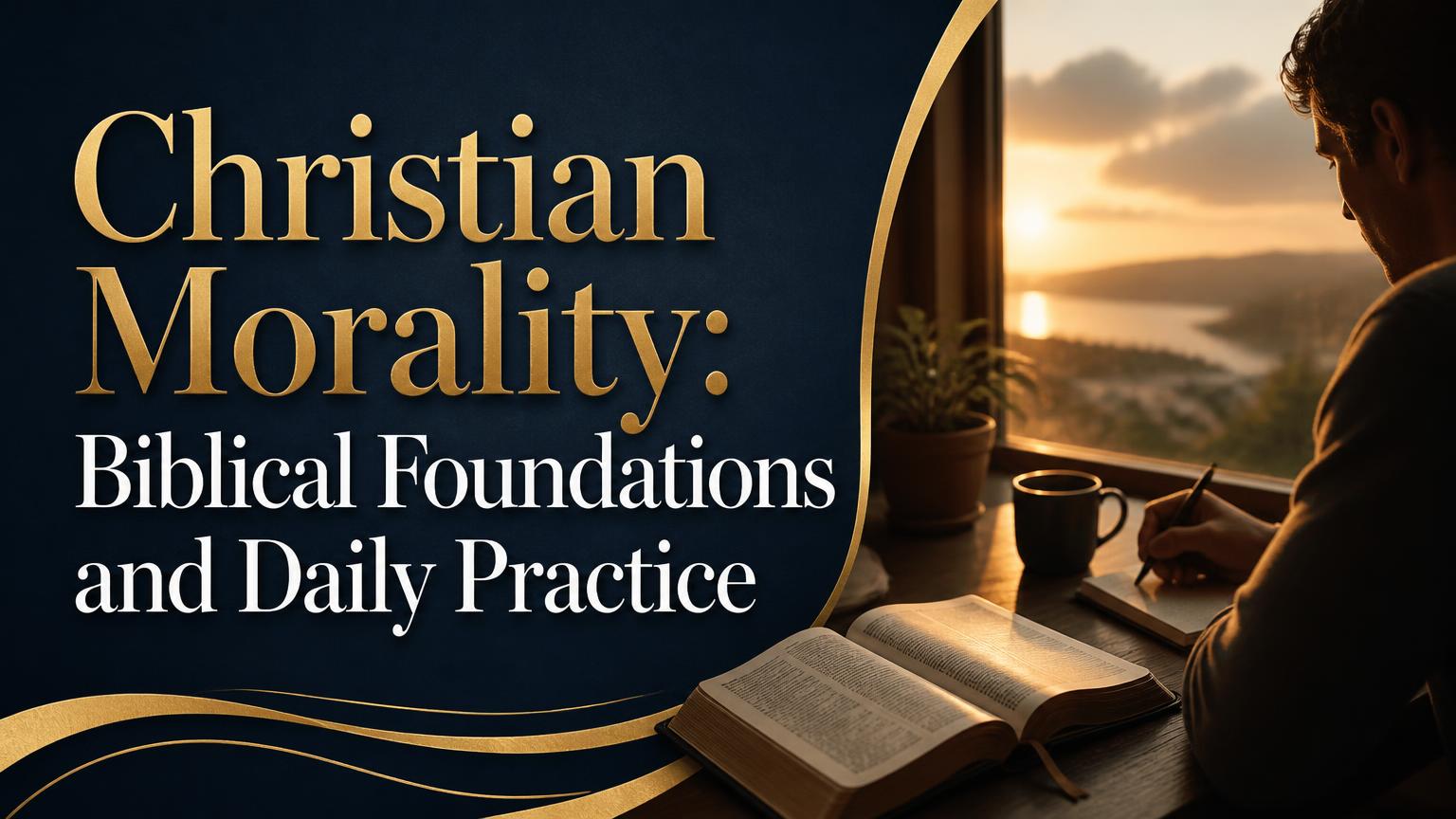
Christian morality is the pattern of thought, character, and conduct that follows from Christian belief about God, humanity, sin, redemption, and the purpose of life. It is not merely a list of prohibitions or a private code of respectable behavior. Christian morality calls people to love God, love their neighbors, pursue holiness, practice justice, tell the truth, show mercy, and imitate Jesus Christ. Its authority comes from God’s revelation, especially Scripture, while its daily practice requires wisdom, conscience, prayer, and the guidance of the Holy Spirit.
What Is Christian Morality?
Christian morality is a response to God’s character and saving work. Because God is understood as holy, truthful, just, merciful, and loving, Christians are called to reflect those qualities in their own lives. Moral conduct does not earn God’s grace; rather, grace creates a new basis for obedience. The central question is not simply, “What rule applies?” but also, “What kind of person is God forming me to become, and what action expresses love of God and neighbor here?”
A Life Ordered Toward Love of God and Neighbor
Jesus identified the two greatest commandments as loving God with one’s whole being and loving one’s neighbor as oneself (Matthew 22:37–40). This does not reduce morality to warm feelings. Biblical love seeks another person’s genuine good, even when that requires truth, correction, sacrifice, patience, or moral courage.
Love gives Christian ethics its organizing principle. Honesty protects a neighbor from deception; sexual faithfulness honors a covenant relationship; generosity responds to material need; forgiveness refuses revenge; and justice resists exploitation. These actions look different in different situations, but each expresses a commitment to God and to the good of other people.
Biblical Authority and the Shape of Moral Life
Christian morality is grounded in Scripture, which presents both explicit commands and broader moral patterns. The Ten Commandments establish foundational concerns such as worship, truthfulness, faithfulness, respect for parents, and the protection of life and property. The prophets connect worship with justice, warning that religious activity is empty when the poor, vulnerable, and oppressed are neglected (Isaiah 1:10–17; Amos 5:21–24).
Jesus deepens rather than discards this moral vision. In the Sermon on the Mount, he addresses not only outward actions but also anger, lust, retaliation, secret motives, generosity, and love for enemies (Matthew 5–7). Christian morality therefore concerns the heart as well as visible behavior. A person can avoid a particular act while still cultivating pride, hatred, deceit, or greed—the inner dispositions that often produce harmful actions.
Grace, Faith, and Obedience
Christianity does not generally treat moral effort as a way to purchase salvation. The New Testament presents salvation as a gift of grace received through faith, while also insisting that genuine faith produces a transformed life. Ephesians 2:8–10 places grace before good works but describes believers as created for those works. James 2 similarly argues that faith without practical action is lifeless.
This relationship prevents two opposite errors. Legalism treats rules, performance, or religious status as grounds for acceptance with God. Moral indifference treats grace as permission to ignore God’s commands. Christian morality rejects both. Obedience is neither a payment for salvation nor an optional decoration; it is the grateful, imperfect response of people being changed by God.
The Biblical Foundations of Christian Morality
The Bible presents Christian morality through several connected foundations rather than through isolated rules. Human dignity, God’s commands, Christ’s example, and the Spirit’s transforming work belong together.
Human Dignity and the Image of God
Genesis 1:26–27 teaches that human beings are made in the image of God. This provides a basis for treating every person as possessing inherent worth, regardless of wealth, ability, ethnicity, age, social position, or usefulness. Christian moral concern therefore extends beyond people who are personally attractive or beneficial to us.
The image of God does not mean that human beings are morally flawless. Scripture also teaches that sin damages human relationships and desires. Christian morality holds both truths together: every person deserves dignity and protection, yet every person also needs repentance, forgiveness, and moral renewal.
The Example and Teaching of Jesus
Jesus is not merely a teacher of moral rules; he is the central model of Christian character. He showed compassion toward the sick and excluded, confronted hypocrisy, welcomed repentant sinners, served his disciples, and accepted suffering without responding through vengeance. Philippians 2:5–8 presents his humility and self-giving as a pattern for believers.
Following Jesus does not mean copying first-century cultural details without interpretation. It means adopting his priorities: faithfulness to God, concern for the vulnerable, truthful speech, purity of intention, mercy toward the repentant, and courage against injustice. His command to love enemies is especially distinctive because it seeks another person’s good without approving that person’s wrongdoing.
The Holy Spirit and Moral Transformation
Christian morality depends on more than willpower. Galatians 5:22–23 describes the “fruit of the Spirit” as love, joy, peace, patience, kindness, goodness, faithfulness, gentleness, and self-control. These qualities describe a formed character, not merely occasional good decisions.
The Spirit’s work does not eliminate effort. Christians practice prayer, confession, Scripture reading, accountability, generosity, and self-control as means through which habits are reshaped. Moral growth is usually gradual. Failure calls for honest repentance and renewed obedience, not despair or self-justification.
How Christian Morality Guides Daily Practice
Christian principles become meaningful through ordinary choices involving speech, money, work, relationships, sexuality, authority, suffering, and the use of time. A sound decision-making process considers both the action itself and the person it is forming.
Discernment, Conscience, and Wisdom
Scripture provides commands and principles, but not a separate verse for every modern decision. Christians therefore use discernment: prayerful reasoning that asks what is true, loving, just, wise, and consistent with biblical teaching. Romans 12:2 connects moral discernment with the renewal of the mind rather than conformity to surrounding pressures.
Conscience is important but not infallible. It is an inner moral awareness that may warn, accuse, or approve, yet it can be misinformed, overly sensitive, or weakened by repeated wrongdoing. A Christian should educate conscience through Scripture, wise counsel, truthful self-examination, and attention to the effects of a proposed action. Personal conviction should not automatically be treated as a universal command for everyone else.
Virtues, Habits, and Moral Formation
Christian morality concerns virtues—stable qualities of character that make faithful action more likely. Honesty, courage, patience, humility, chastity, generosity, and justice become stronger through repeated practice. Conversely, resentment, dishonesty, envy, and self-indulgence can become entrenched through repetition.
This explains why Christian moral teaching addresses seemingly small choices. A single careless word may cause limited harm, but a habit of contempt reshapes a person’s relationships. One generous act does not make someone fully generous, but repeated giving can weaken greed and increase attentiveness to others. Moral formation occurs through patterns, not only dramatic decisions.
Love Expressed Through Concrete Responsibility
Love must be translated into responsible action. A Christian caring for a family member may need to set a boundary rather than enable destructive behavior. A manager may practice justice by paying fairly and refusing discrimination. A neighbor may protect a vulnerable person from abuse rather than remain silent in the name of keeping peace.
Christian love also includes accountability. Forgiveness does not always mean immediate restoration of trust, and mercy does not require ignoring danger or excusing exploitation. Biblical morality joins compassion with truth because sentimental approval can leave harmful conditions unchanged.
Core Areas of Christian Moral Responsibility
The Bible applies moral principles across personal character, relationships, social life, and material stewardship. Christians may disagree about some applications, but the underlying concerns are widely recognizable.
Truthfulness, Integrity, and Self-Control
Christian morality calls for truthful speech, dependable promises, sexual integrity, and control over appetites. Jesus warned against hypocrisy, while Paul instructed believers to reject falsehood and speak truthfully to one another (Ephesians 4:25). Integrity means that public behavior, private conduct, stated beliefs, and actual motives are brought into increasing alignment.
Self-control is not hatred of the body or denial that physical desires are part of human life. It is the ability to govern desires so that they serve love, faithfulness, health, and responsibility rather than controlling the person. This principle applies to sexuality, anger, food, alcohol, digital media, spending, and the pursuit of status.
Justice, Mercy, and Care for the Vulnerable
Christian morality includes concern for people who lack power or protection. Biblical commands repeatedly address widows, orphans, foreigners, the poor, workers, prisoners, and those who are easily exploited. Micah 6:8 summarizes this orientation as doing justice, loving mercy, and walking humbly with God.
Justice has personal and institutional dimensions. Individuals should refuse fraud, prejudice, cruelty, and exploitation, while communities should examine whether their practices unfairly burden the weak. Christians differ about the best political or economic solutions, but concern for the vulnerable is not an optional addition to Christian ethics.
Work, Money, Creation, and Authority
Money is morally significant because it reveals priorities and creates power. Jesus warned against serving both God and wealth (Matthew 6:24), while the New Testament commends honest work, generosity, contentment, and care for dependents. Christian stewardship treats possessions as responsibilities rather than absolute ownership without accountability.
The same principle applies to authority and creation. Leaders are expected to serve rather than dominate, and people are called to cultivate and care for the created world. Christian stewardship does not require one uniform economic or environmental program, but it does challenge wastefulness, greed, abuse of power, and indifference to consequences.
Christian Morality, Legalism, and Moral Relativism
Christian morality differs from legalism because it is not based on accumulating rules to gain God’s approval. Legalism can focus on visible compliance while neglecting mercy, justice, humility, and the condition of the heart. Jesus criticized religious leaders who carefully observed minor practices while neglecting “the weightier matters” of the law (Matthew 23:23). Rules have a place, but they must serve faithfulness rather than replace it.
Christian morality also differs from moral relativism, the view that moral truth is determined entirely by personal or cultural preference. Christians believe that some actions are genuinely right or wrong because moral reality is accountable to God. At the same time, Christians should distinguish biblical conviction from personal custom. Not every cultural preference has the authority of Scripture, and disagreements about difficult applications require humility, careful interpretation, and charity.
Where Christian Traditions Disagree
Christians share central moral commitments but do not agree on every issue. Differences may concern war and pacifism, capital punishment, economic systems, political responsibility, divorce and remarriage, bioethics, gender roles, sexual ethics, and the relationship between church and state. These disagreements arise from different interpretations of biblical texts, theological traditions, understandings of natural law, and judgments about practical consequences.
That diversity does not mean Christian morality has no stable content. Love of God and neighbor, truthfulness, justice, mercy, holiness, care for the vulnerable, and faithfulness to Christ remain central across historic Christianity. Responsible moral reasoning should state where Scripture is clear, recognize where interpretation is contested, and avoid treating every inherited cultural opinion as a direct command from God.
Conclusion
Christian morality is a God-centered way of life shaped by Scripture, fulfilled in the teaching and example of Jesus, and enabled by the Holy Spirit. It includes rules, but it cannot be reduced to rules; it concerns motives, habits, relationships, institutions, and practical responsibilities. Its central direction is love that is truthful, holy, sacrificial, and attentive to justice. Grace means that Christians do not obey in order to purchase acceptance, yet grace also calls them into genuine transformation. Faithful practice therefore combines conviction with humility, moral courage with mercy, and personal holiness with concern for the good of others.