
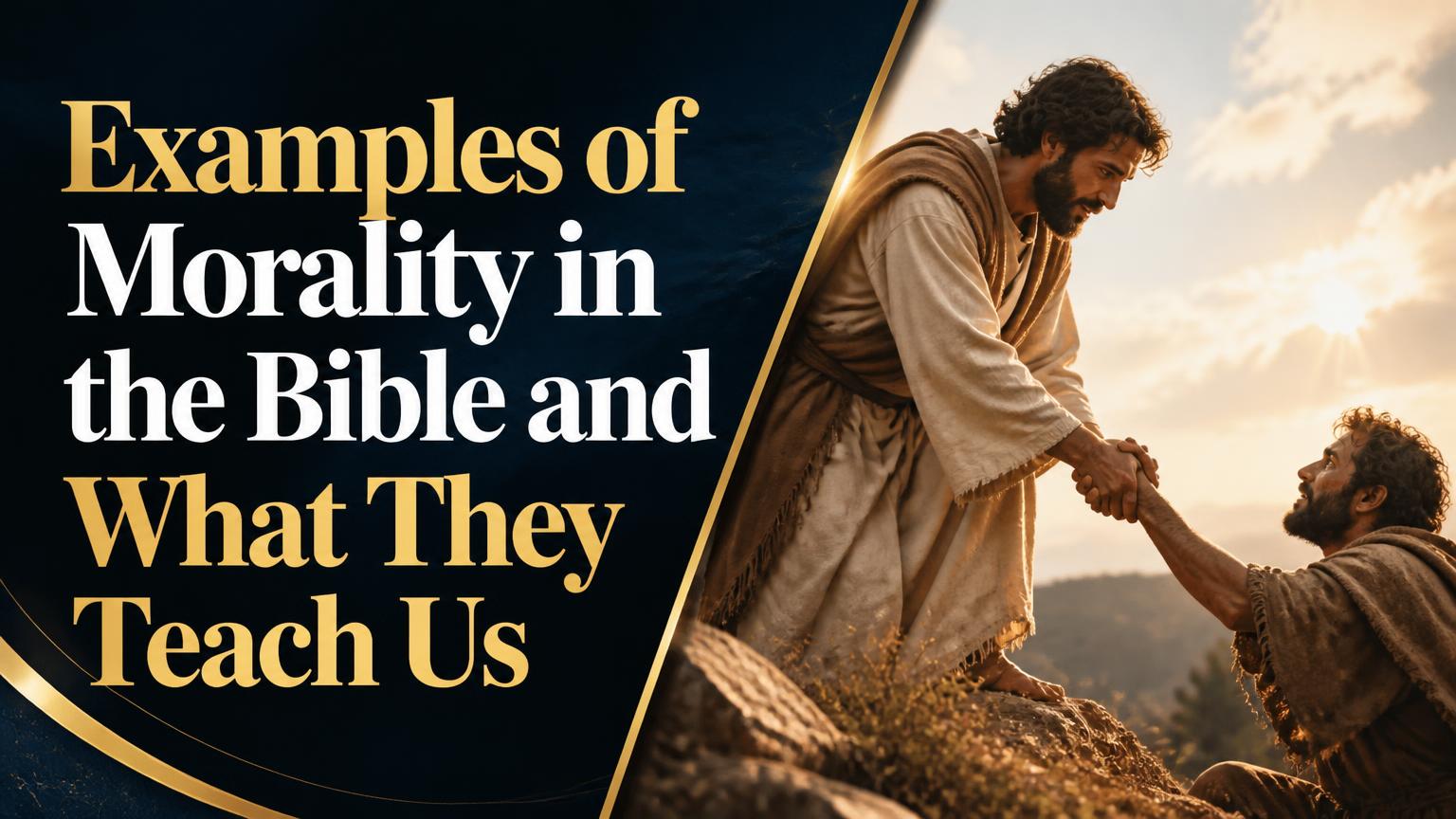
Examples of morality in the Bible include love for God and neighbor, honesty, sexual faithfulness, justice, mercy, humility, generosity, repentance, and concern for vulnerable people. Biblical morality is not limited to a list of prohibitions. It addresses both outward behavior and inward motives, asking how people treat God, other people, possessions, power, truth, and responsibility. The examples below show how these principles appear in biblical laws, teachings, stories, warnings, and acts of repentance.
Examples of Morality in the Bible
Love God and Love Your Neighbor
Jesus identified love as the central moral commandment. When asked about the greatest commandment, he joined Deuteronomy 6:5—loving God with one’s whole being—with Leviticus 19:18, which commands love for one’s neighbor. He stated that all the Law and the Prophets depend on these two commands (Matthew 22:37–40).
This teaching gives biblical morality a unifying principle. Love for God involves worship, loyalty, gratitude, and obedience; love for a neighbor involves seeking that person’s good rather than exploiting, deceiving, or harming them. Love in this context is not merely an emotion. It is expressed through truthful speech, generosity, forgiveness, protection of the vulnerable, and practical responsibility. Romans 13:8–10 similarly presents love as the fulfillment of the law because genuine love refuses to wrong another person.
Follow the Ten Commandments
The Ten Commandments in Exodus 20:1–17 provide one of the Bible’s clearest moral frameworks. They address worship, idolatry, misuse of God’s name, rest, family responsibility, murder, adultery, stealing, false testimony, and coveting. Their scope shows that morality includes both public actions and private desires.
The commandments were given within Israel’s covenant relationship with God, so Christians differ over how specific Old Testament laws apply under the new covenant. Even so, the moral concerns they express remain central throughout Scripture: worship should not be replaced by idols, human life should be protected, marriage should be honored, property and truth should be respected, and envy should not govern the heart. The commandments therefore connect social conduct with spiritual allegiance.
Examine the Inner Life, Not Only Outward Behavior
In the Sermon on the Mount, Jesus deepens several familiar moral commands. He connects murder with anger and contempt, adultery with lust, and retaliation with a call to respond to enemies through love and prayer (Matthew 5:21–48). He also warns against practicing religious acts merely to gain public admiration (Matthew 6:1–18).
Jesus is not saying that outward conduct does not matter. He is showing that behavior grows from the heart. A person may avoid visible wrongdoing while cultivating hatred, greed, pride, or lust internally. Biblical morality therefore includes motives, attitudes, intentions, and secret choices. This does not make morality impossible; it reveals why moral transformation must involve character rather than simple rule-keeping.
Show Mercy Across Social and Religious Boundaries
The parable of the Good Samaritan illustrates morality through practical compassion (Luke 10:25–37). A wounded man is ignored by two religious figures but helped by a Samaritan, a member of a group viewed with hostility by many Jews of that period. The Samaritan treats the man’s wounds, transports him to safety, pays for his care, and promises to cover further expenses.
Jesus uses the story to redefine “neighbor” as someone toward whom mercy is shown, not merely someone who belongs to one’s community. The moral action is costly, inconvenient, and concrete. It involves noticing suffering, crossing social boundaries, using personal resources, and accepting responsibility. The parable challenges morality that remains theoretical or limited to people who are similar, respectable, or likely to return the favor.
Choose Integrity Under Temptation
Joseph provides an example of moral resistance in Genesis 39. After being repeatedly pressured by Potiphar’s wife, Joseph refuses an adulterous relationship. His explanation is both relational and theological: such an act would betray his master and constitute sin against God (Genesis 39:9).
Joseph’s example shows that integrity often requires refusing an opportunity that promises immediate pleasure or advantage. His decision does not produce an immediate reward; he is falsely accused and imprisoned. The story therefore does not present morality as a guaranteed path to short-term success. It portrays faithfulness as doing what is right even when the person may suffer because of it. His conduct also illustrates that moral choices are shaped by how a person understands responsibility, loyalty, and the presence of God.
Practice Justice, Mercy, and Humility
The prophets repeatedly connect morality with social justice. Micah 6:8 summarizes the Lord’s requirements as doing justice, loving mercy, and walking humbly with God. Amos condemns religious observance that coexists with exploitation and calls for justice to flow like a river (Amos 5:21–24).
These passages reject the idea that religious activity can compensate for oppression, dishonesty, or indifference to suffering. Biblical morality includes treatment of the poor, immigrants, widows, workers, debtors, and people without social power. Laws concerning gleaning allowed the poor and foreign residents to gather food from fields (Leviticus 19:9–10). Justice, however, is held together with mercy and humility. Biblical morality seeks fairness without turning moral concern into self-righteousness or cruelty.
Demonstrate Repentance Through Restitution
Zacchaeus illustrates how moral change affects the use of money and power (Luke 19:1–10). As a chief tax collector, he was associated with a system that could enable exploitation. After encountering Jesus, Zacchaeus announces that he will give half his possessions to the poor and repay four times what he has taken unjustly.
The story presents repentance as more than regret or verbal confession. When wrongdoing has caused material harm, changed conduct may include restitution, generosity, and accountability. Zacchaeus does not purchase salvation through charitable acts; rather, his actions provide visible evidence that his relationship with wealth and other people has changed. The narrative holds grace and responsibility together: Jesus welcomes the sinner, and that welcome produces a new pattern of life.
Learn From David’s Moral Failure
The Bible also uses moral failure as a warning. David’s adultery with Bathsheba and his arrangement of her husband Uriah’s death are recorded in 2 Samuel 11–12. David possessed authority, religious status, and military success, but those advantages did not excuse his abuse of power. The prophet Nathan confronts him through a parable, and David is forced to recognize the seriousness of his actions.
This account prevents readers from treating biblical heroes as morally flawless. David’s repentance is significant, but it does not erase the damage caused by his choices or remove all consequences. The story teaches that power can intensify moral responsibility, that hidden wrongdoing can harm many people, and that accountability must reach even respected leaders. Biblical morality includes forgiveness, but forgiveness should not be confused with denial of harm or exemption from consequences.
How to Read Biblical Moral Examples Correctly
A biblical story does not automatically approve every action it records. Scripture describes deception, violence, betrayal, abuse, and injustice as well as faithfulness and courage. The fact that a person such as David, Samson, or Jacob appears in the biblical narrative does not mean that every decision they make is a model to imitate. Readers must distinguish between a behavior the text commands, a behavior it describes, and a behavior it exposes as sinful or destructive.
Context also matters. The Ten Commandments belong to Israel’s covenant at Sinai, wisdom literature often teaches through poetry and general principles, prophetic passages address particular forms of social and religious corruption, and Jesus’ teachings reveal the depth and direction of God’s moral purposes. Responsible interpretation considers the immediate passage, the wider biblical witness, the people involved, and the difference between a specific ancient circumstance and a universal principle.
Biblical morality also cannot be separated from grace. Scripture calls people to obedience, but it does not present moral achievement as a way to manipulate God into accepting them. In Christian teaching, forgiveness and new life come through God’s grace, while obedience is the response that should follow. Ephesians 2:8–10 expresses this relationship by distinguishing salvation as God’s gift from the good works believers are created to practice.
What These Examples Teach About Moral Living
These examples show that biblical morality has both personal and communal dimensions. Personal integrity matters in situations involving sexuality, anger, greed, speech, and temptation. At the same time, morality extends to economic behavior, leadership, treatment of outsiders, care for the poor, and the use of power. A person cannot claim faithfulness to God while deliberately harming neighbors or ignoring injustice.
They also show that biblical ethics joins truth with mercy. Moral standards are real, but the Bible does not present moral seriousness as permission for pride, exclusion, or vindictiveness. The Good Samaritan demonstrates compassion, Zacchaeus demonstrates restitution, and Jesus’ teaching emphasizes forgiveness without treating wrongdoing as harmless. Faithful moral action therefore requires discernment: it must identify wrong clearly while seeking restoration where restoration is possible.
Conclusion
Examples of morality in the Bible teach that ethical faithfulness involves far more than avoiding a short list of forbidden actions. The Bible calls people to love God and their neighbors, tell the truth, practice justice, resist temptation, protect the vulnerable, use power responsibly, and repent when they cause harm. Its stories also show that respected people can fail and that forgiveness does not remove the need for accountability. Taken together, these examples present morality as a transformed way of living—one shaped by love, integrity, humility, mercy, and responsibility before God.