
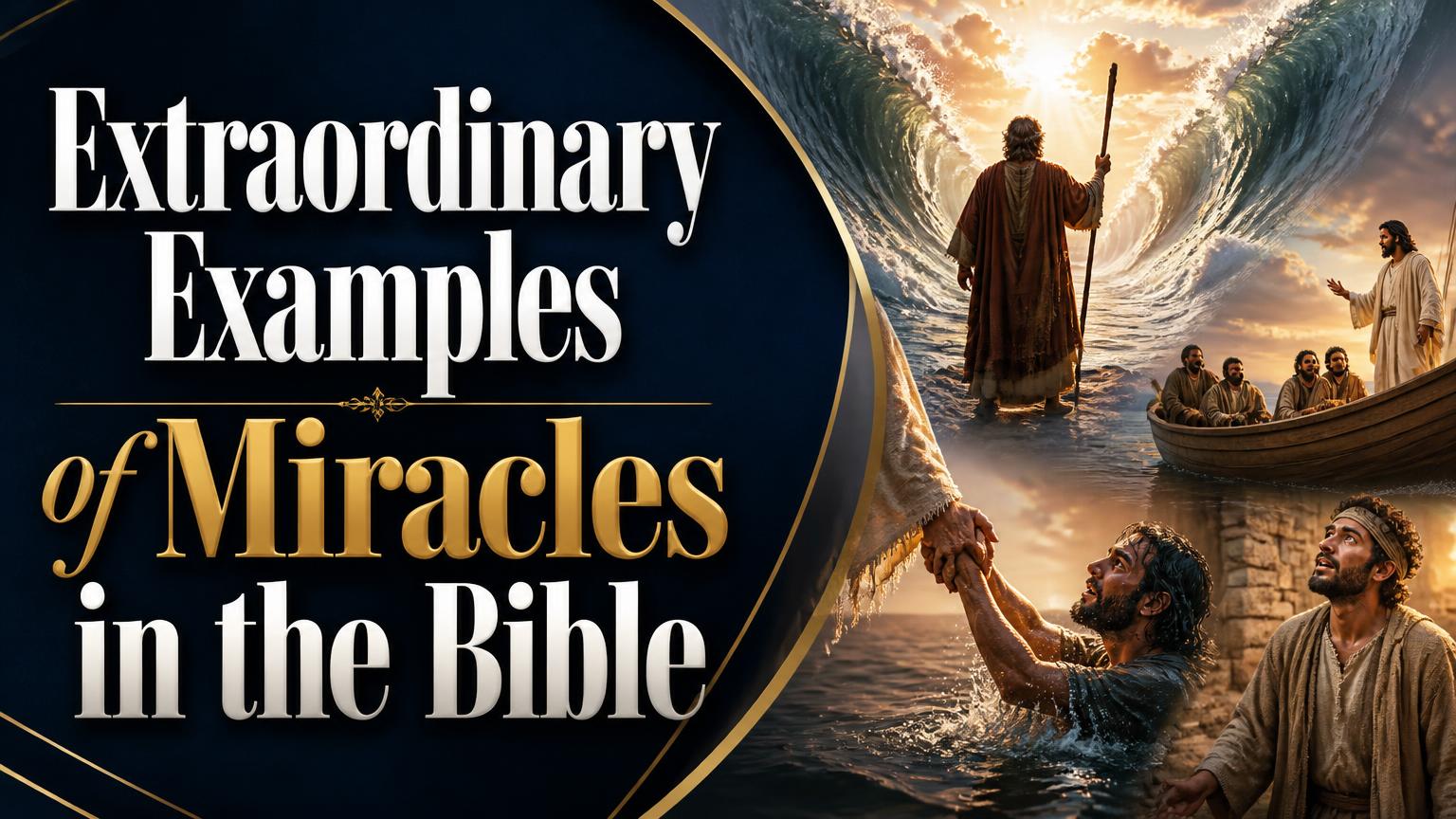
Examples of miracles in the Bible include the parting of the Red Sea, manna from heaven, Jesus’ healings, the feeding of the five thousand, Lazarus being raised from the dead, and Jesus’ own resurrection. Biblical miracles are presented as extraordinary acts of God that reveal his power, communicate his purposes, deliver his people, and advance the story of redemption. They are not treated as magic or spectacle; their meaning is connected to the character of God and the message surrounding each event.
The Bible records miracles in many forms: creation and judgment, healing and deliverance, provision and protection, control over nature, resurrection, and supernatural signs accompanying God’s messengers. Understanding these examples requires attention both to what happened and to why the biblical writers included each account.
Examples of Miracles in the Bible
The Bible’s miracle accounts span both Testaments. Some display God’s authority over nature, while others meet immediate human needs or confirm a prophetic message. The greatest concentration of miracles appears in the ministries of Moses, Elijah and Elisha, Jesus, and the apostles.
The Plagues of Egypt and the Red Sea
God’s deliverance of Israel from Egypt contains several connected miracles. Through Moses, God brought ten plagues upon Egypt, including darkness, hail, locusts, and the death of the firstborn. These judgments challenged Pharaoh’s authority and demonstrated that the Lord—not Egypt’s rulers or idols—controlled creation and history (Exodus 7–12).
The best-known event followed Israel’s departure: God divided the Red Sea so that the Israelites crossed on dry ground, then allowed the waters to return over the pursuing Egyptian army (Exodus 14). The miracle was therefore both judgment and salvation. It rescued a vulnerable people who had no military means of escape and established the Exodus as a foundational demonstration of God’s covenant faithfulness.
Manna and Water in the Wilderness
During Israel’s wilderness journey, God provided food called manna and brought water from a rock. Manna appeared regularly so that the people could gather enough for each day, with special instructions concerning the Sabbath (Exodus 16). The provision taught Israel dependence: they could not secure their future through ordinary resources alone, yet they were expected to trust God’s instructions rather than hoard anxiously.
Water from the rock appears in Exodus 17 and Numbers 20. Although the two accounts occur in different settings, both show God sustaining the nation in an environment where ordinary water supplies were unavailable. These miracles are also connected with Israel’s complaints and unbelief, reminding readers that divine provision does not mean the absence of human discontent or spiritual testing.
Miracles Through Elijah, Elisha, and Daniel
The ministries of Elijah and Elisha include miracles that confront idolatry, provide for the vulnerable, and confirm prophetic authority. Elijah’s contest with the prophets of Baal on Mount Carmel culminated when fire from the Lord consumed the sacrifice, altar, and water surrounding it (1 Kings 18). The event was meant to answer the central question of the contest: who is truly God?
Elijah also saw a widow’s small supply of flour and oil endure during famine (1 Kings 17). Elisha multiplied a widow’s oil, healed Naaman of his leprosy, and was associated with the raising of a child (2 Kings 4–5). Daniel’s preservation in the lions’ den presents another form of miraculous deliverance: God shut the lions’ mouths and protected Daniel because of his faithfulness (Daniel 6). These accounts emphasize that God can act publicly through signs or quietly through protection and provision.
The Virgin Birth of Jesus
Matthew and Luke describe Jesus’ conception as a work of the Holy Spirit rather than the result of an ordinary human father (Matthew 1:18–25; Luke 1:26–38). The virgin birth is significant because it identifies Jesus’ origin as a direct act of God and connects his arrival with promises concerning the Messiah.
This account differs from a healing miracle or a rescue from danger. It occurs before Jesus’ public ministry and establishes the identity of the person whose later works will reveal God’s kingdom. Christians therefore understand the virgin birth as part of the incarnation: the eternal Son of God entered human history as Jesus Christ.
Jesus’ Healings and Exorcisms
The Gospels record Jesus healing blindness, paralysis, leprosy, fever, chronic bleeding, and other conditions. He also cast out demons, demonstrating authority over spiritual evil. Examples include the healing of the paralytic in Mark 2, the cleansing of a leper in Mark 1, and the restoration of sight to Bartimaeus in Mark 10.
These miracles addressed real suffering, but they also carried theological meaning. Jesus often connected healing with faith, forgiveness, compassion, or the arrival of God’s kingdom. In Mark 2, for example, Jesus healed a paralyzed man after declaring his sins forgiven. The physical healing served as visible evidence of his less visible authority to forgive sins. The Gospels do not present Jesus’ miracles as impersonal displays of power; they show him responding to people with mercy while revealing who he is.
The Feeding of the Five Thousand and Calming the Storm
Jesus’ feeding of the five thousand is the only miracle, apart from the resurrection, recorded in all four Gospels (Matthew 14; Mark 6; Luke 9; John 6). With five loaves and two fish, Jesus fed a large crowd and left twelve baskets of fragments. The account shows compassion for hungry people, but it also recalls God’s provision of bread in the wilderness and presents Jesus as one who provides abundantly.
On another occasion, Jesus calmed a storm on the Sea of Galilee by rebuking the wind and waves (Mark 4:35–41). The disciples responded with fear and asked who he was, since even the wind and sea obeyed him. The miracle therefore reveals authority over nature and raises a question about Jesus’ identity, rather than functioning merely as a rescue story.
The Raising of Lazarus
In John 11, Jesus raised Lazarus after Lazarus had been dead and buried for four days. Jesus deliberately arrived after Lazarus’s death, allowing the event to become a public sign rather than a private recovery from illness. He wept with Lazarus’s sisters, demonstrating genuine compassion, and then called Lazarus from the tomb.
The miracle points directly to Jesus’ teaching: “I am the resurrection and the life” (John 11:25). It illustrates his authority over death while also anticipating his own resurrection. Lazarus eventually would die again, so his restoration was not the same as Jesus’ resurrection into an imperishable life. That distinction matters: Lazarus was returned to ordinary mortal existence, whereas the resurrection of Jesus became the central Christian proclamation.
The Resurrection of Jesus
The resurrection of Jesus is the defining miracle of the New Testament. The Gospels report that Jesus was crucified, buried, and found alive on the third day; they also describe appearances to his disciples and others (Matthew 28; Luke 24; John 20–21). The resurrection is not presented as a mere recovery from unconsciousness but as God’s victory over death and vindication of Jesus.
According to 1 Corinthians 15, the resurrection is essential to Christian faith because it confirms the message about Jesus, grounds the hope of believers, and anticipates the future resurrection of God’s people. It also differs from every other biblical resurrection account: those individuals returned to mortal life, while Jesus rose as the firstfruits of a transformed and everlasting resurrection life.
Pentecost and Miracles Through the Apostles
At Pentecost, the Holy Spirit came upon Jesus’ disciples, and they spoke in other languages as a sign accompanying the proclamation of the gospel (Acts 2). The event enabled people from different nations to hear about God’s works and marked a significant stage in the formation of the church.
Acts also records healings, deliverances, visions, imprisonments overcome, and other signs through the apostles. Peter healed a lame man at the temple (Acts 3), and Paul restored a man after a serious fall (Acts 20:7–12). These miracles are attributed to God rather than treated as evidence of independent apostolic power. They supported the apostolic witness, served people in need, and demonstrated that the risen Christ continued working through his representatives.
What Makes an Event a Biblical Miracle?
A biblical miracle is an extraordinary event attributed to God’s direct action and presented as meaningful within his purposes. The Bible uses several related ideas, including “sign,” “wonder,” and “mighty work.” A sign points beyond itself, a wonder evokes astonishment, and a mighty work displays power. These dimensions often overlap, but they show why biblical miracles are more than unusual events.
Miracles are also distinct from magic. Magic attempts to manipulate supernatural forces through techniques, formulas, or personal control. Biblical miracles depend on God’s authority and initiative. They do not make human beings divine or give religious leaders unlimited power. Even when God works through Moses, Elijah, Jesus’ disciples, or another person, the biblical narrative identifies God as the true source of the act.
Not every extraordinary event in Scripture is labeled a miracle in exactly the same way. Some passages emphasize providence—God working through ordinary circumstances—while others describe unmistakable signs. The distinction does not mean that ordinary provision is less important. Biblical faith often recognizes both dramatic intervention and faithful care through everyday means.
Why Biblical Miracles Matter
Miracles Reveal God’s Character
Miracles reveal attributes such as power, mercy, holiness, faithfulness, and authority. The Red Sea displays deliverance and judgment; manna displays provision; Jesus’ healings display compassion; and the resurrection displays victory over death. The event and the divine character it reveals should therefore be interpreted together.
Miracles Confirm God’s Message
In several biblical accounts, a miracle supports the authority of a messenger or confirms a revelation. Moses’ signs authenticated his mission before Israel and Pharaoh. Elijah’s fire addressed false worship. Jesus’ works supported his claim to bring God’s kingdom, although the Gospels also show that observers could witness miracles and still refuse to believe.
A miracle is not a substitute for moral and spiritual response. The biblical writers never suggest that seeing power automatically produces faith. The meaning of a sign depends on whether people recognize what it reveals about God.
Miracles Point Toward Redemption
Many miracles anticipate a larger work of salvation. The Exodus becomes a pattern of deliverance, healings preview restoration, the raising of Lazarus points toward resurrection, and Pentecost marks the spread of the gospel to the nations. Their significance extends beyond the immediate benefit because they fit into the Bible’s larger movement from creation, through sin and judgment, toward renewal.
How to Read Miracle Accounts Carefully
Miracle stories should be read in their literary and historical context rather than isolated as collections of spectacular events. Ask who performs the act, who receives help, what problem is being addressed, what message accompanies the sign, and what response the account calls for. These questions prevent a reader from reducing a miracle to either entertainment or a bare argument.
The accounts also require distinctions. A healing is not the same as resurrection, an apostolic sign is not the same as Jesus’ authority, and a symbolic number or repeated pattern should not automatically be treated as a hidden code. Christian traditions differ over how miracles occur today and how particular passages should be interpreted, but the biblical accounts consistently direct attention away from human fascination with power and toward God’s identity, purposes, and saving work.
Conclusion
The examples of miracles in the Bible range from creation, judgment, and deliverance in the Old Testament to Jesus’ healings, control over nature, provision, resurrection, and the signs surrounding the early church. Their purpose is not simply to make the biblical story dramatic. They reveal God’s character, confirm his message, meet human need, confront evil, and point toward redemption. The resurrection of Jesus stands at the center because it turns the Bible’s many acts of deliverance into the foundation of Christian hope: God has authority not only to rescue from danger but ultimately to defeat death itself.