
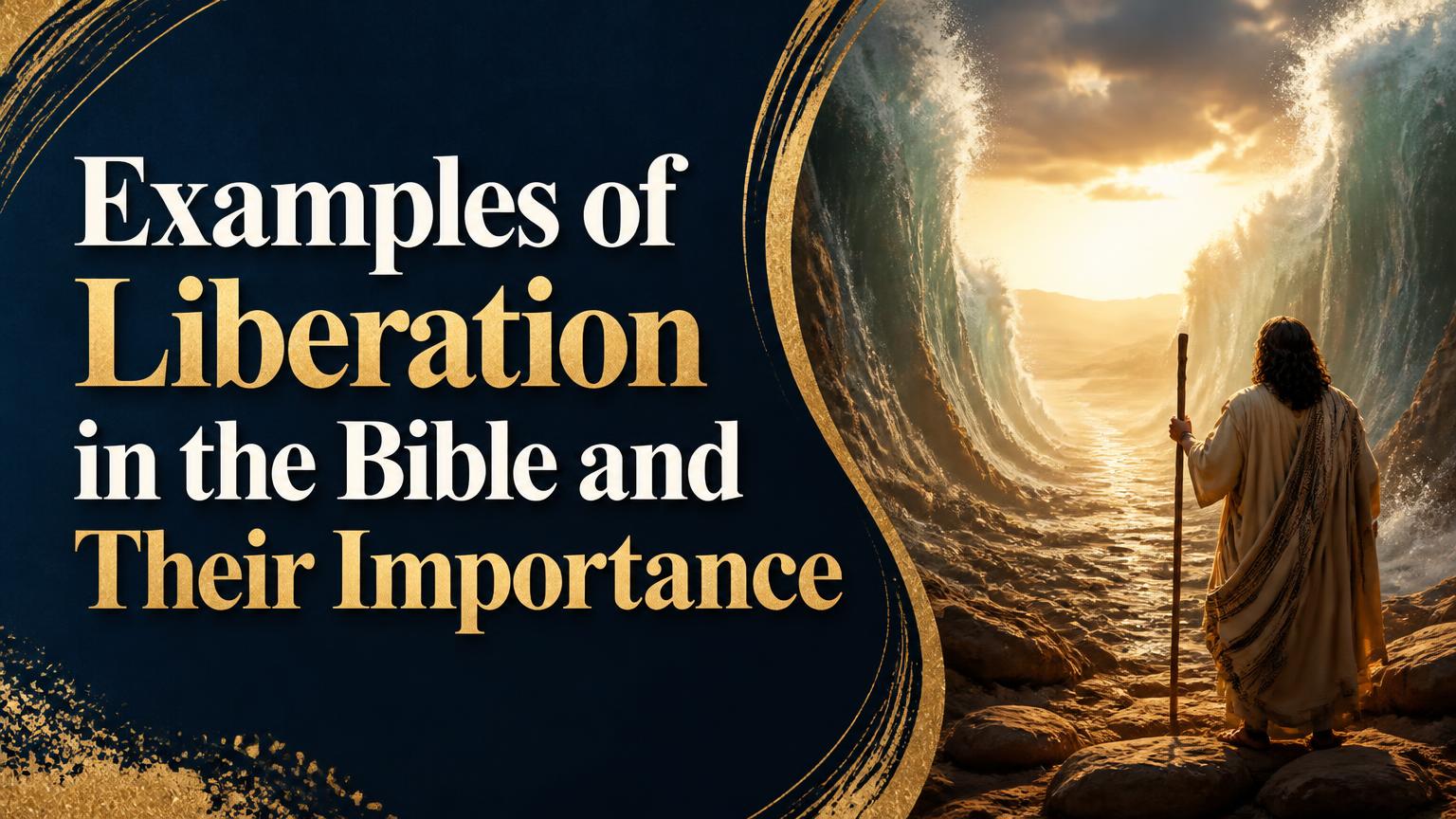
The Bible presents liberation as God’s work of rescuing people from oppression, bondage, sin, fear, injustice, and death. These examples include Israel’s exodus from Egypt, the return from Babylonian exile, Esther’s deliverance of the Jewish people, Jesus’ ministry to the oppressed, and the release of prisoners in Acts. Biblical liberation is broader than political independence or escape from personal hardship: it restores people to worship, community, dignity, righteousness, and purposeful freedom under God.
Examples of Liberation in the Bible
The Bible’s liberation stories move from national deliverance to personal restoration and, ultimately, the promise of a renewed creation. Some accounts describe freedom from physical captivity, while others focus on sin, demonic oppression, social exclusion, or the fear of death.
Israel’s Liberation from Egypt
The exodus is the Bible’s foundational account of liberation. The Israelites were enslaved under Pharaoh, and God heard their cries, remembered his covenant, and sent Moses to lead them out of Egypt (Exodus 1–14). The plagues, Passover, crossing of the Red Sea, and destruction of Pharaoh’s army all demonstrate that liberation came through God’s power rather than Israel’s military strength.
Yet the exodus was not merely a transfer from one location to another. God freed Israel so that the people could worship him, live under his covenant, and become a distinct community. Exodus therefore connects liberation with responsibility: freedom from Pharaoh became a call to faithful obedience, justice, and care for the vulnerable.
Jubilee and the Release of the Oppressed
Leviticus 25 describes the Year of Jubilee, when Israelites held in servitude were released and ancestral land was returned to its original families. The system limited the possibility that poverty, debt, or economic misfortune would permanently destroy a family’s place in Israel. It expressed the principle that the land ultimately belonged to God and that Israelites were not to treat one another as permanent property.
The Jubilee was not simply an economic policy detached from worship. It reflected God’s ownership, mercy, and concern for social restoration. The practice also provides important background for Jesus’ announcement of “liberty to the captives” and “the year of the Lord’s favor” in Luke 4:16–21. Whether or not Israel consistently practiced Jubilee, its vision shaped biblical expectations of release and restoration.
Return from Babylonian Exile
After Jerusalem fell, Babylon carried many people of Judah into exile. The exile involved political defeat, displacement, loss of the temple, and a crisis of national identity. The later return under Persian rule, described in books such as Ezra and Nehemiah, became another major example of God liberating and restoring his people.
This liberation unfolded in stages rather than through one dramatic escape. Persian policy permitted Jewish exiles to return, rebuild the temple, and reestablish life in Jerusalem. The biblical writers interpret this restoration as evidence that God had not abandoned his covenant. At the same time, the returned community remained politically subordinate to Persia, showing that biblical liberation can be genuine without meaning complete national independence.
Esther’s Rescue of the Jewish People
The book of Esther describes the threatened destruction of the Jewish population within the Persian Empire. Haman arranged a decree authorizing their annihilation, but Esther and Mordecai acted courageously within the royal court. Esther risked approaching the king, exposed Haman’s plot, and helped secure a new decree allowing the Jewish people to defend themselves (Esther 3–9).
God’s name is not explicitly mentioned in Esther, which makes the story distinctive. Nevertheless, the narrative emphasizes providence through timing, courage, political wisdom, and responsible action. The Jewish people’s liberation did not come through a miraculous plague or an angelic rescue. It came through people using their positions, taking risks, and acting for the protection of others. The account also shows that liberation may require both moral courage and practical strategy.
Jesus Announces Liberty to the Captives
In the synagogue at Nazareth, Jesus read from Isaiah and applied the passage to his own ministry: good news for the poor, release for captives, recovery of sight, freedom for the oppressed, and the year of the Lord’s favor (Luke 4:16–21). His announcement gathers together spiritual, physical, social, and economic dimensions of restoration.
Jesus did not lead an armed revolt against Rome, but neither did he reduce liberation to an invisible inner experience. He healed the sick, welcomed outcasts, forgave sinners, confronted abusive religious power, fed the hungry, and restored people to community. His kingdom challenged every form of bondage while placing reconciliation with God at its center. The ministry of Jesus shows that biblical liberation changes both a person’s relationship with God and that person’s place among other people.
Freedom from Sin, Death, and Fear
The New Testament presents sin as a form of slavery. Jesus says that everyone who practices sin is a slave to sin, but that the Son can bring genuine freedom (John 8:34–36). Paul develops the same idea in Romans 6, where believers are described as transferred from slavery to sin into a new life of obedience to God.
This freedom does not mean unlimited self-direction or immediate perfection. It means release from sin’s controlling authority and movement into a new allegiance. Hebrews 2:14–15 also describes Christ as freeing people who were held in slavery by the fear of death. Through Jesus’ death and resurrection, liberation reaches beneath visible circumstances to the powers that distort human desire, condemn the guilty, and produce fear. The Christian claim is not that suffering has already disappeared, but that sin and death no longer have the final authority.
Deliverance from Demonic and Physical Bondage
Several Gospel accounts portray Jesus liberating people from forces that have damaged their bodies, minds, relationships, or ability to participate in community. In Mark 5, Jesus frees a man tormented by many demons. The man had lived among tombs, injured himself, and become socially isolated; afterward, he is clothed, mentally restored, and able to sit with Jesus.
This story shows that deliverance is more than the removal of an affliction. Jesus restores a person’s dignity and social identity. Similarly, Jesus describes the bent-over woman in Luke 13:10–17 as someone whom Satan had bound for eighteen years, then heals her publicly. These accounts should not be used to label every illness or disability as demonic. They do show, however, that Jesus opposes forces that deform human life and restores people to wholeness.
Prisoners Released in Acts
Acts contains several vivid examples of physical liberation. An angel leads Peter out of prison in Acts 12, while in Acts 16 an earthquake opens the doors of the prison holding Paul and Silas. The second account is especially significant because Paul and Silas do not simply flee. When the jailer assumes the prisoners have escaped and prepares to kill himself, Paul stops him. The event leads to the jailer and his household hearing the gospel and being baptized.
The story connects liberation with compassion and justice. Paul’s freedom is not used to abandon a vulnerable person to despair. Later, Paul also insists that the magistrates acknowledge that he and Silas, Roman citizens, were publicly beaten without a proper trial. Biblical liberation therefore includes rescue from danger, concern for the oppressor or bystander, and the pursuit of lawful accountability.
What Biblical Liberation Means
The examples above use different forms of language and address different historical situations. Together, they establish several principles that prevent the idea of liberation from becoming either too narrow or too vague.
Liberation Comes from God and Leads to Covenant
In the exodus, God initiates rescue because he hears suffering and remembers his promises. In the prophets, God promises restoration to exiles and freedom to the oppressed. In the Gospels, Jesus announces liberation as part of God’s reign. Human courage and action matter, but the Bible treats them as responses to God’s purposes rather than replacements for them.
Because liberation comes from God, it has a moral direction. The Israelites were not freed merely to pursue individual advantage; they were freed to become God’s covenant people. Deuteronomy repeatedly connects their experience of slavery with the command to treat widows, orphans, foreigners, and the poor justly.
Liberation Restores People to Community
Biblical freedom rarely ends with a person simply escaping. The exiles return to rebuild a community. The man freed in Mark 5 is restored to social life. The healed woman in Luke 13 joins the gathered worshipers. The jailer in Acts moves from fear and violence toward hospitality and faith.
This pattern matters because oppression often isolates people as well as controlling them. Liberation therefore includes restored relationships, dignity, belonging, and participation. A person may be physically free yet remain excluded, exploited, or ashamed. Biblical restoration addresses those deeper consequences rather than treating escape as the entire goal.
Freedom Has a Purpose
Paul warns believers not to use freedom as an opportunity for selfishness but to serve one another through love (Galatians 5:13). This principle clarifies the difference between biblical freedom and unrestricted autonomy. The Bible does not present liberation as the right to do whatever one wants. It presents freedom as the recovery of the ability to love God and neighbor.
That purpose affects personal and public life. People liberated from destructive habits are called to practice righteousness. Communities rescued from oppression are expected to establish justice. Christians who receive mercy are commanded to extend mercy. Freedom becomes mature when it produces responsibility rather than another form of domination.
Liberation Is Already Present but Not Yet Complete
The Bible describes real liberation in the present while also anticipating a final deliverance. Jesus forgives sins, heals bodies, and releases people from destructive powers, yet his followers still suffer, face persecution, and eventually die. Romans 8 describes creation itself as waiting for freedom from decay, and Revelation 21–22 looks forward to a world without death, mourning, pain, or the curse.
This “already and not yet” pattern prevents two opposite mistakes. Christians should not dismiss present injustice by saying that only heaven matters. Nor should they claim that every believer will receive complete physical, political, or financial freedom now. Biblical hope motivates action in the present while recognizing that God’s final liberation will be completed in the renewal of all things.
How Christians Should Apply Biblical Liberation
Biblical liberation has practical implications, but applying it requires balance. The Bible addresses both spiritual bondage and social oppression, so neither dimension should erase the other.
Confront Injustice Without Ignoring Spiritual Bondage
The exodus, Jubilee, the prophets, and Jesus’ ministry show that God cares about exploitation, poverty, exclusion, and abuse. Christians should therefore resist the habit of describing every social problem as merely a spiritual issue that requires no practical response. Advocacy, generosity, protection of the vulnerable, honest leadership, and care for neighbors belong within biblical discipleship.
At the same time, social change alone cannot solve the human problems the Bible calls sin. Greed, pride, violence, and deceit can survive changes in institutions because they also operate within human hearts. Christian action should seek both just conditions and transformed character.
Reject Both Political Reductionism and Spiritual Reductionism
Biblical liberation cannot be reduced to a modern political program. Scripture includes national deliverance, personal conversion, physical healing, resistance to oppression, and final resurrection, but these themes do not map perfectly onto one contemporary ideology. Christians may disagree about political strategies while still affirming the biblical obligation to protect human dignity and oppose injustice.
The opposite error is spiritual reductionism: treating liberation as only freedom from guilt while ignoring imprisonment, hunger, exploitation, racism, abuse, or social exclusion. Jesus’ ministry holds these concerns together. Reconciliation with God is central, but it produces tangible love, justice, mercy, and service.
Practice Freedom Through Love and Responsibility
A Christian response to liberation can include repentance from destructive patterns, generosity toward people in need, hospitality, protection of the vulnerable, and truthful opposition to abuse. Romans 12:13 calls believers to share with those in need and practice hospitality; James 1:27 connects pure religion with care for the vulnerable and moral integrity.
These actions should respect the dignity and agency of the people being helped. Biblical liberation is not control disguised as charity. It seeks wise assistance, fair opportunity, protection from harm, and restored participation. It also recognizes limits: Christians should not promise miraculous deliverance in every situation or blame sufferers for lacking faith.
Conclusion
The examples of liberation in the Bible range from Israel’s release from Egypt and the restoration of exiles to Jesus’ deliverance of the oppressed and the apostles’ release from prison. Together, they show that liberation is God’s rescue from forces that enslave, destroy, isolate, and condemn. It includes physical, social, moral, and spiritual dimensions, but it always has a purpose: restored relationship with God and responsible love toward others.
Biblical liberation is therefore neither merely private nor merely political. It calls Christians to confront injustice, resist sin, care for vulnerable people, and hope for the final renewal promised in Christ. Present acts of deliverance matter, even though complete freedom from death and corruption awaits God’s future kingdom.