
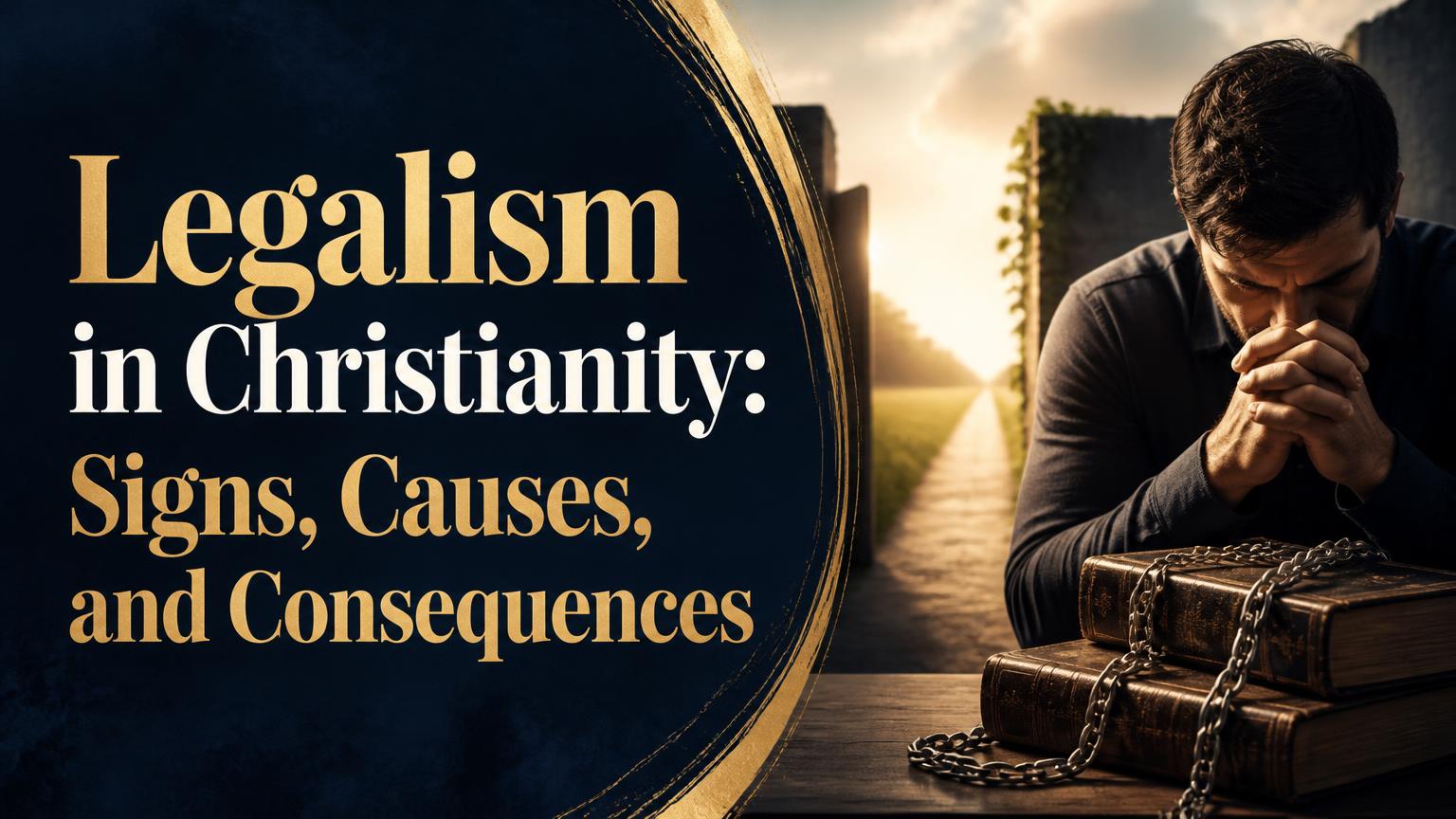
Legalism in Christianity is the attempt to gain, keep, or demonstrate acceptance before God through human rule-keeping rather than through God’s grace received by faith. The word can also describe adding man-made requirements to biblical teaching, judging other believers by those requirements, or emphasizing outward conformity while neglecting love, mercy, and inward transformation. Christianity teaches obedience, holiness, and moral responsibility—but these are responses to grace, not a substitute for it.
Legalism in Christianity
What Legalism Means
Legalism is not simply taking sin seriously or trying to obey Scripture. In Christian theology, it usually refers to treating religious performance as the basis of justification, spiritual status, or acceptance with God. A legalistic person may believe, consciously or unconsciously, that God will accept them because they have achieved a sufficient level of morality, religious activity, doctrinal correctness, or conformity to a particular community’s customs.
Legalism may also arise when people treat human traditions as though they carry the same authority as Scripture. A church or individual can move beyond biblical instruction by making personal preferences, cultural practices, or denominational customs tests of genuine faith. The result is a system in which people are measured by standards God has not given.
The term “legalism” is not used as a formal technical category in the Bible, so Christians sometimes apply it differently. Nevertheless, the underlying concerns appear throughout Scripture: self-righteousness, reliance on works for justification, burdensome human traditions, outward religion without inward faithfulness, and judgmental treatment of others.
Legalism and Biblical Obedience Are Not the Same
Biblical obedience is the grateful response of people who trust God. Legalism treats obedience as a way to purchase God’s favor or establish superiority over others. The outward action may look similar, but the foundation and purpose are different.
Ephesians 2:8–10 holds these truths together: salvation is by grace through faith, not a human achievement, yet believers are created in Christ for good works. Romans 3:28 emphasizes justification by faith apart from works of the law, while Romans 6 rejects the idea that grace gives Christians permission to continue in sin. Grace therefore does not eliminate obedience; it changes its source, meaning, and goal.
A useful distinction is this: legalism says, “I obey so that God will accept me,” while the gospel says, “Because God has shown mercy in Christ, I seek to obey him.” Christian obedience remains serious, but it is no longer an attempt to earn a status that God gives through Christ.
Common Signs of Legalism
Legalism can appear in individuals, churches, families, or entire religious cultures. Its signs are often clearest when external performance becomes more important than faith, character, and love.
Common indicators include:
- Acceptance based on performance: A person feels worthy before God only when meeting a personal or religious standard.
- Human rules treated as divine commands: Customs about clothing, worship style, entertainment, food, schedules, or social behavior become tests of salvation or maturity without clear biblical support.
- Judgment based on appearances: Visible conformity receives more attention than honesty, compassion, repentance, or integrity.
- Fear-driven spirituality: People obey mainly to avoid rejection, shame, punishment, or loss of status rather than from trust and love.
- Comparison and spiritual competition: Religious activity becomes a way to rank believers and identify who is “more serious.”
- Neglect of mercy: Rules are defended even when applying them ignores compassion, justice, restoration, or a person’s actual circumstances.
- Confession without assurance: Even sincere believers can never rest because they believe one more achievement is necessary before God will receive them.
These signs do not prove that every strict practice is legalistic. The key questions are whether the practice is biblical, what authority is being claimed for it, and whether it is being used to earn acceptance or condemn people whom Scripture does not condemn.
Why Legalism Harms Christians
Legalism distorts the gospel because it shifts confidence away from God’s grace and toward human achievement. Those who appear successful may become proud, while those who struggle may fall into despair. Both responses misunderstand the basis of salvation: neither superiority nor failure determines a Christian’s standing before God.
It can also produce hypocrisy. When a community rewards appearance more than truth, people learn to hide weakness rather than confess sin and seek help. Moral problems may continue beneath an impressive exterior because maintaining a reputation becomes more urgent than genuine repentance.
Legalism damages relationships as well. It encourages suspicion, criticism, and exclusion, particularly when secondary issues become tests of faithfulness. Jesus criticized religious leaders who carefully observed certain practices while neglecting “the weightier matters of the law: justice and mercy and faithfulness” (Matthew 23:23). His point was not that small matters never matter, but that obedience becomes malformed when external precision replaces love for God and neighbor.
What the Bible Teaches About Grace and Works
Jesus’ Critique of External Religion
Jesus did not condemn obedience to God’s commands. He confronted religious practices that elevated human tradition, displayed piety for public approval, or used religious authority to burden others. In Mark 7:8–13, he warned that tradition can effectively set aside God’s command when people treat human regulations as spiritually ultimate.
In Matthew 23, Jesus described leaders who emphasized visible religious behavior while neglecting justice, mercy, and faithfulness. His criticism addressed the relationship between inward character and outward conduct. Religious actions are not automatically wrong, but they become corrupt when they are performed to gain admiration, conceal sin, or claim righteousness apart from humble dependence on God.
This distinction prevents a common mistake: reducing Jesus’ teaching to “rules are bad.” Jesus called people to repentance, love, truth, prayer, generosity, and obedience. His opposition was directed toward distorted religion, not toward holiness itself.
Paul’s Teaching on Faith and the Law
Paul strongly rejected the idea that people are justified by “works of the law.” In Romans and Galatians, he argues that sinners are made right with God through faith in Jesus Christ, not by using religious observance to establish their own righteousness. This was especially important in debates about whether Gentile converts needed to adopt Jewish identity markers and ceremonial practices.
Paul’s teaching does not mean that God’s moral will is irrelevant. In Galatians 5:13–14, freedom from condemnation is not permission for selfishness; believers are called to serve one another through love. In Romans 12, Paul connects God’s mercy with transformed conduct. Good works are therefore the fruit of reconciliation with God, not the price paid to obtain it.
Christian traditions differ in how they explain the relationship among faith, works, sanctification, and final judgment. They broadly agree, however, that human works cannot replace Christ’s saving work and that genuine faith produces a changed life.
The Role of Christian Freedom
The New Testament gives believers freedom in matters where Scripture permits legitimate differences, but freedom is not self-centered independence. Romans 14 addresses disputes over food and special days, urging Christians not to despise or condemn one another over disputable matters. First Corinthians 8 adds that knowledge must be governed by love because personal liberty can harm another believer.
Christian freedom therefore has two boundaries: obedience to God’s revealed truth and love for other people. A practice may be permissible for one believer but unwise in a particular setting if it encourages another person to sin or violates conscience. Conversely, one Christian’s personal restriction should not automatically become a universal command for everyone else.
This framework helps distinguish conviction from legalism. A personal conviction can guide faithful discipleship; legalism turns that conviction into a measure of salvation, maturity, or worth for all believers.
Why Legalism Develops
Fear, Insecurity, and the Desire for Control
Legalism often grows from the desire for certainty. Clear rules can feel easier to manage than the demanding work of trusting God, examining motives, applying wisdom, and loving difficult people. A person may use religious performance to quiet guilt or create a sense of control over spiritual life.
Communities can develop the same pattern. Leaders may create extensive regulations to protect good values, but later generations may forget the original purpose and treat the regulations themselves as sacred. What began as a pastoral safeguard can become a boundary marker that determines who belongs.
The answer is not to reject all guidance. Mature Christian teaching explains why a practice matters, distinguishes biblical commands from prudential applications, and leaves room for repentance, growth, and conscience.
Confusing Sanctification With Justification
Justification concerns a person’s standing before God: sinners are accepted through God’s grace because of Christ, received through faith. Sanctification concerns the continuing process by which believers are shaped into holiness. Legalism confuses these categories by treating spiritual growth as the basis of acceptance rather than the result of acceptance.
This confusion can operate in either direction. Some people try to earn salvation through moral effort. Others, after trusting Christ, assume that every failure proves God has rejected them. The gospel addresses both errors: Christ is the foundation of reconciliation, and the Holy Spirit continues forming believers in obedience.
Growth still requires discipline, correction, and perseverance. But these practices are means by which God forms his people, not payments that force God to love them.
Group Identity and Cultural Tradition
Religious communities naturally develop shared habits, language, and standards. These can strengthen fellowship, but they can also become identity markers that divide “faithful” people from “unfaithful” people. The danger increases when cultural preferences are described as the only Christian position.
A healthy church distinguishes among biblical commands, wise applications, historical traditions, and individual preferences. It can teach convictions clearly without claiming that every disagreement is a gospel issue. That distinction protects both truth and Christian unity.
How to Resist Legalism Without Rejecting Holiness
Christians can resist legalism by repeatedly returning to the gospel: acceptance with God rests on Christ, not on a record of personal achievement. This produces humility because no believer can boast, and it produces assurance because salvation does not depend on flawless performance. It also creates room for honest confession, since failure can be brought into the light rather than hidden to preserve an image.
Practical discernment involves asking several questions: Is this requirement clearly taught in Scripture? If it is an application rather than a direct command, is it being presented honestly as an application? Does it cultivate love, truth, justice, self-control, and faithfulness? Does it protect people from genuine harm, or mainly enforce conformity? Are people being restored when they fail, or merely shamed and excluded?
Holiness should remain concrete. Christians are called to reject sin, keep their promises, practice sexual integrity, care for the vulnerable, forgive others, speak truthfully, and worship God. Yet holiness cannot be reduced to a visible checklist. The New Testament joins moral transformation to the work of the Spirit, love of neighbor, renewal of the mind, and conformity to Christ’s character.
Conclusion
Legalism in Christianity is the distortion of obedience into a system of earning acceptance, enforcing human standards as divine law, or judging people by outward conformity while neglecting faith and love. Biblical Christianity does not oppose holiness or disciplined obedience. It teaches that salvation is received by grace through faith and that good works follow as the fruit of a transformed life. The essential distinction is therefore not between rules and no rules, but between obedience that flows from grace and performance used to secure worth, status, or salvation. Recognizing that distinction helps Christians pursue genuine holiness without fear-driven religion or self-righteousness.