
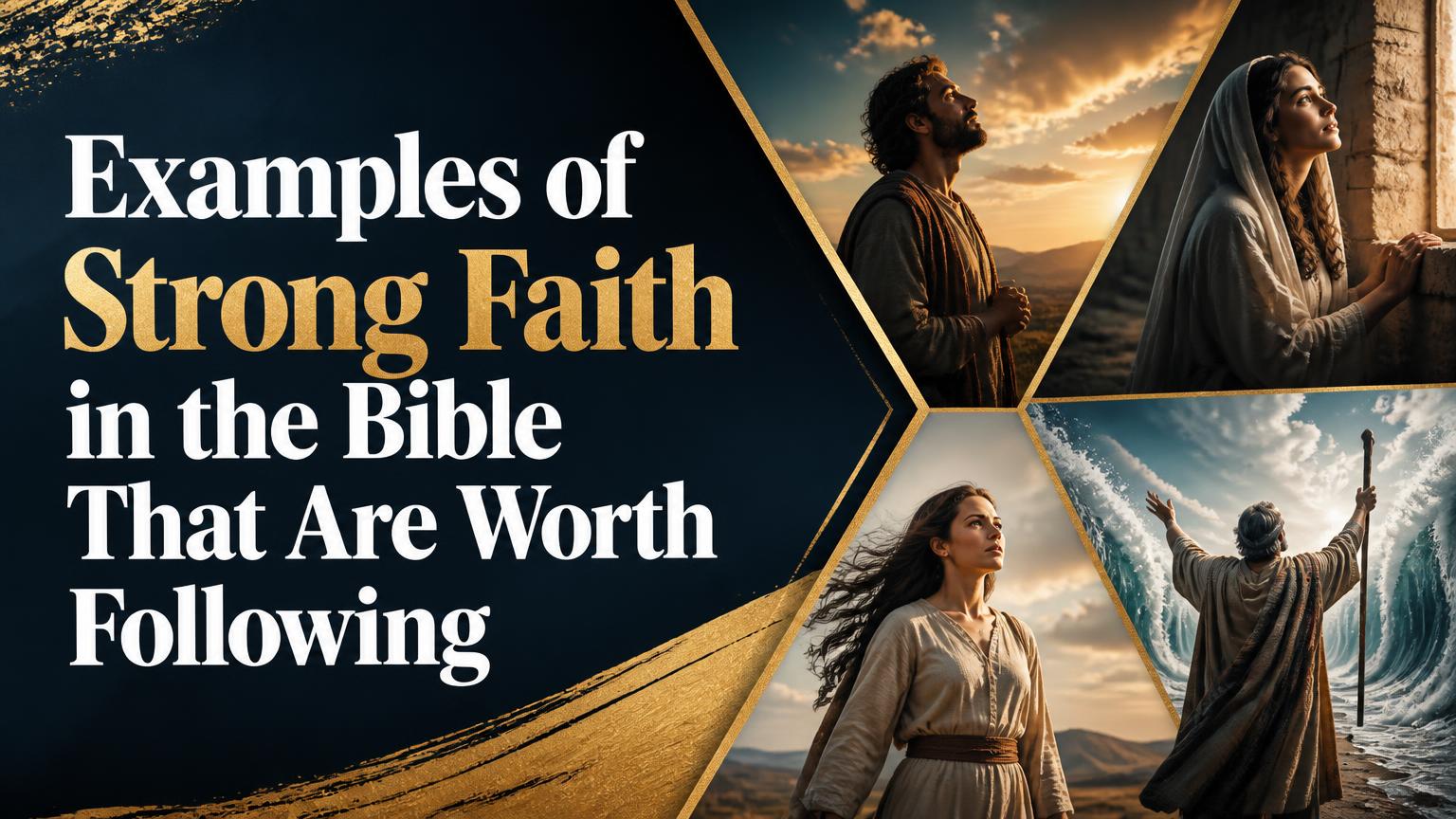
Examples of strong faith in the Bible show that biblical faith is more than positive thinking, emotional confidence, or a life free from doubt. It is a settled trust in God’s character and promises that produces obedience, courage, patience, and perseverance. Abraham trusted God’s promise, Moses chose faithfulness over privilege, Rahab acted on what she had learned about the Lord, and Mary accepted a costly calling. Their stories also show that strong faith does not require perfect people or guaranteed outcomes.
Examples of Strong Faith in the Bible
The Bible presents strong faith through people who trusted God when circumstances were uncertain, threatening, or painful. Their faith was expressed through decisions: leaving familiar places, obeying difficult commands, protecting others, resisting pressure, or accepting God’s will without knowing every detail. These examples are not accounts of flawless people. They show how genuine trust in God can shape a person’s actions even amid fear, weakness, and suffering.
Noah Obeyed Before He Saw the Evidence
Hebrews 11:7 describes Noah as acting “by faith” when God warned him about events he could not yet see. Noah built the ark in response to God’s command, even though the warning involved a future judgment that was not visible at the time. His faith therefore included trust in God’s word and practical obedience to it.
Noah’s example challenges the idea that faith is merely agreeing with a religious belief. He accepted God’s warning seriously enough to change his priorities, invest years of effort, and endure the possibility of ridicule. Strong faith often begins with taking God’s revealed instruction seriously before its outcome becomes apparent.
Abraham Trusted God Through Uncertainty
Abraham demonstrated faith by leaving his homeland when God called him to go to a place he had not yet seen (Genesis 12:1–4; Hebrews 11:8). God promised to make him a great nation, yet Abraham and Sarah remained childless for many years. Genesis 15:6 says Abraham believed the Lord, and that faith was counted to him as righteousness.
His faith reached a profound test when God commanded him to offer Isaac (Genesis 22). Abraham did not treat the command casually, but he trusted that God could remain faithful to His promise even when the situation seemed impossible. Abraham’s story shows that faith rests on God’s character and promises rather than on a complete understanding of every step.
Moses Chose God’s People Over Egypt’s Privileges
Moses could have remained connected to the Egyptian royal household, but Hebrews 11:24–29 says that he refused to be identified as Pharaoh’s daughter’s son. He chose to suffer with God’s people rather than enjoy the temporary benefits of sin and status. His decision reflected a different evaluation of value: faith enabled him to regard obedience to God as more significant than immediate privilege.
Moses also had to confront his own reluctance. In Exodus 3–4, he expressed fear and uncertainty about leading Israel. Strong faith did not mean Moses felt naturally capable. It meant that he ultimately depended on God’s presence and power rather than treating his limitations as the final word.
Rahab Acted on What She Believed
Rahab had heard what the Lord had done for Israel and recognized that Israel’s God was the true God of heaven and earth (Joshua 2:8–11). She then protected the Israelite spies, placing herself at risk among the people of Jericho. Hebrews 11:31 commends her faith, while James 2:25 points to her actions as evidence that her belief was active rather than merely verbal.
Rahab did not possess complete knowledge of Israel’s future or understand every part of God’s purposes. She responded faithfully to the truth she had received. Her story also demonstrates that strong faith is available to people from outside the expected religious or social circle. God’s grace can create a new allegiance and redirect a person’s entire identity.
David Faced Goliath With Confidence in God
David’s confrontation with Goliath in 1 Samuel 17 illustrates faith that interprets a frightening situation through God’s power rather than through human size or military strength. David did not deny that Goliath was dangerous. Instead, he believed that the Philistine’s defiance of God would not have the final word. His confidence rested on the Lord, not on his own natural ability.
David’s later life adds an important qualification. He committed serious sins and sometimes responded to danger imperfectly. Yet his failures do not erase the reality of his faith; they show that strong faith is not the same as sinless performance. David’s example encourages courageous trust while also warning against separating devotion to God from repentance and moral responsibility.
Daniel and His Friends Stayed Faithful Under Pressure
Shadrach, Meshach, and Abednego refused to worship Nebuchadnezzar’s image in Daniel 3. They believed God could rescue them from the furnace, but they also declared that they would not worship the image even if He did not rescue them. This “even if not” faith is one of Scripture’s clearest pictures of trust that is not based on controlling the outcome.
Daniel showed similar faith when he continued praying after the king prohibited prayer to anyone except the king (Daniel 6). These men did not assume that faith would prevent suffering. They considered loyalty to God more important than safety, reputation, or survival. Their example distinguishes faith from a demand that God produce a preferred result.
Mary Accepted God’s Calling With Humble Courage
When the angel announced that Mary would give birth to Jesus, she did not receive a detailed explanation of every future consequence. She responded, “Let it be to me according to your word” (Luke 1:38). Elizabeth later called her blessed because she believed that the Lord’s promise would be fulfilled (Luke 1:45).
Mary’s faith involved surrender, courage, and willingness to bear social misunderstanding. She accepted a calling that would affect her relationships, reputation, and future. Her response does not show passive resignation; it shows active trust in God’s wisdom. Faith sometimes means receiving a responsibility before one can see how every difficulty will be resolved.
The Roman Centurion Trusted Jesus’ Authority
In Matthew 8:5–13, a Roman centurion asked Jesus to heal his servant. The centurion believed Jesus did not need to enter his home; he only needed to give the command. Drawing on his own understanding of military authority, he recognized that Jesus possessed authority over illness. Jesus described this as remarkable faith.
The centurion’s faith was humble as well as confident. He did not claim personal worthiness or demand a sign. He approached Jesus on behalf of someone else and trusted His authority to act. This account shows that strong faith is not measured by religious status, extensive knowledge, or public position. It is measured by the object of faith and the trust placed in Christ.
What These Examples Teach About Strong Faith
The biblical examples above share important patterns, but they should not be reduced to a formula. Faith looks different in Noah, Rahab, David, Mary, and the centurion because their circumstances and responsibilities differ. The common element is not a particular personality type. It is reliance on God that becomes visible through decisions, endurance, and obedience.
Faith Is Trust, Not Complete Certainty
Biblical faith does not mean having every question answered or feeling no internal struggle. Hebrews 11:1 describes faith in terms of confidence in what is hoped for and conviction concerning what is not seen. That confidence is directed toward God, not toward a detailed prediction of how events must unfold.
This distinction protects faith from becoming presumption. Daniel’s friends believed God could save them, but they did not require Him to prove His faithfulness by granting the outcome they wanted. Strong faith can say, “God is able,” while also saying, “I will remain faithful if the outcome is different.”
Faith Produces Obedient Action
In Scripture, belief and conduct belong together. Noah built, Abraham journeyed, Rahab protected the spies, Moses returned to Egypt, and Daniel prayed. Their actions did not purchase God’s favor; they revealed that their trust was genuine. Biblical obedience is a response to God’s grace and authority, not an attempt to earn salvation through human achievement.
This principle also prevents a common misunderstanding. Faith is not simply intense emotion or agreement with religious ideas. It changes what a person does with time, fear, money, relationships, responsibilities, and moral choices. The action may be dramatic, as in confronting a king, or ordinary, as in continuing to pray and obey when no one is watching.
Faith Can Coexist With Fear and Suffering
Several faithful people in the Bible experienced fear. Moses felt inadequate, David faced terror, and the disciples often struggled to understand Jesus. Faith did not remove their humanity. It redirected their response by teaching them where to turn and whom to trust.
Scripture also refuses to promise that every faithful person will be rescued from immediate trouble. Hebrews 11 praises people who endured persecution and death as well as people who received miraculous deliverance. Strong faith therefore cannot be measured only by visible success. Its deepest evidence may be continued allegiance to God when circumstances provide no immediate reward.
How to Practice Strong Faith Today
Following these biblical examples begins with learning what God has actually revealed rather than treating personal wishes as divine promises. Christians can examine Scripture, pray honestly, seek wise counsel, and identify the obedience required in the situation before them. Faith may involve forgiving someone, resisting temptation, accepting responsibility, serving another person, speaking truth, or continuing faithfully through uncertainty.
It is also wise to separate trust in God from confidence about a specific result. A believer may ask boldly for healing, protection, provision, or reconciliation while leaving the final outcome in God’s hands. That approach is neither passive nor pessimistic. It combines active obedience with humility, allowing a person to remain faithful whether God answers through immediate deliverance, gradual change, unexpected provision, or sustaining grace.
Conclusion
Examples of strong faith in the Bible reveal a consistent pattern: people trusted God’s character, took His word seriously, and acted accordingly. Noah obeyed before seeing the flood, Abraham followed God through uncertainty, Rahab risked her safety, Moses surrendered privilege, Daniel and his friends remained loyal under threat, Mary accepted a costly calling, and the centurion trusted Jesus’ authority. Their faith was not flawless confidence or a guarantee of an easy life.
Strong faith is therefore best understood as faithful dependence on God that continues to obey even when circumstances remain unclear. It can include fear, questions, waiting, sacrifice, and suffering, but it refuses to make visible circumstances the final measure of God’s faithfulness. These examples are worth following because they direct attention away from human strength and toward the God who is trustworthy in every circumstance.