
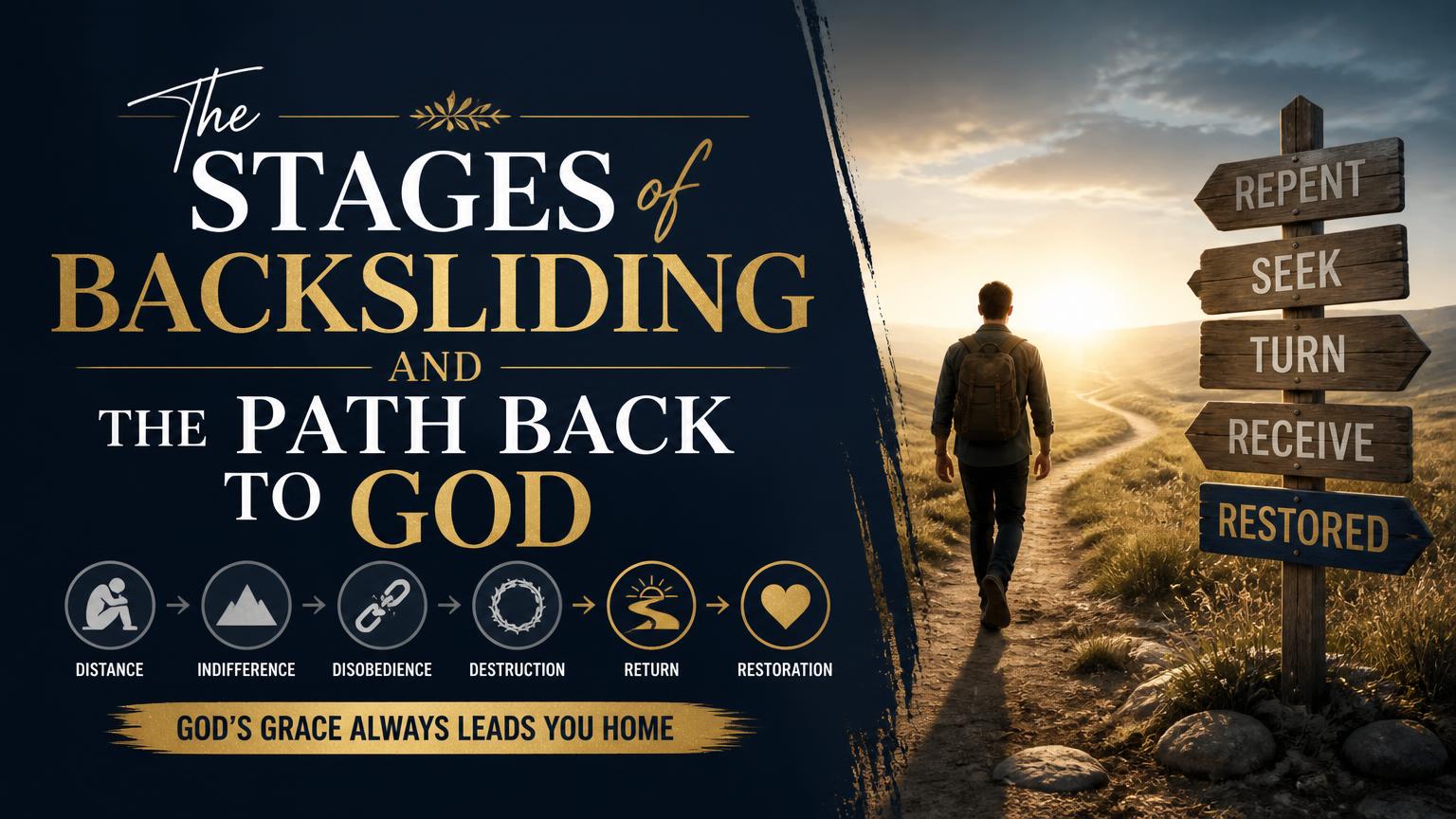
Backsliding describes a progressive turning away from God after a person has professed faith or previously walked closely with Him. It usually develops through neglected spiritual habits, tolerated sin, weakened conviction, and increasing resistance to correction rather than through one isolated failure. The Bible presents backsliding as serious, but it also repeatedly calls those who have wandered to return through repentance, faith, and renewed obedience.
Stages of Backsliding
The Bible does not provide one official numbered sequence called “the stages of backsliding.” However, its warnings and examples reveal a recognizable pattern. These stages are best understood as a pastoral framework for discernment, not a rigid formula. People may move through them at different speeds, repeat them, or turn back at any point.
Spiritual Neglect and Distraction
Backsliding often begins with neglect rather than open rejection. Prayer becomes occasional, Scripture loses priority, worship becomes routine or disappears, and fellowship with other believers is gradually abandoned.
The issue is not that a Christian must maintain a flawless devotional schedule. Christians experience busy seasons, grief, illness, doubt, and spiritual dryness. The concern is a sustained pattern of treating communion with God as unnecessary while other interests consistently take first place.
Jesus warned that the cares of the world, the deceitfulness of riches, and the desire for other things can choke spiritual fruitfulness (Mark 4:18–19). Distraction becomes dangerous when it reshapes a person’s loves. What begins as “I am too busy to pray” can eventually become a life organized around everything except God.
Diminished Conviction and Compromised Obedience
As spiritual attention weakens, sensitivity to sin may also decline. A person still recognizes biblical standards but begins making exceptions for conduct, relationships, attitudes, or priorities that conflict with them.
This stage commonly involves gradual compromise. Someone may continue attending church or speaking Christian language while privately permitting resentment, dishonesty, sexual immorality, greed, substance abuse, or pride to become established. The central problem is not merely committing a sin; every Christian sins. It is repeatedly choosing disobedience without a serious desire to confront or forsake it.
Conviction is meant to lead to repentance, not despair. When a person responds to conviction by returning to God, the pattern can be interrupted. When conviction is continually suppressed, the conscience may become less responsive over time.
Rationalizing and Concealing Sin
Persistent disobedience often creates a need for self-justification. A person may minimize the seriousness of sin, blame others, redefine obedience, or argue that biblical teaching does not apply in a particular situation.
Concealment intensifies the problem. David’s experience in Psalm 32 illustrates the physical and spiritual burden of hiding sin, while 1 John 1:9 points to confession as the opposite response: bringing sin into the light before God rather than managing appearances.
Rationalization does not always sound openly defiant. It may appear as:
- “Everyone does this.”
- “God understands, so repentance is unnecessary.”
- “I can stop whenever I want.”
- “This is just how I am.”
- “I am serving God in other ways, so this does not matter.”
These arguments protect a behavior or desire from correction. They also make restoration more difficult because a person cannot turn from what he or she refuses to name truthfully.
Isolation and Resistance to Correction
Backsliding frequently produces withdrawal from people who might offer wise, loving correction. The person may avoid Christian friends, stop attending church, reject pastoral care, or become hostile toward anyone who asks difficult questions.
Hebrews 3:12–13 connects spiritual danger with the deceitfulness of sin and urges believers to encourage one another continually. Isolation matters because sin distorts judgment. A person separated from honest Christian relationships has fewer opportunities to recognize rationalization, receive encouragement, or be reminded of God’s promises.
Healthy correction is not control, humiliation, or condemnation. Galatians 6:1 instructs spiritually mature believers to restore someone who has been caught in sin with gentleness and self-awareness. The goal is recovery, not public shame.
Hardening, Deception, and Open Rebellion
If neglect, compromise, concealment, and isolation continue, the heart may become increasingly resistant to God. Scripture describes this condition as hardness of heart, spiritual deception, or turning away.
At this point, a person may no longer merely struggle against sin but defend rebellion as morally right. Christian identity may be discarded, biblical authority openly rejected, or former faith treated with contempt. The outward result differs from person to person, but the inward movement is a settled resistance to God’s rule.
The warnings in Hebrews 3:12–14 and 10:26–31 should not be used casually to declare that every struggling believer has permanently abandoned salvation. They do show, however, that persistent rejection of known truth is spiritually perilous. God’s grace should never be used as permission to remain deliberately unrepentant.
These Stages Are Progressive, but Not Automatic
Backsliding is not always a straight line. A person may recognize the danger during the first stage and return to God. Another may outwardly appear devoted while privately moving toward serious compromise. Some people experience a brief fall followed by genuine repentance; others develop a long-term pattern of resistance.
The stages also should not be confused with a timetable for judging someone else’s salvation. Only God fully knows the heart. The framework is most useful for self-examination and for responding wisely when someone appears to be drifting.
Why Backsliding Usually Develops Gradually
Backsliding usually grows through repeated choices because spiritual direction is shaped by habits, desires, and interpretations. A single failure may be serious, but it does not automatically establish a settled pattern of apostasy. Repeatedly protecting the failure from repentance gives it greater influence.
Several forces commonly contribute:
- Neglected communion with God: Prayer and Scripture are displaced, so the believer loses regular reminders of God’s character, promises, and commands.
- Unconfessed sin: Hidden sin divides a person’s inner life and makes honesty with God more difficult.
- Misordered desires: Career, pleasure, relationships, money, status, or personal freedom become more important than faithfulness.
- Unhealthy influences: Relationships and environments can normalize attitudes or actions that weaken obedience.
- Disappointment with God: Suffering, unanswered prayer, church conflict, or hypocrisy may create unresolved anger and doubt.
- Pride and self-sufficiency: A person may conclude that personal judgment is more trustworthy than Scripture or wise Christian counsel.
These causes do not excuse sin, and they should not be reduced to simplistic formulas. A struggling believer may also be dealing with trauma, depression, exhaustion, addiction, or abuse. Such conditions may affect spiritual practices and judgment, but they should be addressed with appropriate pastoral, medical, and practical care rather than labeled automatically as rebellion.
Backsliding Is Not the Same as Every Spiritual Struggle
A period of doubt, grief, temptation, or spiritual dryness is not necessarily backsliding. The distinguishing issue is usually the direction of the person’s response to God.
A Christian who says, “I am struggling, but I want to know God and obey Him,” is different from someone who knowingly embraces sin and refuses correction. Doubt can lead a person to seek honest answers. Backsliding tends to use doubt, disappointment, or questions as a reason to avoid truth altogether.
Likewise, a believer can fail seriously without abandoning faith. Peter denied Jesus three times, yet his failure was followed by grief, restoration, and renewed service (Luke 22:54–62; John 21:15–19). Judas’s betrayal and Peter’s denial were both grievous, but their responses diverged. The distinction is not that one person never sinned; it is that repentance and restoration remained possible in Peter’s response.
This distinction should produce both seriousness and hope. Sin must not be minimized, but neither should a repentant person be treated as beyond grace.
The Path Back to God
Returning to God is not achieved by earning forgiveness through religious performance. It begins with turning honestly toward God and receiving His mercy. Scripture consistently presents restoration as repentance joined with faith and a renewed willingness to obey.
Acknowledge the Drift Honestly
The first step is truthful self-examination. Psalm 139:23–24 models a prayer that asks God to search the heart and reveal harmful ways. This is more constructive than vague guilt because it identifies specific patterns: neglected prayer, concealed behavior, bitterness, dishonesty, or misplaced priorities.
Excuses delay restoration. Honest confession begins to dismantle the defenses that allowed backsliding to continue.
Confess Sin and Turn From It
Repentance means more than feeling regret. It involves a change of mind and direction: agreeing with God about sin and taking concrete steps away from it. First John 1:9 assures believers that God is faithful and just to forgive and cleanse those who confess their sins.
Depending on the situation, repentance may require ending a destructive relationship, seeking accountability, accepting consequences, returning what was taken, apologizing, entering recovery, or receiving professional help. These actions do not purchase forgiveness. They demonstrate that repentance has become practical rather than merely emotional.
Return to Scripture, Prayer, and Christian Fellowship
Spiritual practices do not manipulate God into accepting someone. They help restore attention, truth, and dependence. A returning believer may begin with short, honest prayers, a manageable portion of Scripture, regular worship, and contact with mature Christians.
The purpose is not to imitate spiritual enthusiasm but to rebuild a life oriented toward God. Psalm 119:105 describes God’s word as a lamp for the path because Scripture exposes false reasoning and gives direction for obedience. Fellowship provides encouragement and loving accountability that isolation cannot provide.
Receive Grace Instead of Remaining in Shame
Some people recognize their sin but remain trapped in self-condemnation. Shame says, “I am beyond forgiveness”; the gospel calls the repentant person to trust God’s mercy. Jesus’ restoration of Peter shows that failure does not have to be the final word.
Grace does not make sin unimportant. It makes repentance possible. A person who believes forgiveness must be earned may either hide sin or give up entirely. A person who trusts God’s mercy can face sin honestly and begin repairing what has been damaged.
Persevere in a Changed Direction
Returning to God is a direction of life, not merely a dramatic moment. Continued faithfulness may involve repeated confession, new boundaries, accountability, patience with damaged relationships, and endurance when emotions remain unsettled.
Restoration also takes time. God may forgive immediately, while trust, health, and credibility are rebuilt gradually. Others may reasonably need evidence of change before restoring responsibilities. That delay is not necessarily rejection; it can be part of wise healing and protection.
Does Backsliding Mean Someone Has Lost Salvation?
Christian traditions interpret biblical warnings about falling away in different ways. Some emphasize that genuine believers will ultimately be preserved by God; others stress that Scripture’s warnings describe a real possibility of apostasy or final rejection. Both perspectives take seriously passages that call believers to continue in faith and obedience.
What can be said clearly is that a temporary fall, spiritual dryness, or season of doubt does not automatically prove that someone has lost salvation. Scripture calls wandering people to return, and Christ receives those who come to Him in repentance. At the same time, persistent, deliberate rejection of God should never be treated as harmless or automatically covered by a verbal profession of faith.
The appropriate response is neither careless assurance nor hopeless speculation. It is a renewed call to repentance, trust in Christ, submission to truth, and faithful perseverance.
Backsliding is best understood as a drift from God that can deepen through neglect, compromise, concealment, isolation, and resistance. The path back is not self-reform but honest repentance, confession, restored fellowship, dependence on Scripture, and confidence in God’s mercy. The earlier spiritual drift is recognized, the more readily it can be confronted—but even serious wandering should be met with a clear call to return rather than the assumption that restoration is impossible.