
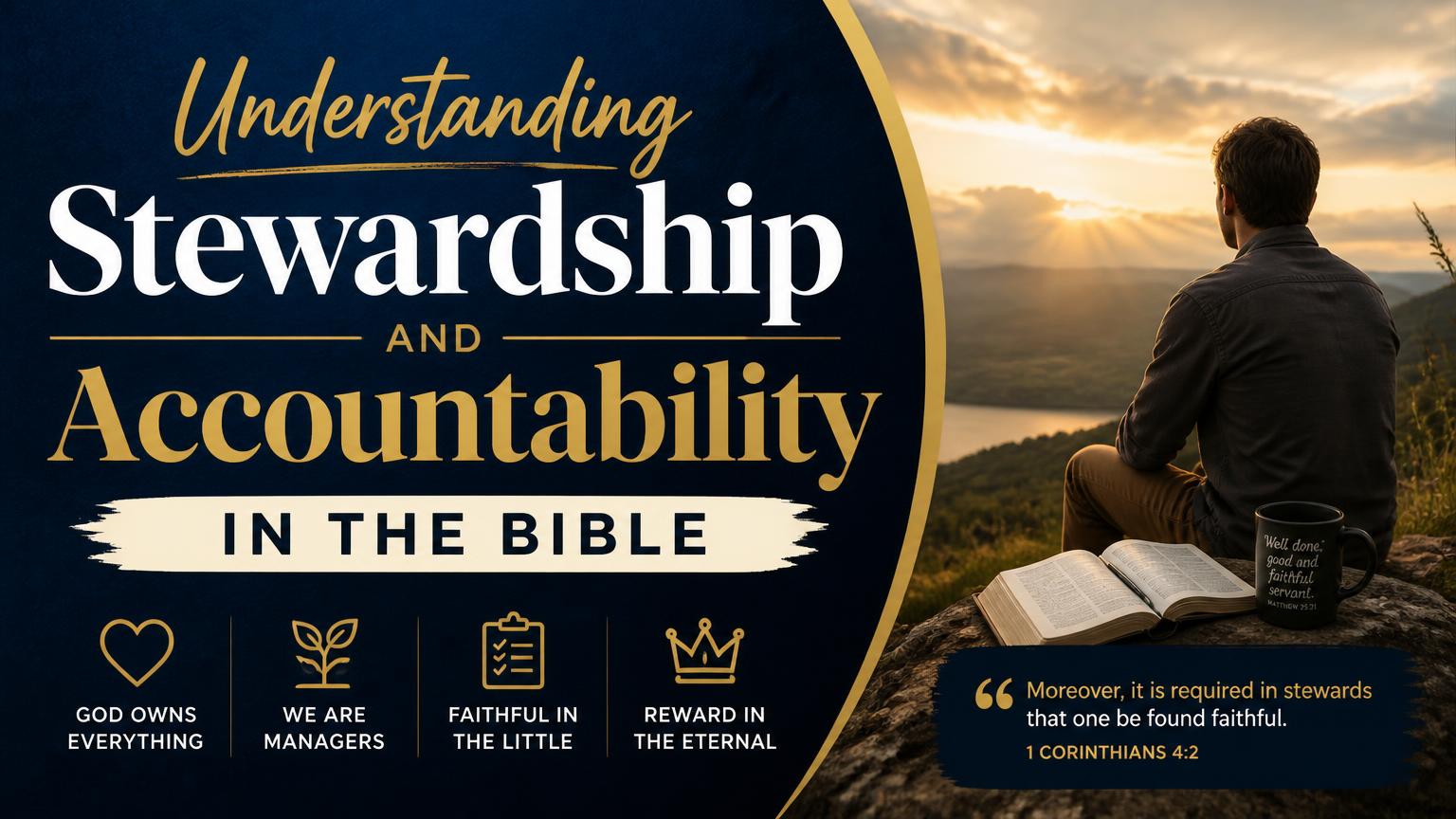
Stewardship and accountability in the Bible describe how people use what God has entrusted to them and how they answer to him for that use. Scripture presents God as the ultimate owner of life, possessions, abilities, authority, and creation. Human beings are managers, not absolute owners. Faithful stewardship therefore involves responsibility, wisdom, justice, generosity, and readiness to give an account to God.
Stewardship and Accountability in the Bible
Stewardship Begins With God’s Ownership
Biblical stewardship rests on the belief that everything ultimately belongs to God. Psalm 24:1 declares, “The earth is the LORD’s, and all its fullness,” while Deuteronomy 8:18 reminds Israel that God gives the ability to produce wealth. These passages do not deny that people possess property or exercise responsibility. They establish that human ownership is limited and dependent.
The creation account gives this relationship a practical shape. God places humanity in the garden “to work it and keep it” (Genesis 2:15). People are given authority over creation, but that authority is delegated. They are meant to cultivate and protect what God has made, not exploit it as though they were answerable to no one.
This distinction changes the question a person asks. Instead of asking only, “What do I own?” biblical stewardship asks, “What has God entrusted to me, and how should I use it faithfully?”
Accountability Means Answering to God
Accountability is the responsibility to explain or answer for one’s actions. In the Bible, the highest accountability is before God. Paul writes that “each of us will give an account of himself to God” (Romans 14:12). Jesus also teaches that people will answer for their words and actions, including what may be hidden from public view.
This accountability is not limited to dramatic moral failures. It includes ordinary decisions involving money, time, influence, work, relationships, opportunities, and spiritual gifts. Jesus says that “one who is faithful in a very little is also faithful in much” (Luke 16:10). Small choices reveal patterns of character because stewardship is fundamentally about faithfulness, not merely visible success.
Accountability also applies to people entrusted with authority. Teachers, pastors, parents, employers, and leaders affect others and therefore carry heightened responsibility. James 3:1 warns that teachers will be judged more strictly. Leadership in Scripture is never a license for control or self-enrichment; it is a trust that must be exercised for the good of others.
What Believers Are Called to Steward
The Bible presents stewardship as broader than financial giving. Several areas belong together:
- Material possessions: Money, land, homes, food, and other resources are to be used wisely and generously. Jesus warns against storing up wealth without being “rich toward God” (Luke 12:13–21).
- Time and opportunities: Ephesians 5:15–16 urges believers to live carefully and make the best use of their time. Opportunity itself is a form of entrusted responsibility.
- Abilities and spiritual gifts: First Peter 4:10 teaches that each believer should use whatever gift he or she has received to serve others as a faithful steward of God’s grace.
- The body and personal life: Believers are called to honor God with their bodies (1 Corinthians 6:19–20). Health, habits, and conduct are not spiritually irrelevant.
- Relationships: Marriage, family, friendship, and community require patience, truthfulness, protection, and service.
- Creation: Humanity’s authority over the earth includes care and cultivation. Dominion in Genesis is not permission for careless destruction.
- Influence and authority: Social position, professional responsibility, and leadership are entrusted for service rather than self-exaltation.
These categories overlap. A person may steward money through generosity, time through service, abilities through work, and authority through protecting vulnerable people. Biblical stewardship is therefore a pattern of life rather than a single religious activity.
Jesus’ Parables Explain Faithful Stewardship
Jesus frequently used stewardship to explain discipleship. In the parable of the talents, a master entrusts different amounts to his servants before leaving. Two servants put what they received to work; one hides it. The master commends the first two as “good and faithful” servants, not because they received equal amounts, but because they responded faithfully to what each had been given (Matthew 25:14–30).
The parable makes several points:
- People receive different responsibilities. Comparison is not the standard of judgment. Faithfulness is measured in relation to what a person has actually received.
- Entrusted resources are meant to be used. The servant fails by allowing fear to produce inactivity.
- The owner expects an account. Stewardship has a future dimension: the servants must answer for their decisions.
- Faithfulness includes courage and discernment. The parable is not a command to pursue profit recklessly. It presents active responsibility rather than fearful neglect.
Luke 12:42–48 makes a related point about servants placed over a household. The faithful servant provides what others need, while the unfaithful servant abuses his position. Accountability is especially serious when a steward’s choices affect people under his care.
Faithfulness Includes Motive, Justice, and Character
Biblical accountability is not simply an audit of outward results. God evaluates motives and character as well as accomplishments. A person can give publicly for recognition, lead for personal power, or accumulate wealth while neglecting justice. Such conduct may appear successful but does not represent faithful stewardship.
Jesus criticizes religious leaders who carefully observe minor practices while neglecting “the weightier matters of the law: justice and mercy and faithfulness” (Matthew 23:23). This shows that stewardship cannot be reduced to donating money or managing resources efficiently. A person’s treatment of neighbors, workers, the poor, and the vulnerable is part of the account he or she gives to God.
Likewise, First Corinthians 4:1–2 describes Christian workers as “servants of Christ and stewards of the mysteries of God,” then identifies the central requirement: “it is required of stewards that they be found faithful.” Faithfulness includes sound teaching, but also humility, integrity, and obedience. The standard is not popularity, visibility, or numerical growth.
How Stewardship and Accountability Relate
Stewardship describes the assignment; accountability describes the answer required for that assignment. God entrusts something, people make choices about it, and those choices carry moral consequences.
This relationship helps explain why biblical stewardship includes both privilege and obligation. The steward has real authority, but not unlimited authority. A manager may make decisions, yet must act within the owner’s purposes. Similarly, people may use their resources freely, but Christian freedom is directed by love, wisdom, and responsibility.
Accountability also guards against two opposite errors:
- Possessiveness: treating resources as personal property with no obligation to God or neighbor.
- Passivity: claiming that because everything belongs to God, personal effort and responsibility do not matter.
Scripture rejects both. God owns all things, but he still commands people to work, plan, give, protect, teach, and serve. Faithful stewardship is active dependence: using what God provides while recognizing that the final authority remains with him.
Stewardship, Salvation, and Judgment
Biblical accountability should not be confused with earning salvation. Scripture teaches that people are reconciled to God by grace through faith, not by accumulating enough good works. Yet grace does not eliminate responsibility. It produces a life of obedience and service.
Jesus’ teaching about final judgment consistently connects faith with conduct. In Matthew 25:31–46, care for people in need reveals whether individuals have understood the King’s purposes. Paul says that believers will appear before Christ’s judgment seat so that each may receive what is due for what he or she has done in the body (2 Corinthians 5:10). These passages concern serious accountability, but they should not be turned into a system in which people purchase God’s favor through performance.
The biblical balance is this: good works do not replace grace, but genuine faith is expected to bear fruit. Stewardship is evidence of a transformed relationship with God, not a way to manipulate or obligate him.
Practicing Biblical Stewardship Today
Faithful stewardship begins with regular examination rather than a single financial decision. Useful questions include:
- What resources, responsibilities, and opportunities has God placed in my care?
- Does my use of them serve love of God and neighbor?
- Am I managing resources wisely or being controlled by fear, greed, or status?
- Are my decisions harming people who have less power?
- Do I use my abilities to serve, or mainly to gain recognition?
- What would faithfulness look like in this specific responsibility?
Financial stewardship includes honest work, prudent planning, generosity, contentment, and concern for those in need. The New Testament commends planned and willing generosity, not coerced giving (2 Corinthians 9:6–8). First Timothy 6:17–19 does not condemn wealth itself; it warns the wealthy not to place their hope in uncertain riches and instructs them to be generous and ready to share.
Stewardship in a church or organization also requires transparency. Those handling shared funds should avoid secrecy, conflicts of interest, and arrangements that place one person beyond accountability. Proper safeguards are not expressions of distrust; they protect both the community and the people entrusted with responsibility.
In daily life, stewardship may involve caring for family members, doing honest work, mentoring someone, using technology responsibly, protecting creation, welcoming strangers, or refusing to use authority to exploit others. Ordinary faithfulness is often more significant biblically than dramatic but occasional sacrifice.
Common Misunderstandings About Biblical Stewardship
Stewardship Is Not the Same as Prosperity
The Bible does not promise that faithful stewardship will make every believer wealthy. Some faithful servants receive abundance; others experience poverty, persecution, or loss. Material increase may be a responsibility, but it is never reliable proof of spiritual superiority. Jesus and the apostles repeatedly warn against greed and define blessing in terms deeper than possessions.
Accountability Does Not Justify Controlling Others
Because everyone answers to God, one person should not claim unlimited authority over another believer’s conscience, finances, or life. Leaders are accountable for how they use influence, and Christian authority must be exercised through service. Accountability should encourage integrity and protection, not manipulation or surveillance.
Stewardship Is Not Limited to Church Giving
Giving is an important expression of stewardship, but it is not the whole of it. A person may donate generously while neglecting family, acting dishonestly at work, abusing authority, or ignoring injustice. God’s concern includes the whole pattern of life.
Equality of Results Is Not the Biblical Standard
The parable of the talents recognizes different levels of opportunity and responsibility. Biblical accountability does not require every person to produce identical outcomes. It asks whether each person has acted faithfully, wisely, and justly with what was entrusted to him or her.
Stewardship and accountability in the Bible are therefore inseparable. God entrusts people with resources, abilities, relationships, authority, and opportunities; they are expected to use them faithfully and answer to him for their choices. The standard is not wealth, visibility, or comparison with others, but faithful service shaped by grace, justice, humility, and love.