
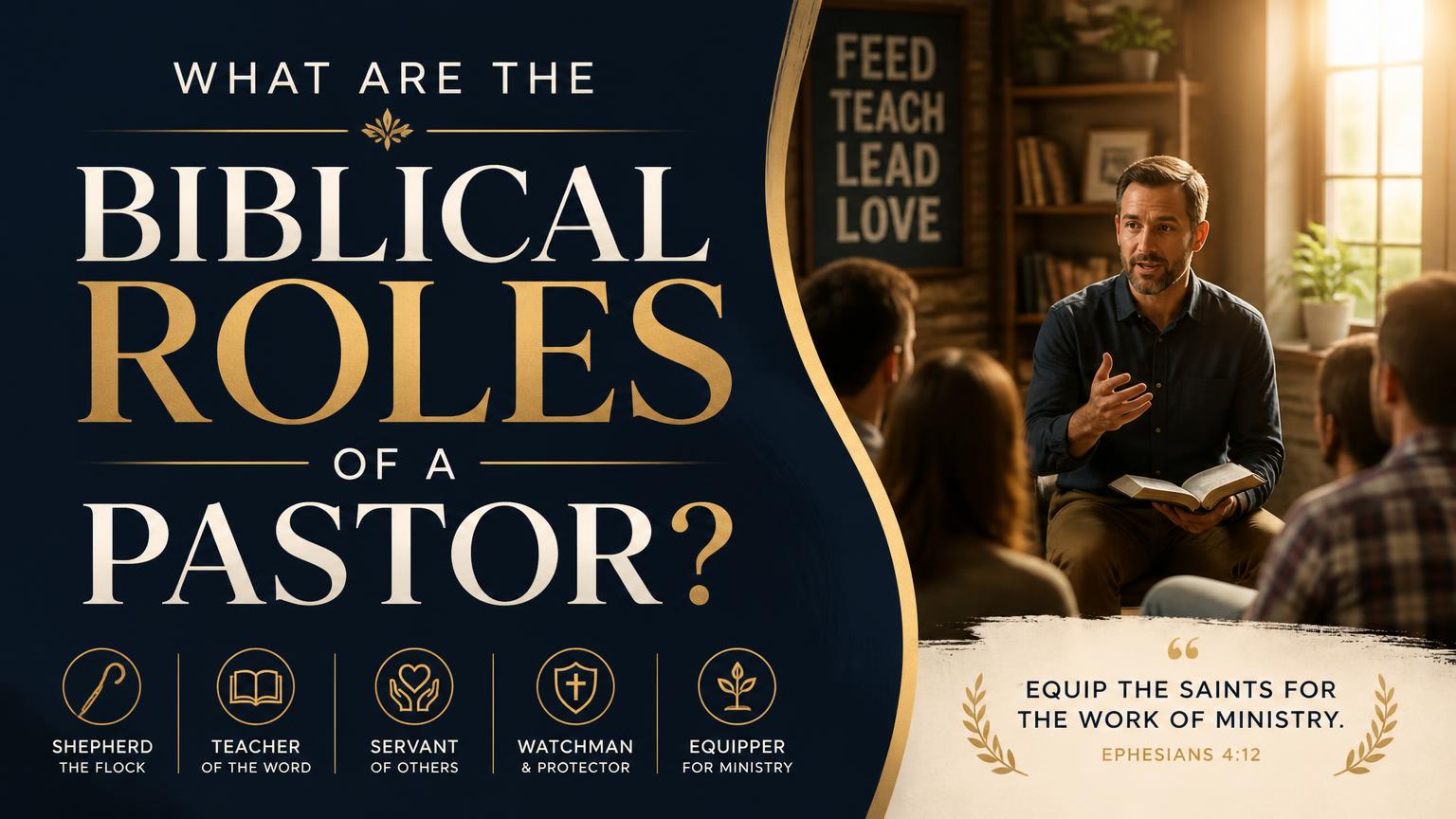
A biblical pastor is a shepherd of God’s people who serves under the authority of Jesus Christ. The pastor’s central responsibilities are to teach Scripture, protect the church from false doctrine, care for believers, equip them for ministry, lead by example, pray, and proclaim the gospel. These responsibilities are not merely organizational duties; they involve helping people grow in faith and remain faithful to Christ.
What Are the Biblical Roles of a Pastor?
The New Testament presents pastoral ministry through the images of a shepherd, teacher, guardian, servant, and spiritual leader. The word pastor means “shepherd,” and Ephesians 4:11 identifies pastors among the ministry gifts Christ gives to His church. Other passages commonly describe the same leaders as elders or overseers, although Christian traditions differ in how these titles and offices are formally organized.
Shepherd the Flock Under Christ
A pastor’s primary role is to shepherd the people entrusted to his or her care. Jesus is the “Chief Shepherd” (1 Peter 5:4), so a pastor does not own the congregation or rule it according to personal preferences. Pastoral authority is delegated, accountable, and exercised on Christ’s behalf.
Shepherding includes:
- Knowing and caring for people
- Providing spiritual direction
- Encouraging the discouraged
- Correcting harmful patterns
- Seeking those who are wandering
- Helping believers mature in faith
Peter instructs elders to “shepherd the flock of God” willingly and eagerly, not for dishonest gain or by domineering over others (1 Peter 5:2–3). This means pastoral care is personal and relational, not limited to preaching from a platform. A pastor may visit the sick, counsel a struggling couple, encourage a grieving person, or help a new believer understand the Christian faith.
Biblical shepherding also requires knowing when a person needs help beyond the pastor’s competence. Pastoral care may include prayer and spiritual guidance, but serious medical, psychological, legal, or safety concerns may require qualified professionals and appropriate safeguarding.
Teach Scripture and Guard the Gospel
Pastors are responsible for communicating God’s Word accurately and applying it faithfully. Paul tells Timothy to “preach the word” with patience and correction (2 Timothy 4:2), while Titus 1:9 describes a qualified elder as someone who holds firmly to the trustworthy message and can encourage others by sound teaching and refute error.
This teaching role includes more than delivering sermons. A pastor may teach through:
- Public preaching
- Bible studies
- Discipleship
- Counseling
- Leadership training
- Catechesis or doctrinal instruction
- Personal conversations
The goal is not simply to transfer information. Biblical teaching explains what Scripture means, connects doctrine with life, exposes error, and helps believers develop wisdom. A pastor should therefore teach the whole counsel of God rather than selecting only popular or comfortable subjects.
Guarding doctrine is part of this responsibility. The New Testament repeatedly warns church leaders about false teachers and destructive teachings (Acts 20:28–31; 1 Timothy 1:3–7). Protecting the church does not mean creating suspicion toward every disagreement. It means distinguishing the central truths of the gospel from teachings that distort God’s character, salvation, Christian conduct, or the authority of Scripture.
Equip Believers for Ministry
Ephesians 4:11–12 teaches that pastors and other ministry leaders are given to equip the saints for the work of ministry and to build up the body of Christ. A pastor’s task is therefore not to perform every ministry personally. It is to prepare the entire congregation to serve.
This distinction corrects a common misunderstanding of pastoral ministry. A church may expect its pastor to lead every program, make every decision, visit every person, solve every conflict, and carry every ministry. The New Testament instead presents the church as a body in which different members have different gifts (Romans 12:3–8; 1 Corinthians 12:12–27).
Pastors equip people by:
- Teaching them how to read and apply Scripture
- Identifying and developing spiritual gifts
- Training leaders
- Delegating responsibility wisely
- Creating opportunities for service
- Encouraging mutual care within the congregation
A healthy pastor works toward a mature church that can minister to one another. Dependence on one highly active leader may create short-term efficiency, but it prevents the wider body from exercising its God-given responsibilities.
Lead Through Service and Example
Pastoral leadership is real leadership, but it is modeled after Christ’s servant leadership rather than worldly control. Jesus taught that greatness among His followers is expressed through serving others (Mark 10:42–45).
Pastors make decisions, provide direction, establish priorities, and sometimes exercise corrective authority. Yet 1 Peter 5:3 warns leaders not to domineer over those in their care but to be examples to the flock. Authority must therefore be joined to humility, transparency, patience, and accountability.
Paul also instructed Timothy to set an example in speech, conduct, love, faith, and purity (1 Timothy 4:12). A pastor’s life does not need to be flawless, but it must be credible. The congregation should see a pattern of repentance, integrity, self-control, faithfulness, and dependence on God.
This does not mean a pastor becomes the congregation’s spiritual substitute or an unquestionable authority. Hebrews 13:17 calls believers to respect godly leaders, but the broader New Testament makes leaders accountable to Christ and warns them against abuse. Pastoral authority is never permission for manipulation, coercion, secrecy, financial exploitation, or protection of misconduct.
Pray for and Care for People
Prayer is a central pastoral responsibility because ministry depends on God rather than merely on communication skills or organizational ability. The apostles described themselves as devoted to “prayer and the ministry of the word” (Acts 6:4). Elders are also instructed to pray for the sick (James 5:14).
Pastoral prayer may involve:
- Interceding for individuals and families
- Praying for wisdom in church decisions
- Asking for spiritual strength and protection
- Confessing dependence on God
- Praying for gospel opportunities
- Bringing suffering before the Lord
Prayer also shapes how pastors care for people. It reminds leaders that they cannot control spiritual outcomes and that each person belongs ultimately to Christ. A pastor may teach, advise, warn, and encourage, but only God gives spiritual growth (1 Corinthians 3:6–7).
Care includes both compassion and truth. Biblical pastoral ministry does not reduce love to affirmation of every choice, nor does it use truth as an excuse for harshness. Pastors are called to restore people gently when they fall, while also taking sin and its consequences seriously (Galatians 6:1).
Protect, Correct, and Restore the Church
Shepherds protect a flock from danger, and pastors have a corresponding responsibility to protect the church spiritually. This involves identifying false teaching, addressing destructive behavior, and responding to conflicts before they harm the congregation.
Correction should aim at repentance and restoration rather than humiliation. Jesus gives a process for addressing sin among believers in Matthew 18:15–17, and Paul instructs churches to respond to serious wrongdoing with both accountability and the possibility of restoration. Church discipline is not personal punishment carried out by a pastor; it is a congregational responsibility exercised under Scripture and with the goal of recovering the person and preserving the church’s witness.
Protection also includes practical responsibility. Churches should establish appropriate safeguards for children and vulnerable adults, handle finances transparently, and create systems that prevent one leader from exercising unchecked power. These practices are not replacements for spiritual shepherding. They are ways of applying biblical integrity and accountability to church life.
Proclaim the Gospel and Strengthen Mission
Pastors teach believers, but they also proclaim the gospel to those who do not yet follow Christ. Paul told Timothy to “do the work of an evangelist” (2 Timothy 4:5). Pastoral ministry should therefore keep the death, resurrection, lordship, and saving grace of Jesus central.
The pastor’s evangelistic role does not imply that evangelism belongs only to ordained leaders. Jesus commissions His entire church to make disciples (Matthew 28:18–20), and every Christian is called to give an answer concerning the hope within them (1 Peter 3:15). Pastors equip believers to witness through their words, conduct, hospitality, and service.
A pastor also helps the church understand its mission beyond its weekly gathering. The congregation should be formed into a people who worship God, love one another, serve their neighbors, and bear witness to Christ.
What Qualifications Must a Biblical Pastor Have?
The New Testament gives greater emphasis to a pastor’s character than to charisma, popularity, academic credentials, or administrative success. The qualifications in 1 Timothy 3:1–7 and Titus 1:5–9 include being above reproach, self-controlled, faithful, hospitable, responsible, able to teach, and respected by others.
Character Before Platform
A pastor must demonstrate integrity in ordinary life. Faithfulness in marriage, honesty with money, emotional self-control, and a good reputation are not secondary concerns. They show whether a person’s public ministry reflects genuine Christian maturity.
The phrase “above reproach” does not mean sinless perfection. It describes a life that is not characterized by a scandalous or disqualifying pattern. A pastor should be willing to confess sin, receive correction, and submit to accountability.
Ability to Teach and Lead
Pastoral calling includes the ability to explain Christian truth clearly and apply it wisely. A person may be sincere and gifted in administration, music, counseling, or public speaking without being qualified to serve as a pastor.
Leadership qualifications also include managing responsibilities well, handling conflict maturely, and caring for people without controlling them. The pastor’s household and relationships do not need to appear perfect, but they should provide credible evidence of responsible leadership.
A Tested and Accountable Life
Paul warns that a new believer should not be placed into church leadership prematurely, because spiritual immaturity can produce pride and failure (1 Timothy 3:6). Pastoral leadership should be recognized after a person’s faith, character, teaching, and relationships have been tested over time.
Accountability should remain in place after appointment. A pastor needs trusted fellow leaders, clear financial practices, procedures for handling complaints, and a church structure that makes abuse of authority more difficult. Biblical leadership is never designed to operate without correction.
How Pastors Relate to Elders, Deacons, and the Congregation
The New Testament uses several overlapping terms for church leadership. In Acts 20:17, 28, Paul addresses the elders of Ephesus and calls them overseers, instructing them to shepherd the church. Titus 1:5–7 also moves between the terms elder and overseer. For this reason, many Christian traditions understand pastor, elder, and overseer as closely related descriptions of the same leadership office or ministry.
Other traditions distinguish these roles more formally. Some use pastor for the primary teaching leader, elder for a governing or spiritually mature leader, and overseer for a supervisory office. The organizational arrangement varies, but the central biblical responsibilities remain teaching, shepherding, guarding, and leading the church faithfully.
Deacons serve the church in important practical and ministry-related ways, as seen in 1 Timothy 3:8–13 and the pattern of service in Acts 6:1–6. Their ministry supports the church’s care and mission, but deacons should not be treated as inferior Christians or merely as administrative assistants.
The congregation also has responsibilities. Members are called to encourage one another, bear one another’s burdens, use their spiritual gifts, pursue holiness, and participate in the church’s mission. A pastor leads the church, but does not replace the church.
What a Biblical Pastor Is Not
A pastor is not a mediator who takes the place of Jesus. Christ alone is the church’s ultimate Shepherd, Savior, and High Priest (1 Peter 5:4; Hebrews 4:14–16). Pastors serve believers by directing them toward Christ, not by making themselves indispensable.
A pastor is also not defined primarily by a title, salary, pulpit, or organizational position. A person may perform many church functions without faithfully carrying out biblical pastoral ministry. Conversely, pastoral work often occurs in quiet settings that receive little public recognition.
Administrative duties, weddings, funerals, counseling, visitation, and program leadership may be legitimate parts of a pastor’s work. However, these activities should serve the larger biblical calling: shepherding people through the Word, prayer, godly example, protection, and preparation for ministry.
Biblical pastoral ministry is therefore best understood as accountable spiritual care under the authority of Christ. The pastor teaches and guards the faith, leads by serving, cares for people, equips the church, and points the congregation toward Jesus rather than toward personal power.