
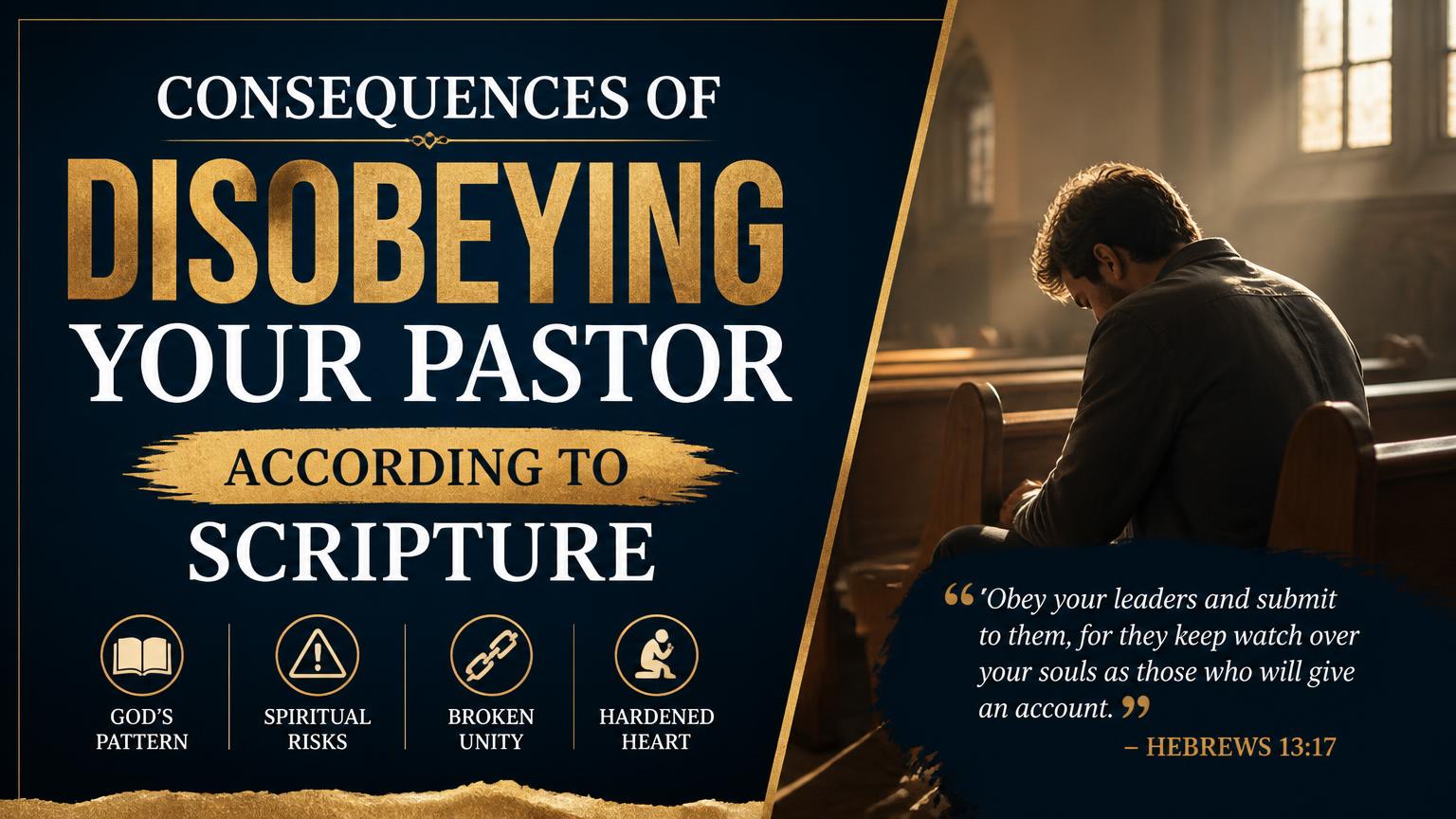
A pastor has real spiritual authority, but Scripture does not present that authority as unlimited or unquestionable. Pastors are called to teach God’s Word, guide the congregation, protect its spiritual health, and lead by example. They are not given permission to control consciences, demand unquestioning loyalty, or replace Christ as the believer’s Lord.
Therefore, the consequences of disobeying your pastor depend on what you disobeyed, why you disobeyed it, and whether the pastor’s instruction agrees with Scripture. Rejecting a clear biblical command is sinful, even if the command was delivered through a pastor. Refusing an unbiblical demand may be an act of faithfulness to God rather than disobedience.
What Are the Consequences of Disobeying Your Pastor?
Disobeying a pastor can produce spiritual, relational, and congregational consequences when the pastor is giving faithful biblical guidance and the member rejects it with a sinful attitude. However, disagreeing with pastoral advice or refusing an unscriptural demand is not automatically sinful.
When Disobedience Is Actually Sin
The clearest case involves rejecting something Scripture plainly teaches. A pastor does not create the authority of the command; he explains and applies God’s authority. For example, if a pastor urges a member to abandon bitterness, pursue reconciliation, stop deceptive conduct, or submit to biblical sexual ethics, resisting that instruction may reveal resistance to Scripture itself.
Hebrews 13:17 tells believers to obey their leaders and submit to them because those leaders keep watch over their souls and will give an account. The reason for submission is not the pastor’s personality, status, or forcefulness. It is the pastor’s God-given responsibility to care for the church. A member who deliberately rejects faithful biblical correction may lose the benefit of wise spiritual oversight and become more vulnerable to sin.
This kind of disobedience can lead to:
- Spiritual stagnation: Resistance to correction can prevent repentance, growth, and restored fellowship with God.
- Hardened conscience: Repeatedly dismissing biblical counsel may make sin easier to justify over time.
- Damaged relationships: A refusal to address sin can harm a marriage, family, friendship, or church community.
- Loss of trust: Persistent rebellion may weaken a person’s credibility with church leaders and fellow believers.
- Church discipline: If the issue involves serious, unrepentant sin, the church may follow a process such as the one described in Matthew 18:15–17.
Church discipline is not supposed to be personal retaliation. Its purpose is correction, protection of the congregation, and restoration of the person who has sinned. A pastor should not treat every disagreement as grounds for discipline.
When Refusal Is Faithfulness to Christ
Pastoral authority is delegated authority. A pastor must remain under Christ and Scripture. When a leader commands what God forbids, forbids what God commands, or demands loyalty to himself above loyalty to Christ, the believer must obey God first.
The apostles expressed this principle in Acts 5:29: “We must obey God rather than men.” That statement does not encourage casual defiance. It establishes a boundary: no human leader has authority to require disobedience to God.
The Bereans in Acts 17:11 provide another important example. They listened to Paul’s teaching but examined the Scriptures to determine whether his message was true. Their testing of apostolic preaching was not portrayed as rebellious. It was commended as noble. If even a respected teacher’s message was tested against Scripture, ordinary pastors should not be treated as infallible.
A member may therefore need to refuse a pastoral demand involving:
- Teaching that contradicts Scripture
- Concealing abuse, criminal conduct, or serious wrongdoing
- Unethical financial payments or personal gifts
- Isolation from family, other Christians, or legitimate outside counsel
- Violations of conscience that Scripture does not require
- Personal control over marriage, employment, medical care, or other decisions that belong to the individual before God
- Covering up doctrinal or moral misconduct
Such refusal may result in conflict, criticism, removal from a ministry role, or even unjust church discipline. Those consequences may be painful, but suffering for doing what is right is not evidence that the refusal was sinful. The standard is not whether the pastor approves; it is whether the response is truthful, humble, and faithful to Scripture.
The Relational Consequences of Rejecting Faithful Counsel
Even when a pastor’s advice is biblically sound, disobedience does not always produce immediate or dramatic punishment. Often, the consequences are relational. A pastor may become less able to provide meaningful oversight when a member repeatedly hides information, rejects correction, or acts deceptively.
This matters because pastoral care depends on trust. A person who requests counsel but has already decided to ignore it should be honest about that decision rather than pretending to seek guidance. Disagreement can be expressed respectfully; manipulation and dishonesty damage the relationship.
The effect on the congregation can also be significant. Publicly encouraging others to disregard faithful biblical teaching may create confusion, factions, or contempt for legitimate leadership. Titus 3:10–11 addresses divisive conduct because division can spread beyond the original disagreement.
Still, a pastor should not demand agreement on every preference. Scripture allows room for differences concerning matters such as ministry methods, schedules, cultural practices, and other issues not settled by a clear biblical command. A church member can disagree without being rebellious when the disagreement is expressed honestly and respectfully.
The Consequences of Blind Submission
Blind submission can also cause serious harm. Scripture commands pastors to shepherd the flock willingly and honorably, not to dominate it. In 1 Peter 5:1–4, elders are told not to domineer over those entrusted to them but to be examples to the flock. Jesus likewise warned against the kind of leadership that seeks status and control rather than service (Matthew 20:25–28).
This means that “obey your pastor” cannot mean:
- Treat the pastor as incapable of error
- Accept every personal opinion as God’s command
- Ignore evidence of abuse or corruption
- Remain silent when Scripture is being distorted
- Submit to coercion simply to avoid conflict
Blind submission can weaken a believer’s spiritual maturity by replacing personal responsibility before God with dependence on a human authority. It can also protect abusive leaders and make victims feel guilty for seeking help. Biblical submission includes discernment, truthfulness, and accountability.
What Authority Does a Pastor Have According to Scripture?
A pastor’s authority primarily involves teaching the gospel, administering the church’s life, correcting error, caring for people, and equipping believers for faithful service. Ephesians 4:11–13 presents church leaders as gifts given to equip the saints, not as rulers who possess the members.
Pastors may faithfully:
- Explain and apply biblical teaching
- Call believers to repentance and holy living
- Give pastoral counsel
- Establish reasonable ministry practices
- Protect the church from destructive teaching or conduct
- Lead church discipline according to Scripture and the church’s established process
- Ask members to serve in ways consistent with their gifts and responsibilities
But pastoral authority has limits. A pastor cannot make a personal preference equal to a biblical command. There is a meaningful difference between “Scripture requires this,” “our church practices this,” and “I recommend this as wise counsel.” Confusing these categories is a common source of spiritual abuse and unnecessary conflict.
A pastor is also accountable to God. Hebrews 13:17 says leaders will give an account, while James 3:1 warns that teachers will be judged more strictly. Authority in the church is therefore a responsibility exercised under judgment, not a privilege that removes accountability.
How to Distinguish Biblical Disobedience From Legitimate Disagreement
Before concluding that someone has disobeyed a pastor, identify the nature of the instruction.
| Type of Pastoral Direction | Appropriate Response |
|---|---|
| A clear biblical command | Receive it seriously and obey God’s Word |
| A reasonable church-policy decision | Respect the church’s order or leave the congregation peacefully if conscience requires |
| Personal pastoral advice | Consider it carefully, but prayerfully decide before God |
| A demand contrary to Scripture | Refuse respectfully and seek appropriate help |
| A matter involving abuse or criminal conduct | Prioritize safety, truth, and lawful reporting rather than secrecy |
The motive also matters. A person may reach the right outward decision for the wrong reason. Refusing counsel because of pride, resentment, or a desire to protect sin is different from refusing because the instruction is unbiblical or coercive.
A wise response includes examining Scripture, praying for wisdom, asking the pastor to explain the biblical basis for the instruction, and seeking counsel from mature and trustworthy Christians. If the concern involves abuse, financial misconduct, threats, or coercive control, the person should not be pressured to handle it privately with the accused pastor. Appropriate church authorities and, where necessary, civil authorities should be involved.
How Should You Respond If You Have Disobeyed Your Pastor?
If the pastor gave faithful biblical correction and you rejected it wrongly, the proper response is repentance rather than fear. Confess the sin to God, acknowledge the matter honestly, and seek reconciliation where another person was harmed. James 5:16 connects confession and prayer with spiritual restoration, while Matthew 5:23–24 emphasizes making peace with someone who has been wronged.
Repentance does not require accepting exaggerated accusations or admitting to wrongdoing that did not occur. You can apologize for a sinful attitude, dishonesty, or harmful action while still explaining respectfully why you cannot comply with an unscriptural demand.
If the pastor’s instruction was controlling or abusive, you do not need to call your refusal sin merely because the pastor labeled it rebellion. Seek clarity, preserve relevant records, involve trustworthy oversight, and protect vulnerable people. A legitimate pastor should be willing to explain his teaching from Scripture and accept appropriate accountability.
Does Disobeying a Pastor Mean You Are Disobeying God?
Not necessarily. A pastor’s instruction carries spiritual weight when it faithfully reflects Scripture, but a pastor’s personal preference does not automatically carry divine authority. The believer’s ultimate allegiance is to Jesus Christ, and every Christian leader remains subject to God’s Word.
Faithful pastoral leadership should produce obedience to Christ, not dependence on a personality. Faithful church membership should involve humility and teachability, not fear-driven compliance. The biblical balance is genuine respect for pastors, careful submission to legitimate leadership, and unwavering obedience to God when human commands conflict with Scripture.
The consequences of disobeying your pastor therefore depend on the nature of the instruction and the heart behind your response. Rejecting biblical correction can bring spiritual and relational harm, while refusing an abusive or unscriptural demand may be an act of Christian faithfulness. The decisive question is not simply, “Did I obey my pastor?” but, “Was my response faithful to Scripture, truthful in motive, and submitted to Christ?”