
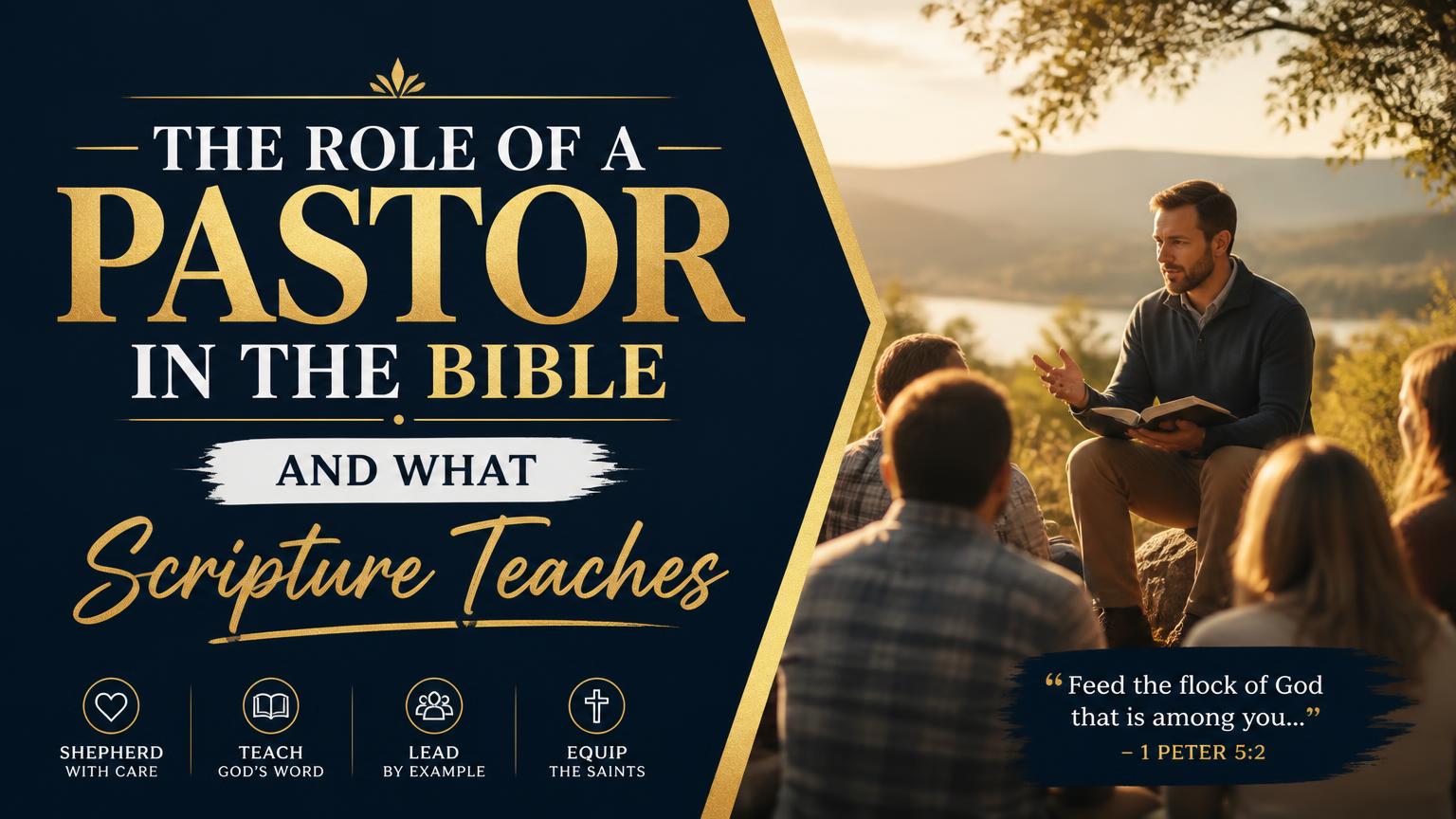
The role of a pastor in the Bible is to shepherd God’s people under the authority of Jesus Christ. Pastors teach Scripture, guard the church from error, lead believers toward spiritual maturity, care for suffering people, equip Christians for ministry, and model faithful Christian character. The work is authoritative, but it is not a license for control; biblical pastoral leadership is exercised through service, humility, truth, and accountability.
What Is the Role of a Pastor in the Bible?
The New Testament presents pastoral ministry through the image of a shepherd. A pastor cares for people as a shepherd cares for a flock: feeding, guiding, protecting, seeking the straying, and watching over their spiritual well-being. This responsibility belongs ultimately to Jesus, who is called the “Chief Shepherd” (1 Peter 5:4). Human pastors serve under him rather than replacing him.
Teach and Explain God’s Word
A pastor’s central responsibility is to teach the truth of Scripture accurately and apply it faithfully. Paul instructed Timothy to “preach the word” with patience and careful instruction (2 Timothy 4:2). Church leaders must be able to teach, refute error, and encourage believers with sound doctrine (1 Timothy 3:2; Titus 1:9).
Biblical teaching involves more than transferring information. It should help people understand God’s character, recognize sin, trust Christ, live wisely, and persevere in faith. Because teaching shapes belief and conduct, James warns that teachers will be judged more strictly (James 3:1).
A pastor therefore teaches both publicly and personally. Preaching, Bible study, counseling, discipleship, and conversations with individual believers all serve the same purpose: bringing people into greater faithfulness to God’s Word.
Shepherd and Care for God’s People
Peter tells church elders to “shepherd the flock of God” by exercising oversight willingly and eagerly, not for dishonest gain or personal power (1 Peter 5:1–3). Pastoral care includes encouragement, prayer, correction, comfort, visitation, and practical support during hardship.
The shepherd metaphor also implies attentiveness. A pastor should know the condition of the people entrusted to his care rather than treating the congregation as an audience or statistic. Paul described his ministry in Ephesus as serving with humility, tears, endurance, and personal instruction (Acts 20:19–21, 31).
This care does not mean that a pastor can solve every problem or meet every need alone. Scripture distributes ministry throughout the body of Christ. The pastor’s responsibility is to care wisely, equip others to serve, and ensure that vulnerable people are not neglected.
Protect the Church From Spiritual Harm
Shepherds guard a flock from danger, and pastors are likewise responsible for protecting the church from false teaching, destructive conduct, and spiritual deception. Paul warned the Ephesian elders that false teachers would arise and urged them to remain watchful (Acts 20:28–31).
Protection requires both doctrinal clarity and moral courage. A pastor must be willing to identify teaching that contradicts the gospel and address behavior that harms the congregation. This correction should be patient and restorative rather than harsh or self-serving (2 Timothy 2:24–26).
A pastor’s protective role does not justify authoritarian control. Scripture condemns leaders who dominate those in their care (1 Peter 5:3). Biblical protection directs people toward Christ and truth; it does not make them dependent on the pastor’s personality, private opinions, or unchecked authority.
Equip Believers for Ministry
Ephesians 4:11–12 describes pastors and teachers as gifts Christ gives to the church “to equip the saints for the work of ministry.” This means a pastor’s success is not measured only by personal visibility or by how many tasks the pastor performs. A healthy pastor prepares the entire church to serve.
Every Christian receives gifts for the good of the body (Romans 12:3–8; 1 Corinthians 12:4–27). Pastoral leadership should therefore identify, train, encourage, and coordinate the gifts of others. A pastor may lead ministry, but should not create a congregation of passive spectators.
This principle also guards pastors against burnout and unhealthy centralization. In Acts 6, the apostles protected their calling to prayer and the ministry of the Word while appointing qualified believers to address an important practical need. Delegation is not neglect when it enables the whole church to fulfill its calling.
Lead by Example
Pastoral authority must be supported by visible Christian character. Paul instructed Timothy to set an example “in speech, in conduct, in love, in faith, in purity” (1 Timothy 4:12). Peter likewise commanded elders to become examples to the flock rather than domineering over it (1 Peter 5:3).
A pastor’s life does not need to be flawless, but it should be credible, repentant, disciplined, and consistent with the message being taught. The qualifications in 1 Timothy 3:1–7 and Titus 1:5–9 emphasize qualities such as self-control, faithfulness in marriage, hospitality, sound judgment, humility, and a good reputation.
These requirements show that biblical leadership is grounded more in character than charisma. Preaching ability, organizational skill, or public popularity cannot compensate for persistent dishonesty, abusive conduct, pride, or moral irresponsibility.
How the Bible Describes Pastoral Leadership
The New Testament uses several related terms to describe church leadership. Their precise relationship is understood somewhat differently among Christian traditions, but they present a consistent picture of responsible, servant-shaped oversight.
Pastor, Elder, and Overseer
“Pastor” translates the shepherding idea associated with the Greek word poimēn. Ephesians 4:11 explicitly includes “pastors and teachers” among Christ’s gifts to the church. The related verb “to shepherd” appears frequently in instructions to church leaders.
The New Testament also uses “elder” (presbyteros) and “overseer” or “bishop” (episkopos). In Acts 20:17, 28, Paul calls the elders of Ephesus and tells them to oversee the church and shepherd it. First Peter 5:1–4 similarly addresses elders and gives them the work of shepherding. These passages strongly connect the functions, even though Christian denominations organize these offices differently.
Some traditions identify pastor, elder, and overseer as different names for the same local leadership office. Others distinguish a pastor from other elders or overseers. The important common ground is that biblical leaders are responsible for teaching, spiritual oversight, protection, and care.
A Servant, Not a Spiritual Celebrity
Jesus directly rejected the model of leadership based on status and domination. He taught that whoever wants to become great must become a servant, following his own example (Mark 10:42–45). Jesus’ authority was real, but he used it to teach, heal, confront evil, and give his life for others.
Pastoral leadership should reflect this pattern. A pastor may make decisions, correct error, and exercise legitimate oversight, but the purpose is the spiritual good of the church—not personal admiration, financial gain, or control.
This distinction matters because a pastor’s influence can become unusually concentrated. Biblical principles require transparency, shared leadership, submission to Scripture, and accountability. No pastor stands above Christ’s Word or beyond the correction of the church.
A Steward Under Christ
Paul described Christian ministers as servants of Christ and stewards of God’s mysteries (1 Corinthians 4:1–2). A steward manages what belongs to someone else. The church belongs to Christ, not to its pastor.
This gives pastoral ministry both dignity and limits. Pastors are entrusted with people, teaching, and responsibility, but they do not own the congregation. They must therefore handle Scripture faithfully, treat people as those made in God’s image, and remember that they will give an account to God (Hebrews 13:17; James 3:1).
What Qualifications Does a Pastor Need?
The clearest biblical qualifications appear in 1 Timothy 3:1–7 and Titus 1:5–9. They include:
- Moral integrity: The leader must be above reproach, self-controlled, respectable, and disciplined.
- Faithful relationships: The qualifications address marriage, household management, and the ability to lead a family well.
- Spiritual maturity: A new convert should not be placed in leadership prematurely, because pride can damage the person and the church.
- Teaching ability: The leader must understand Scripture and be able to communicate and defend sound doctrine.
- A good reputation: The leader’s conduct should be credible both within the church and among outsiders.
- A hospitable and generous character: Biblical leadership is oriented toward people rather than isolation or self-protection.
- The ability to correct error: An overseer must hold firmly to trustworthy teaching and respond appropriately to opposition.
These qualifications describe tested character, not merely professional competence. They also show that pastoral ministry should be recognized by a mature Christian community, not claimed solely by personal ambition.
What a Pastor Is Not
Several misconceptions arise when modern church practice is treated as though it were identical to the biblical pattern.
A Pastor Is Not the Only Person Who Ministers
The New Testament teaches that the whole church participates in ministry. Pastors equip believers, while Christians use their gifts to encourage, teach, serve, give, lead, show mercy, and build one another up (Romans 12:4–8; Ephesians 4:12–16).
A congregation should not expect one person to perform every ministry function. Such an expectation weakens the church and places an unsustainable burden on the pastor.
A Pastor Is Not a Replacement for Christ
Jesus is the church’s head, mediator, and Chief Shepherd (Ephesians 1:22–23; 1 Timothy 2:5; 1 Peter 5:4). A pastor can preach the gospel, pray with people, and guide them, but cannot take Christ’s place or control another person’s conscience.
Pastors serve believers by directing them to Christ and Scripture. They should not encourage dependence on private access, personal revelations, or unquestioned loyalty.
A Pastor Is Not Defined by a Job Title
The modern title “pastor” may refer to a paid congregational leader, a senior minister, a church planter, or someone with a particular denominational role. The biblical emphasis, however, falls on calling, character, teaching, shepherding, and faithful service.
A person does not become a biblical pastor simply by receiving a title, salary, or platform. Conversely, not every form of pastoral ministry will look identical across churches. The essential question is whether the ministry reflects the responsibilities and qualifications Scripture gives.
How Should Christians Respond to Pastoral Leadership?
The Bible calls believers to respect faithful leaders, receive sound teaching, pray for them, and cooperate with their spiritual oversight (1 Thessalonians 5:12–13; Hebrews 13:17–18). This response is not blind submission. Leaders remain accountable to Scripture, and churches must take allegations of serious wrongdoing seriously, especially when vulnerable people may be at risk.
Pastors also need prayer, encouragement, honest feedback, and practical support. Paul repeatedly asked churches to pray for his ministry (Ephesians 6:18–20; Colossians 4:2–4). Supporting a pastor does not mean excusing sin or avoiding accountability; it means helping faithful leaders persevere in a demanding calling.
Conclusion
The role of a pastor in the Bible is to shepherd Christ’s people through faithful teaching, spiritual care, protection from error, equipping for ministry, and exemplary Christian character. Pastors exercise real responsibility, but they do so as servants and stewards under Jesus Christ—the true Chief Shepherd. Biblical pastoral leadership is therefore measured less by prominence or control than by faithfulness to Scripture, sacrificial care for people, humility, and a life that points the church back to Christ.