
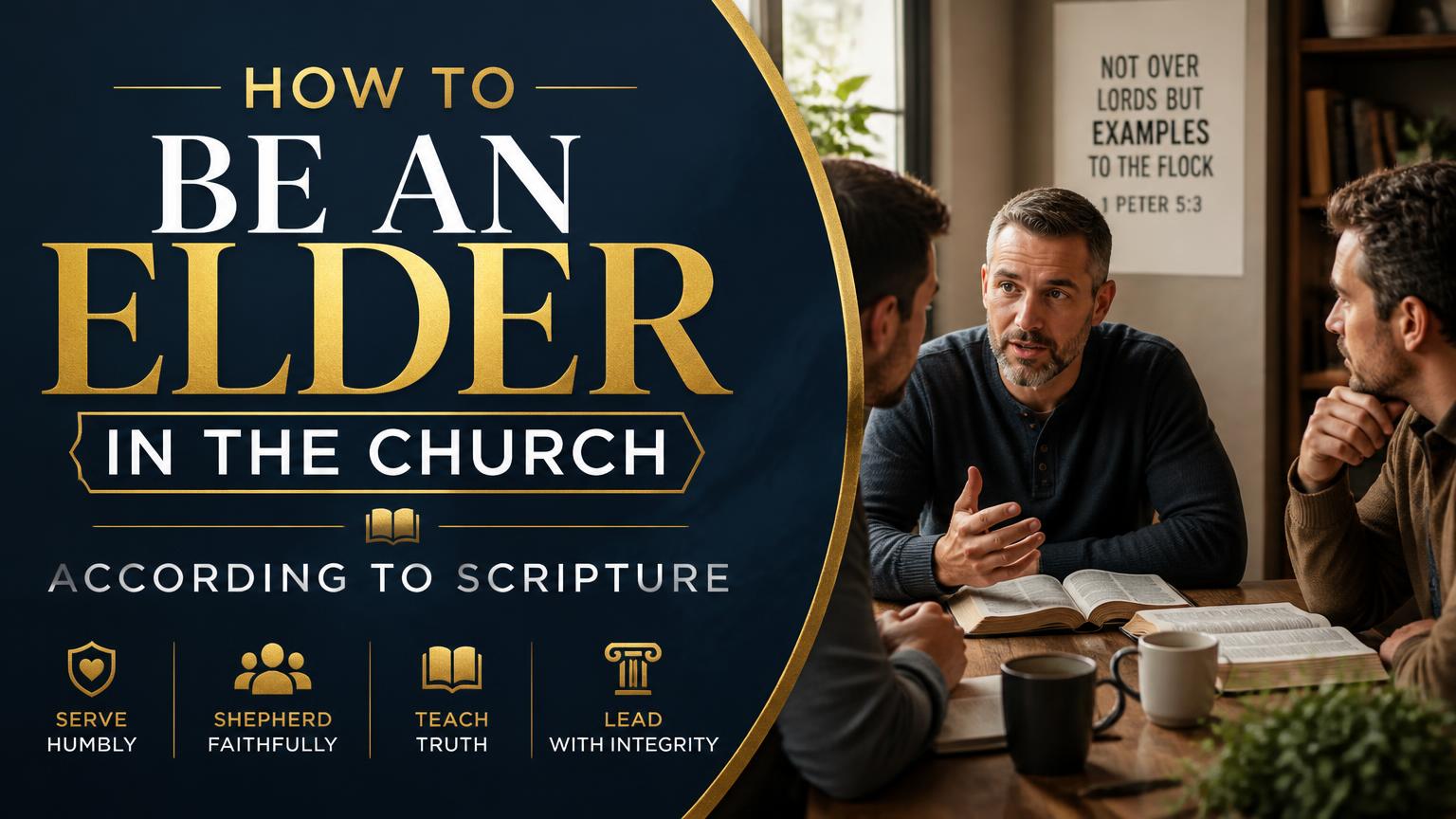
An elder in the church is a spiritually mature Christian who is recognized and appointed to shepherd God’s people. Scripture emphasizes character before charisma, faithful teaching before public influence, and servant leadership rather than status. A prospective elder should therefore pursue Christlike maturity, sound doctrine, a well-ordered life, and faithful care for the congregation—not merely seek a title or position.
How to Be an Elder in the Church
The clearest qualifications for an elder appear in 1 Timothy 3:1–7 and Titus 1:5–9. Together, these passages show that an elder must be above reproach, spiritually mature, able to teach, faithful in relationships, self-controlled, and capable of leading a household and congregation wisely.
Meet the Biblical Qualifications
The qualifications are primarily tests of proven character. Paul does not begin with education, wealth, popularity, or organizational ability. He begins with a life that can withstand examination.
An elder should be:
- Above reproach: This does not mean sinless perfection. It means that no persistent, credible pattern of ungodliness undermines his profession of faith or damages the church’s witness.
- Faithful in marriage and sexual conduct: “The husband of one wife” points to marital and sexual faithfulness. Churches differ on how this applies to singleness, divorce, or remarriage, but the central concern is demonstrated integrity and covenant faithfulness.
- Temperate and self-controlled: An elder should not be governed by anger, alcohol, impulsiveness, greed, or other uncontrolled desires.
- Respectable and hospitable: He should be approachable, orderly, and willing to welcome and care for others, including people who cannot advance his interests.
- Able to teach: This involves more than public speaking. An elder must understand Scripture accurately, explain it clearly, correct error patiently, and apply it to real situations (1 Timothy 3:2; Titus 1:9).
- Not quarrelsome or domineering: A man may be decisive without being harsh. Elders lead by persuasion, patience, and example rather than intimidation.
- Free from greed: Church leadership must not become a means of gaining money, influence, or personal security.
- Spiritually mature: Paul warns against appointing a recent convert, because authority without tested maturity can produce pride and spiritual harm (1 Timothy 3:6).
These qualities are not merely an ideal checklist. They provide a way for a church to evaluate whether a candidate’s private life supports his public ministry.
Shepherd People Rather Than Pursue Status
In the New Testament, elders are shepherds of God’s flock. Peter instructs elders to care for believers willingly, eagerly, and by example, “not domineering over those in your charge” (1 Peter 5:1–4). Jesus identifies servant leadership as the pattern for his followers: greatness is expressed through service, not control (Mark 10:42–45).
This means an elder should know the people entrusted to him, listen to their concerns, pray for them, teach them, and help protect them from destructive doctrine and conduct. Shepherding includes encouragement and correction. Love does not ignore serious sin or false teaching, but correction should seek restoration rather than humiliation.
The elder’s authority is therefore ministerial, not absolute. Elders serve under Christ, the chief Shepherd, and remain accountable to God and, in appropriate ways, to the congregation and fellow leaders.
Become Competent in Scripture and Doctrine
An elder must hold firmly to the trustworthy word so that he can encourage believers with sound teaching and refute error (Titus 1:9). Biblical leadership requires more than sincere opinions or personal experience. The elder must learn how the Bible fits together and handle it responsibly.
This usually involves:
- Regular study of Scripture: An elder should read broadly, interpret passages in context, and understand the Bible’s central message.
- Doctrinal clarity: He should know what the church believes about the gospel, God, Christ, salvation, the church, Christian living, and future hope.
- Ability to explain: He should make biblical truth understandable to people at different levels of maturity.
- Discernment: He must distinguish central Christian teaching from secondary disagreements and identify teachings that distort the gospel.
- Application: Biblical knowledge should produce faithful action, not merely impressive discussion.
James 3:1 warns that teachers will be judged more strictly. That warning should produce humility, careful speech, and a willingness to keep learning.
Lead the Household Faithfully
Paul connects church leadership with household leadership: “If someone does not know how to manage his own household, how will he care for God’s church?” (1 Timothy 3:5). The home is not a perfect performance review, and faithful parenting cannot guarantee that children will believe. The issue is whether the candidate demonstrates responsible, loving, and orderly leadership in ordinary relationships.
A prospective elder should show that he can:
- keep his commitments;
- treat a spouse and children with patience and honor;
- exercise appropriate authority without cruelty;
- accept correction;
- manage time, money, and responsibilities wisely; and
- cultivate an environment where faith is taught and practiced.
The home matters because leadership character is most visible where a person receives no public applause.
Demonstrate a Willingness to Serve
First Peter 5:2 describes elders as serving willingly, not under compulsion. A person may be encouraged to consider eldership, but he should not pursue it merely because of pressure, prestige, or resentment that others have been chosen.
A healthy desire for eldership is a desire to help people follow Christ. Paul calls the desire to serve as an overseer a noble aspiration (1 Timothy 3:1), but that desire must be tested against the other qualifications. Wanting influence is not the same as wanting responsibility for souls.
What Elders Do in the Local Church
The New Testament presents several connected responsibilities rather than one narrow job description.
Teach and Guard the Faith
Elders preserve the church’s doctrinal health by teaching Scripture, answering questions, correcting error, and ensuring that public ministry remains centered on the gospel. This may involve preaching, leading Bible studies, counseling, discipling individuals, or evaluating teaching.
Pray and Care for the Congregation
Acts 6:4 identifies prayer and the ministry of the word as central apostolic priorities, and elders share this pastoral concern. Elders pray for the sick, distressed, tempted, and wandering. They help believers interpret suffering and make wise decisions in light of Scripture.
Guide the Church Together
Acts 14:23, Acts 20:17–35, and 1 Peter 5 present eldership as a shared responsibility. In many churches, elders make decisions together, oversee ministry, address serious problems, and help set the congregation’s direction.
This does not require every elder to have identical gifts. One may teach regularly, another may excel in visitation or administration, and another may be especially skilled in counseling. All, however, should meet the character requirements and participate meaningfully in shepherding.
Equip Others for Ministry
Elders should not create dependence on themselves. Ephesians 4:11–16 describes leaders who equip believers for works of service so that the whole body grows. An elder’s success is therefore seen partly in whether members become more mature, capable, and active in serving others.
How a Church Should Recognize and Appoint Elders
A biblical process begins with observation, not self-promotion. The church should watch a candidate’s conduct over time, examine his doctrine, consider his family and relationships, and observe how he responds to disagreement, correction, suffering, and responsibility.
A wise process commonly includes:
- A tested period of service: A man should demonstrate faithfulness in ordinary ministry before receiving formal authority.
- Doctrinal and character evaluation: Leaders should discuss his beliefs, lifestyle, relationships, and understanding of eldership.
- Feedback from people who know him: Private reputation matters. A candidate should be respected both inside and outside the church where possible (1 Timothy 3:7).
- Prayer and communal discernment: Appointment is not simply an administrative decision. Acts 14:23 shows elders being appointed with prayer and dependence on God.
- Public recognition and accountability: The church should understand the elder’s responsibilities and know how concerns can be addressed.
The exact procedure differs among congregations. Some churches elect elders; others appoint them through existing leadership. Scripture gives principles and qualifications without prescribing one universal administrative model.
Important Distinctions and Qualifications
Elder, Overseer, and Pastor
In the New Testament, “elder” emphasizes maturity and recognized leadership, “overseer” emphasizes supervision, and “pastor” emphasizes shepherding. Acts 20:17, 28 and Titus 1:5–7 closely connect these terms. Many traditions therefore understand them as different descriptions of the same pastoral office, although churches may use the titles differently today.
A local title alone does not make someone a biblical elder. The responsibilities and qualifications matter more than the label.
Elders and Deacons
Elders provide spiritual oversight, teaching, and shepherding. Deacons serve the church through practical ministry and meet their own qualifications in 1 Timothy 3:8–13. The roles overlap in the need for godly character, but they are not identical offices.
Authority and Accountability
Hebrews 13:17 calls believers to respect faithful leaders, while 1 Peter 5 forbids elders from domineering. Biblical submission is not permission for spiritual abuse, secrecy, or unaccountable control. Elders remain under Christ’s authority, must act according to Scripture, and should operate with plurality, transparency, and appropriate correction.
Gender and Church Tradition
Many churches understand the elder qualifications—especially the masculine wording in 1 Timothy 3 and Titus 1—alongside 1 Timothy 2:11–15 as teaching that the office of elder is reserved for qualified men. Other Christian traditions interpret these passages differently and permit women to serve as elders or pastors. This is a genuine interpretive disagreement, not a minor issue of terminology. Churches should state their convictions carefully, interpret the relevant passages in context, and treat one another with Christian charity.
What Disqualifies or Undermines an Elder?
A person need not be flawless to serve as an elder, but persistent, unrepentant patterns can disqualify him. Serious concerns include sexual unfaithfulness, uncontrolled anger, addiction, dishonesty, financial exploitation, doctrinal corruption, pride, abusive leadership, refusal of correction, and a household or public life marked by sustained disorder.
Repentance matters, but restoration to fellowship and restoration to a position of spiritual oversight are not automatically the same. Because elders influence many people, a church must consider both genuine change and whether trust can responsibly be rebuilt.
Conclusion
To be an elder in the church, a Christian must pursue more than leadership ability. Scripture calls for tested character, faithful relationships, sound doctrine, spiritual maturity, a willingness to shepherd, and a life that reflects the gospel in private as well as public. The church then recognizes and appoints those whose lives already display these qualities. Eldership is not primarily a platform to occupy; it is a responsibility to carry under the authority of Christ and for the good of his people.