
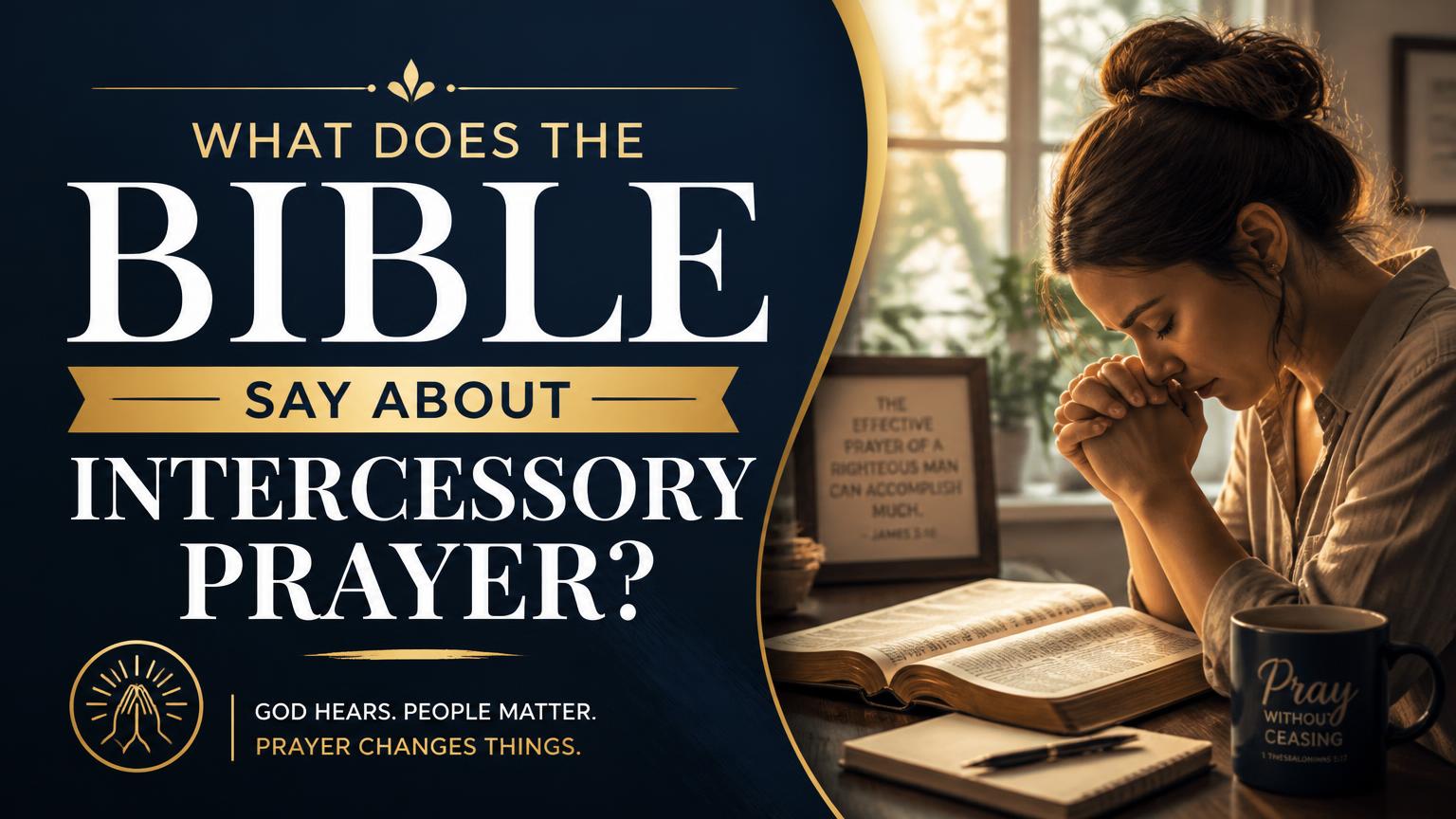
Intercessory prayer is prayer offered to God on behalf of other people, communities, rulers, churches, or nations. The Bible presents it as a normal expression of love and responsibility within faith—not as a way to control God or replace a person’s need for repentance and trust in him. Scripture shows believers interceding for enemies, leaders, the sick, fellow Christians, and people who do not yet believe.
What Does the Bible Say About Intercessory Prayer?
The Bible consistently portrays intercession as bringing another person’s needs before God with humility, persistence, and concern for God’s will. It includes asking for forgiveness, protection, healing, wisdom, spiritual growth, justice, and salvation.
Intercessory Prayer Means Praying on Behalf of Others
The word intercession refers to appealing to God for another person. It is closely related to biblical words for pleading, supplication, and prayer. Intercession may be specific—asking for a friend’s healing—or broad, such as praying for a nation, a church, or government leaders.
Paul gives one of the clearest descriptions in 1 Timothy 2:1–2, where he urges “supplications, prayers, intercessions, and thanksgivings” for all people, including kings and those in authority. The passage shows that intercessory prayer is not limited to private concerns or people who are already close to us.
It also reflects love in action. Instead of merely noticing someone’s suffering, fear, sin, or need, the intercessor brings that concern before God and asks for his help.
The Old Testament Shows Intercession as Loving Advocacy
Several Old Testament figures interceded for others:
- Abraham pleaded for Sodom, asking whether God would spare the city for the sake of righteous people (Genesis 18:22–33).
- Moses prayed for Israel after the golden calf, asking God to show mercy rather than destroy the nation (Exodus 32:11–14, 30–32).
- Samuel considered it a sin to stop praying for Israel and promised to continue teaching the people the right way (1 Samuel 12:23).
- Job prayed for his friends, even after they had spoken wrongly about his suffering (Job 42:8–10).
- Daniel confessed the sins of his people and pleaded for mercy, identifying himself with the community rather than treating its failures as someone else’s problem (Daniel 9:3–19).
These accounts do not suggest that human beings force God to change his character or abandon justice. They show people responding to God’s covenant, mercy, and purposes by asking him to act. Intercession involves honest appeal, but it remains submission to God’s wisdom.
Jesus Is the Central Biblical Example of Intercession
Jesus repeatedly prayed for other people. He prayed for his disciples, asking the Father to protect them, sanctify them, and preserve their unity (John 17:6–26). He told Peter that he had prayed for Peter’s faith not to fail (Luke 22:31–32). He also taught his followers to pray for their enemies rather than respond to hostility with hatred (Matthew 5:44).
Jesus’ prayer in John 17 shows that intercession can include several dimensions:
- protection from spiritual evil
- growth in truth and holiness
- unity among believers
- perseverance in faith
- effective witness to the world
The New Testament also describes Jesus as continuing to intercede for his people. Hebrews 7:25 says that he “always lives to make intercession” for those who draw near to God through him. Romans 8:34 similarly presents Christ as risen, reigning, and interceding for believers.
This does not make Christian intercession unnecessary. Instead, it gives it its foundation. Christians pray for others because Jesus himself intercedes and because believers are invited to participate in God’s care for people.
The Holy Spirit Also Intercedes
Romans 8:26–27 teaches that the Holy Spirit helps believers in their weakness when they do not know what to pray. The Spirit intercedes for God’s people “according to the will of God.”
This passage addresses a common difficulty in intercessory prayer: sometimes a person’s situation is so painful or complicated that specific words are hard to find. The promise is not that every prayer will be eloquent. It is that God understands human weakness and that the Spirit’s work is perfectly aligned with God’s will.
The Spirit’s intercession also places human prayer within the larger work of the Trinity. Christians pray to the Father through the Son, with the help of the Holy Spirit. Intercession is therefore not an attempt to persuade a reluctant God to care. It is participation in the relationship and purposes God has already established.
The Church Is Commanded to Intercede
Intercession appears throughout the instructions given to Christian communities. Believers are told to:
- pray for all people and governing authorities (1 Timothy 2:1–4)
- pray for one another’s healing and restoration (James 5:14–16)
- pray for fellow Christians to receive wisdom and spiritual understanding (Ephesians 1:15–19)
- pray for boldness in sharing the gospel (Ephesians 6:18–20; Colossians 4:2–4)
- pray for those who suffer and for those who are imprisoned or mistreated (Hebrews 13:3)
- pray for enemies and those who persecute them (Matthew 5:44)
The breadth of these commands matters. Biblical intercession is not only about asking for personal comfort. It includes the spiritual, moral, physical, social, and eternal well-being of others.
What Should Christians Pray for When Interceding?
The Bible gives considerable guidance about the content of intercessory prayer. Effective biblical prayer is not measured by dramatic language but by whether it reflects God’s character and revealed priorities.
Pray for Spiritual Growth and Faithfulness
Paul’s prayers often focus on what people are becoming, not merely on the removal of their difficulties. He prays that believers will know God’s will, grow in wisdom, walk in a manner worthy of the Lord, and be strengthened with endurance (Colossians 1:9–12).
This does not mean physical, emotional, or practical needs are unimportant. It means intercession should include deeper requests: that suffering will not destroy faith, that temptation will be resisted, that wisdom will guide decisions, and that a person will become more like Christ.
Pray for Protection and Deliverance
Jesus prayed that his disciples would be kept from the evil one (John 17:15). Christians may therefore pray for protection from temptation, deception, violence, destructive choices, and spiritual oppression.
Protection should not be treated as a guarantee that believers will experience no hardship. The New Testament promises God’s presence and sustaining grace, but it also prepares Christians for suffering. Intercession asks God to preserve a person’s faith and bring good through hardship, whether or not he removes the hardship immediately.
Pray for Healing and Practical Needs
James 5:14–16 instructs the church to pray for the sick, and many biblical prayers ask God to provide food, safety, justice, relief, and restoration. Christians can bring concrete needs to God without pretending to know exactly how or when he will respond.
Biblical prayer holds two truths together: God is able to heal and intervene, and God’s answer is not controlled by the confidence, wording, or persistence of the person praying. Prayer is an act of trust, not a technique that guarantees a desired result.
Pray for Salvation, Mercy, and Justice
Paul expresses deep concern for the salvation of others (Romans 10:1). Abraham, Moses, Daniel, and many of the prophets also pleaded for mercy and restoration. Intercession may therefore ask God to expose sin, grant repentance, open the truth to people, protect the vulnerable, and restrain evil.
Praying for justice does not require personal vindictiveness. Biblical intercession can ask God to defend the oppressed and stop wrongdoing while leaving final judgment in his hands.
How Should Intercessory Prayer Be Practiced?
The Bible emphasizes the character and posture of the person praying as much as the subject of the prayer.
Pray With Love Rather Than Control
Intercession should seek another person’s true good, not the fulfillment of the intercessor’s preferences. For example, praying for someone’s “restoration” should not mean asking God to make that person conform to a particular plan or relationship. It means asking for wisdom, healing, repentance where needed, protection, and whatever genuinely serves God’s good purposes.
Love also changes how Christians pray for enemies. Jesus’ command to pray for persecutors (Matthew 5:44) prevents intercession from becoming a religious form of revenge.
Pray Persistently and Specifically
Jesus used the parable of the persistent widow to teach his disciples to pray continually and not lose heart (Luke 18:1–8). Persistence does not mean repeating words mechanically or trying to wear God down. It expresses dependence and keeps a person attentive to the need.
Specific prayer also makes it possible to recognize different kinds of answers. Instead of praying only, “Bless them,” an intercessor might ask for courage in a difficult conversation, wisdom for a decision, protection from temptation, provision for a known need, or comfort in grief.
Pray With Faith and Submission to God’s Will
First John 5:14 defines confidence in prayer as asking according to God’s will. This does not require certainty about every outcome. It means trusting God’s character while honestly presenting requests.
Jesus provides the clearest model in Gethsemane. He asked for the cup of suffering to be removed, yet submitted to the Father’s will (Matthew 26:36–46). Christian intercession can therefore be both bold and surrendered: bold enough to ask for real change, surrendered enough to accept that God’s wisdom exceeds the intercessor’s understanding.
Pray and Act Responsibly
Intercession is not an excuse to avoid practical obedience. A person who prays for the hungry may also need to provide food; someone praying for the lonely may need to visit; a church praying for the persecuted may need to offer material and pastoral support.
Prayer and action are not competing alternatives. Prayer acknowledges dependence on God, while responsible action becomes one way God answers prayer through his people. James 2:15–16 warns against offering religious words to people in need while refusing appropriate practical help.
What Intercessory Prayer Does Not Mean
Several important distinctions prevent misunderstanding.
Intercession Is Not Manipulating God
The Bible does not present prayer as a formula, magical force, or method for compelling God to grant a request. God remains sovereign, wise, and morally consistent. The purpose of prayer is not to change God from uncaring to caring; Scripture already portrays him as compassionate and attentive.
Prayer may be part of how God accomplishes his purposes, but the Bible does not explain every relationship between divine sovereignty and human prayer. Christians can affirm both that God reigns and that he genuinely commands and uses the prayers of his people.
Intercession Is Not the Same as Mediation
First Timothy 2:5 describes Jesus Christ as the one mediator between God and humanity. That unique role concerns reconciliation with God and salvation. No human intercessor shares Christ’s redemptive position.
At the same time, the same chapter commands believers to offer intercessions for others (1 Timothy 2:1). Christians therefore may pray on behalf of others without claiming to replace Christ or serve as an alternative way of access to God.
Intercession Does Not Guarantee a Specific Outcome
Some biblical prayers receive the requested result; others do not. Paul prayed repeatedly for his “thorn in the flesh” to be removed, but God answered by promising sufficient grace rather than immediate removal (2 Corinthians 12:7–10). Jesus prayed in Gethsemane, yet he still endured the cross.
This does not make intercession pointless. Prayer may bring healing, change circumstances, strengthen faith, provide wisdom, restrain evil, or sustain someone through an unchanged situation. The answer may differ from the request without making the prayer ignored or meaningless.
A Biblical Pattern for Interceding
A simple pattern can help organize prayer:
- Begin with God’s character. Praise him for his mercy, justice, wisdom, and power.
- Name the person or situation clearly. Avoid vague concern when specific knowledge is available.
- Confess relevant sin and ask for repentance. This applies to the intercessor, the community, or the situation as appropriate.
- Ask for concrete needs. Pray for healing, protection, provision, wisdom, reconciliation, justice, or salvation.
- Pray for spiritual endurance. Ask that faith, hope, integrity, and obedience will be strengthened.
- Submit the outcome to God. Trust his wisdom even when the answer is delayed or different.
- Consider obedient action. Ask whether practical help, encouragement, advocacy, or presence is required.
Conclusion
The Bible presents intercessory prayer as loving, persistent prayer for the needs of others. Its examples include Abraham, Moses, Samuel, Daniel, Jesus, the Holy Spirit, and the early church. Christians are instructed to pray for friends and enemies, the sick and suffering, leaders and nations, spiritual growth and salvation. Biblical intercession is bold but not controlling, compassionate but not passive, and confident while remaining submitted to God’s will. Its foundation is Christ’s continuing intercession and its goal is the good of others and the fulfillment of God’s purposes.