
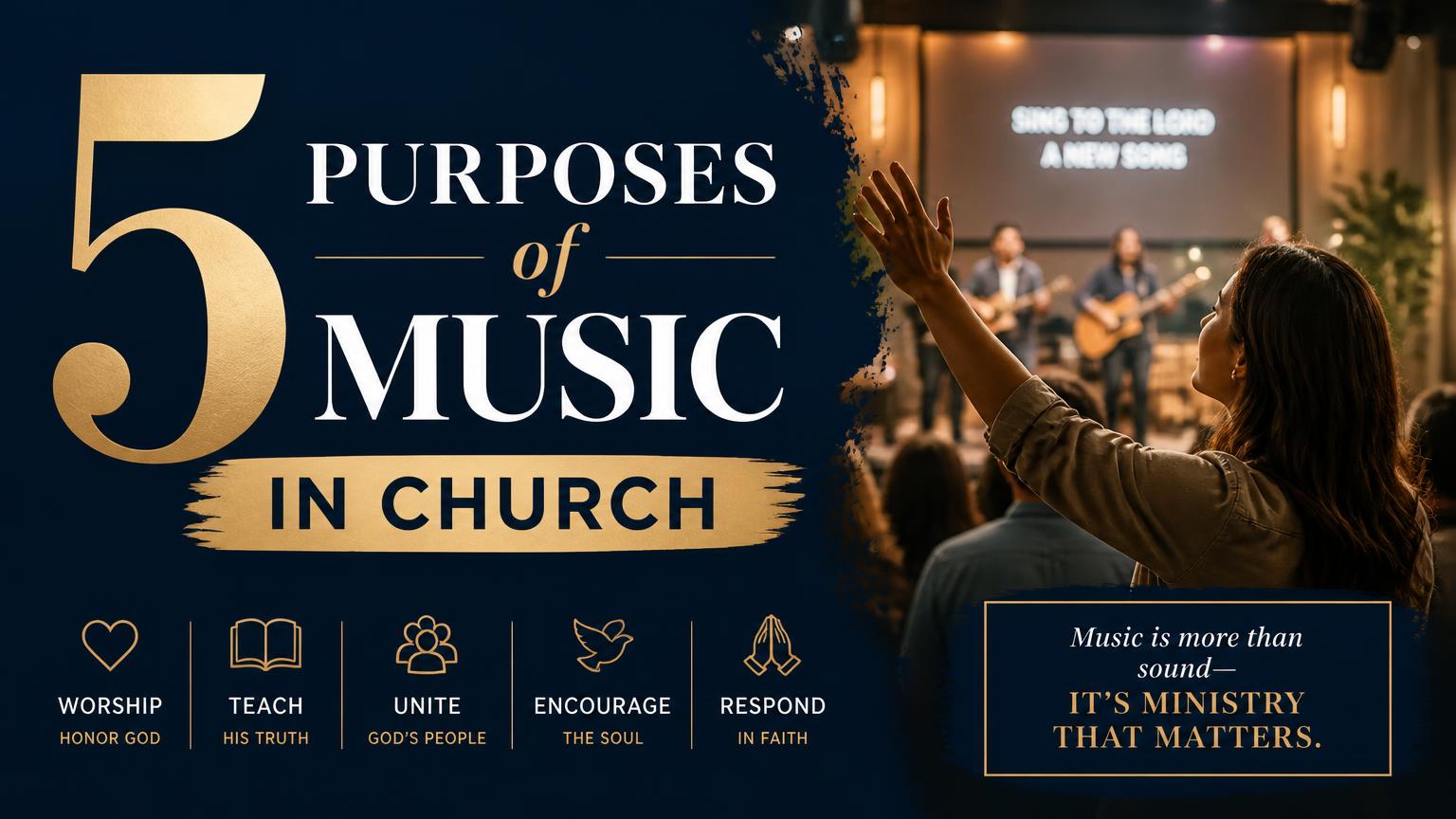
Music in church serves more than an aesthetic or emotional function. It helps the congregation address God, remember biblical truth, express faith, participate as one body, and make the gospel audible to others. Its purpose is not merely to create a mood before a sermon; rightly used, music supports the church’s worship, formation, fellowship, and witness.
5 Purposes of Music in Church
The five purposes overlap, but each highlights a distinct way music serves the gathered church.
1. Worship and Glorify God
The primary purpose of church music is to honor God. Singing gives the congregation a direct way to praise God’s character, remember His works, confess His lordship, and respond to His grace.
The Psalms repeatedly call God’s people to sing because of who God is and what He has done. Psalm 96:1–2 connects singing with declaring God’s glory and proclaiming His salvation. Music therefore directs attention beyond the musicians, the congregation’s emotional experience, or the quality of the performance. Its central subject is God.
This purpose includes more than joyful praise. Worship music can express reverence, thanksgiving, confession, trust, dependence, and surrender. A quiet hymn of repentance and a joyful song of resurrection both glorify God when they truthfully respond to Him.
Music also helps worshipers engage both mind and heart. A congregation may understand a theological statement intellectually, but singing it can help them confess that truth personally and communally. The musical setting does not make the truth more true; it helps the church respond to the truth with its whole person.
2. Teach and Remember Biblical Truth
Church music teaches. Colossians 3:16 instructs believers to teach and admonish one another with psalms, hymns, and spiritual songs. This means songs function as a form of theological instruction within the life of the church.
People often remember words set to music long after they have forgotten a spoken explanation. For that reason, lyrics can shape a congregation’s understanding of God, sin, salvation, suffering, the church, and Christian hope. A song may reinforce biblical teaching throughout the week as people recall and repeat it.
Effective worship songs should therefore communicate truth clearly rather than rely only on emotional intensity or religious vocabulary. They can:
- retell the story of redemption;
- summarize biblical doctrine;
- rehearse God’s promises;
- teach the meaning of Christ’s death and resurrection;
- give language to prayer and confession;
- remind believers how to live faithfully.
This purpose also explains why theological accuracy matters in church music. A memorable song can preserve a sound biblical conviction, but it can also preserve a vague or misleading idea. Songs need not quote Scripture word for word, but their central claims should agree with Scripture and represent Christian truth responsibly.
3. Express the Church’s Full Range of Response
Music gives believers language for responses that are difficult to express in ordinary speech. The Bible includes songs of celebration, lament, repentance, longing, confidence, thanksgiving, grief, and hope. The Psalms show that faithful worship does not require pretending that life is always joyful.
James 5:13 gives a simple example: those who are cheerful should sing praise, while those who suffer should pray. Scripture also gives the church songs for seasons of fear, injustice, loss, waiting, and apparent silence from God. This prevents music from becoming a tool for emotional denial.
Lament is especially important. A church that sings only triumphal songs may unintentionally suggest that sorrow reflects weak faith. Songs of lament allow suffering believers to bring honest pain before God while still holding on to trust. The movement from grief to hope does not always happen immediately, but music can help believers remain oriented toward God during the process.
This purpose has a pastoral effect. A person who cannot find words for personal sorrow may join a congregation singing a biblical confession of trust. The song does not erase the pain, but it places that pain within the larger story of God’s presence and promises.
4. Unite and Strengthen the Congregation
Congregational singing physically and spiritually gathers individual believers into a shared confession. People with different ages, personalities, cultures, and experiences use the same words to praise the same God. Music therefore expresses the unity of the body of Christ.
The New Testament describes worship as something believers offer together. Ephesians 5:19 connects singing with speaking to one another through psalms, hymns, and spiritual songs. The words are addressed to God, but they also encourage the people who hear and sing them.
Music strengthens the church in several ways:
- it reminds believers that they do not follow Christ alone;
- it gives the congregation a shared vocabulary of faith;
- it encourages perseverance during difficulty;
- it allows the whole church to participate rather than remain an audience;
- it helps different generations and backgrounds confess common truths.
This is why congregational participation matters. A technically impressive performance may be musically excellent but still fail to serve the church if it leaves most people unable or unwilling to sing. Musical skill has value, but in a worship gathering it should support intelligible, meaningful participation rather than replace it.
Unity does not require every congregation to use the same musical style. Churches may differ in instruments, languages, arrangements, and cultural expressions while remaining united in the truth they proclaim. The essential question is whether the music helps the church worship together, not whether it reflects one universal aesthetic preference.
5. Proclaim the Gospel and Bear Witness
Church music can communicate the gospel both within the congregation and beyond it. Songs announce who God is, what Christ has done, why people need redemption, and what hope believers have. In that sense, singing is a form of proclamation.
Psalm 96:3 connects worship with declaring God’s glory among the nations. The church’s songs can make its beliefs understandable to visitors, children, seekers, and those who are hearing Christian truth for the first time.
Acts 16 provides a vivid example. Paul and Silas prayed and sang hymns while imprisoned, and their witness became part of the jailer’s encounter with the gospel. The passage does not present music as a guaranteed technique for producing conversion. Rather, it shows how faithful worship can bear witness under pressure and provoke questions about the hope Christians possess.
This purpose requires balance. Music should not be treated as a marketing device or manipulated to create a predetermined response. A church’s witness is strongest when its songs are truthful, its worship is sincere, and its communal life supports what it sings. The message of a song becomes more credible when the congregation demonstrates the humility, holiness, love, and hope it professes.
How These Purposes Shape Church Music
Because church music has several purposes, no single measure can determine whether it is serving the congregation well. Musical quality matters, but it is not the only consideration. A useful evaluation asks whether the music is faithful, understandable, participatory, pastorally appropriate, and directed toward God.
Congregational Participation Should Remain Central
In a church service, the congregation is not merely an audience watching specialists perform. Ephesians 5:19 and Colossians 3:16 present singing as a shared activity in which believers speak and minister to one another.
This does not prohibit choirs, bands, soloists, or other forms of musical leadership. Those ministries can enrich worship when they help the congregation sing, listen attentively, or respond meaningfully. The danger arises when performance becomes the central event and congregational worship becomes secondary.
Musical Style Is a Means, Not the Purpose
The Bible does not prescribe one modern musical style for every church. Scripture includes varied instruments, forms, and emotional expressions. Musical style is shaped by culture, history, language, and the people a congregation is serving.
That freedom does not make style irrelevant. Music communicates through sound as well as words, and a style may help or hinder participation for a particular congregation. The wise question is not simply, “Is this style traditional or contemporary?” It is, “Does this musical approach help this church sing truthful worship together?”
Excellence Should Serve Meaning
Careful preparation honors both God and the congregation. Clear arrangements, competent musicianship, appropriate volume, and thoughtful song selection can remove distractions and help people participate.
Yet excellence must remain a servant rather than a master. A complex arrangement that prevents the congregation from singing may be less suitable than a simpler one. Likewise, emotional impact should not substitute for biblical substance. The goal is not to make a service impressive but to help the church respond faithfully to God.
Songs Should Fit the Church’s Pastoral Needs
A congregation needs more than songs of celebration. Its musical life should provide language for the whole Christian journey: confession, assurance, baptism, communion, suffering, mission, thanksgiving, death, resurrection, and hope.
Song selection can also respond to the church’s circumstances. A congregation grieving a death may need songs that acknowledge sorrow and affirm resurrection hope. A church facing injustice may need songs that proclaim God’s righteousness and teach patient faithfulness. Pastoral wisdom recognizes that the same musical emphasis will not serve every congregation or every season equally.
What Music in Church Is Not
Music is a significant part of Christian worship, but it is not identical to worship itself. Romans 12:1 describes the presentation of one’s whole life to God as worship. Prayer, preaching, generosity, service, obedience, fellowship, and care for the vulnerable also belong to the church’s worship.
Music should therefore support the church’s broader calling rather than become a substitute for it. A congregation can sing accurate words without practicing them, just as it can hear sound teaching without obeying it. Biblical music joins truthful words to faithful response.
Music is also not a guarantee of a particular emotional experience. Some people feel deeply moved while singing; others experience worship more quietly. Emotional response can be genuine and valuable, but it is not the final measure of whether worship has occurred. The central issue is whether the church is truthfully turning toward God in faith and obedience.
Conclusion
The five purposes of music in church are to glorify God, teach biblical truth, express the church’s range of response, unite and strengthen believers, and proclaim the gospel. These purposes explain why church music deserves thoughtful theological and pastoral attention. Its effectiveness is not measured primarily by popularity, style, or emotional intensity, but by whether it helps the congregation sing truthfully, participate faithfully, and live out what it confesses.