
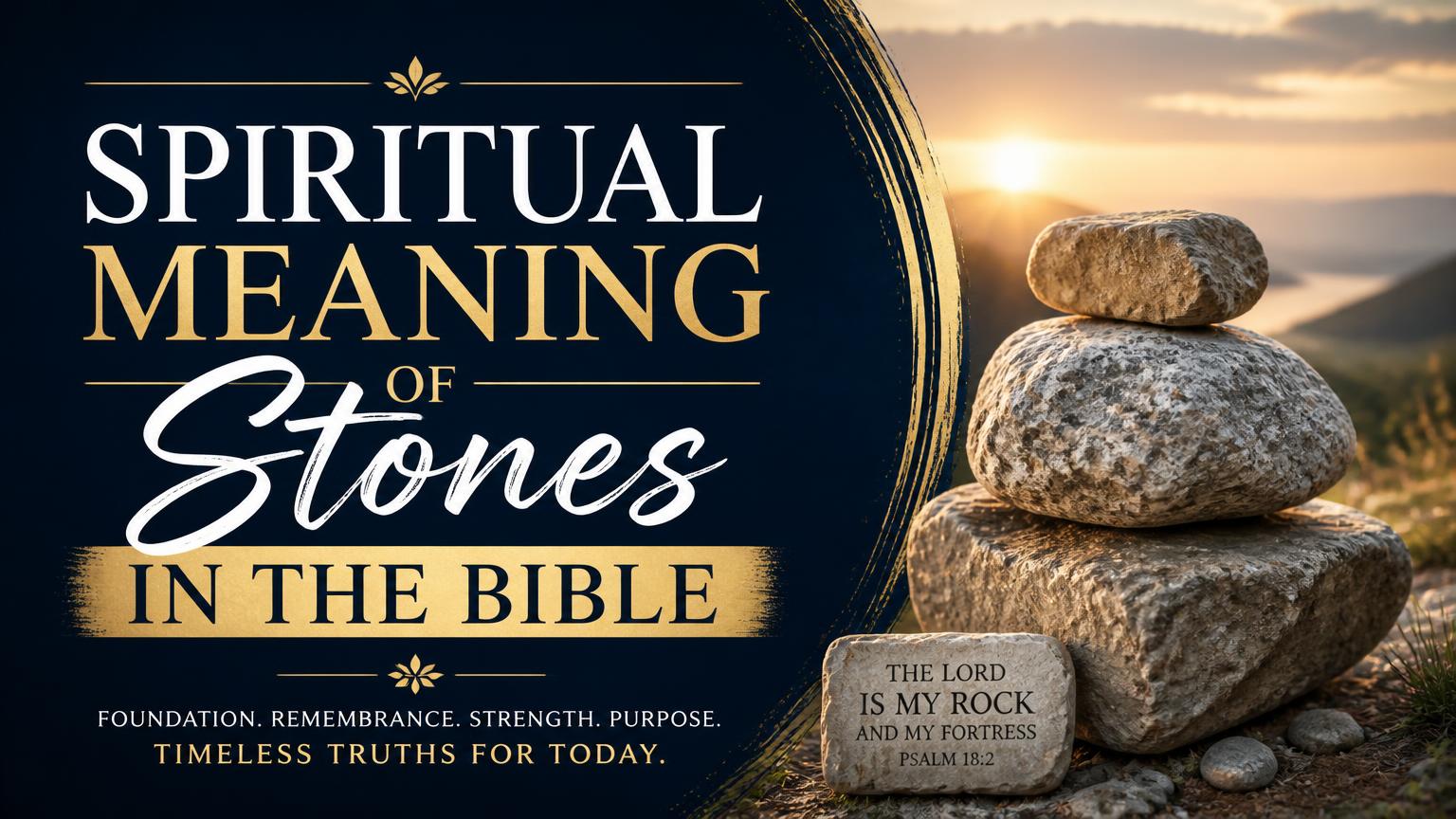
Stones appear throughout the Bible as physical objects, building materials, memorials, weapons, signs of judgment, and images of spiritual realities. Their meaning depends on the passage. A stone may represent remembrance, stability, worship, judgment, hardness of heart, Christ, or God’s people united as a spiritual house.
The Bible does not provide one universal “stone symbolism” or a fixed meaning for every dream involving stones. The surrounding story and the biblical use of the image determine its significance.
Spiritual Meaning of Stones in the Bible
Stones as Memorials of God’s Faithfulness
One of the clearest biblical meanings of stones is remembrance. People sometimes set up stones to mark what God had done and to teach future generations.
After Israel crossed the Jordan River, Joshua instructed twelve men to take stones from the riverbed and set them up at Gilgal. When children later asked about the stones, the Israelites were to explain how God had stopped the Jordan so His people could cross (Joshua 4:1–24). The stones functioned as a visible testimony to God’s power and faithfulness.
Jacob also used a stone as a memorial after God met him at Bethel. He set up the stone on which he had rested his head and consecrated the place to God (Genesis 28:18–22).
This meaning appears in other passages as well:
- Samuel set up a stone called Ebenezer after God helped Israel defeat the Philistines (1 Samuel 7:12).
- Joshua set up a stone as a witness to Israel’s covenant commitment (Joshua 24:26–27).
- Stones connected with altars often marked places of worship and encounters with God.
The spiritual principle is practical: visible reminders can help people remember invisible realities. Biblical memorials were not magical objects. Their purpose was to direct attention away from the stone itself and toward God’s acts, promises, and covenant.
Stones as Altars and Acts of Worship
Stones frequently served as materials for altars. Noah built an altar after the flood (Genesis 8:20), Abraham built altars during his journeys (Genesis 12:7–8; 13:18), and Elijah repaired an altar of the Lord made with twelve stones representing the tribes of Israel (1 Kings 18:30–32).
In these settings, stones represent consecration, sacrifice, worship, and a deliberate response to God. An altar marked a place where people acknowledged God’s presence and depended on His mercy.
The Bible also placed limits on how altars were to be constructed. Israel was warned against shaping altar stones in a way that reflected human pride or pagan practices (Exodus 20:25). This reinforces an important theme: worship is centered on God rather than on human craftsmanship or religious display.
Stones as Foundations, Security, and Stability
A stone foundation represents strength and permanence. Jesus used this image in the parable of the wise and foolish builders. The person who hears His words and acts on them is like someone who builds a house on rock; when rain, floods, and winds come, the house remains standing (Matthew 7:24–27).
The image does not promise a life without storms. It teaches that obedience to Jesus provides a reliable foundation when trials come. Stability results from hearing and practicing His teaching, not merely from possessing religious knowledge.
The Bible also uses stone imagery to describe God Himself:
- “The Rock” is a recurring title for God in Deuteronomy, the Psalms, and other Old Testament books.
- Psalm 18:2 describes the Lord as a rock, fortress, shield, and stronghold.
- Deuteronomy 32 contrasts the true Rock with false gods and unreliable sources of security.
In this sense, stone symbolizes dependability. God is not unstable or temporary; He is a refuge who can be trusted.
Christ as the Cornerstone
The cornerstone is one of the Bible’s most important stone images. In ancient construction, a cornerstone helped establish the position and alignment of a building. The image therefore suggests both foundation and authority.
Psalm 118:22 says, “The stone that the builders rejected has become the cornerstone.” Jesus applied this passage to Himself in Matthew 21:42. Although religious leaders rejected Him, God appointed Him as the essential foundation of His redemptive work.
The same theme appears in Isaiah 28:16, which speaks of a tested and precious cornerstone, and in 1 Peter 2:6–8. Christ is the cornerstone for those who believe, but the same Christ becomes a “stone of stumbling” for those who reject Him.
This does not mean that Jesus changes character depending on the person. The difference lies in the human response to Him. The one who trusts Christ finds a firm foundation; the one who refuses Him encounters the consequence of rejecting God’s appointed foundation.
Believers as Living Stones
First Peter 2:4–5 describes Christians as “living stones” being built into a spiritual house, with Jesus Christ as the cornerstone. This metaphor contains several ideas.
First, believers receive spiritual life from their relationship with Christ. A literal stone is lifeless, but Christians are “living stones” because they have been made spiritually alive through God’s work.
Second, individual believers are not pictured as isolated objects. They are joined together into a spiritual house. The image emphasizes community, mutual belonging, and shared worship.
Third, the church’s identity depends on Christ. The stones do not determine the building’s design independently; they are built upon the cornerstone. Christian community therefore cannot be separated from submission to Jesus.
The metaphor also gives dignity and responsibility to believers. They are part of God’s dwelling and are called to offer spiritual sacrifices through Jesus Christ, including worship, obedience, service, and lives devoted to God.
Stones and Hardness of Heart
Stone can also symbolize spiritual stubbornness and resistance to God. Through Ezekiel, God promised to remove a “heart of stone” and give His people a “heart of flesh” (Ezekiel 36:26).
Here, the contrast is between an unresponsive heart and one made receptive to God. A heart of stone does not mean a person lacks emotion in a psychological sense. It describes moral and spiritual resistance—an unwillingness to listen, repent, or obey.
The promise of a new heart shows that spiritual transformation is God’s work. People do not make themselves spiritually alive merely through external religious behavior. God changes the inner person, enabling faithful obedience.
This image should be handled carefully. Calling someone “hard-hearted” in Scripture is a moral and spiritual diagnosis, not permission to condemn people casually. The passage ultimately points to God’s mercy and power to renew those who have resisted Him.
Stones as Witnesses and Testimony
Because stones endure and remain visible, the Bible sometimes presents them as witnesses. In Joshua 24:27, Joshua says that a stone will serve as a witness against Israel because the people have affirmed their covenant with God.
The stone is not conscious or supernatural. It represents the permanence of a public commitment. The people had made a declaration, and the memorial stone marked the seriousness of their words.
This symbolism carries a warning: covenant promises and public professions bring responsibility. A person’s words should correspond to faithful conduct. The stone’s role as a witness emphasizes that commitments before God are not casual statements.
Stones as Judgment, Rejection, and Stumbling
Stones can represent judgment in several ways. In the Old Testament, stones were sometimes used in the execution of legal penalties for serious offenses under Israel’s covenant law. Such passages belong to Israel’s particular legal and covenant setting and should not be treated as general authorization for personal violence.
Stone imagery also describes the danger of rejecting God. Isaiah 8:14 calls the Lord a stone over which people may stumble. Romans 9:32–33 applies related language to Christ, and 1 Peter 2:7–8 again connects the cornerstone with stumbling.
A “stumbling stone” is not merely an inconvenience. It is something that exposes a person’s opposition, unbelief, or disobedience. Christ becomes a dividing point: people either build upon Him in faith or reject the foundation God has provided.
Jesus also spoke of a stone falling in judgment in Matthew 21:44, following His teaching about the rejected cornerstone. The point is not that stone possesses independent power. The image communicates the certainty and seriousness of divine judgment.
Precious Stones and God’s Glory
Precious stones often signify beauty, honor, wealth, holiness, and glory. The high priest’s breastpiece included precious stones engraved with the names of the tribes of Israel (Exodus 28:15–21). These stones represented the people before God, showing that they were remembered in the context of worship and covenant.
The New Jerusalem in Revelation 21 is described with precious stones, jewels, and foundations adorned with beauty. This imagery communicates the splendor, purity, permanence, and value of God’s future dwelling with His people. It is not necessarily intended as a construction diagram; it is apocalyptic symbolism that uses extraordinary material beauty to portray divine glory.
The lesson is that what belongs to God is precious, set apart, and worthy of honor. Precious stones in biblical imagery point beyond material wealth to the beauty of holiness and the value of God’s redemptive work.
The Stone at Jesus’ Tomb
The stone placed at Jesus’ tomb represented closure, death, and an apparently final barrier. When the stone was rolled away, it did not mean that Jesus needed help escaping. The resurrection had already occurred by the time the women arrived; the opened tomb revealed that He was risen and allowed the witnesses to see that it was empty (Matthew 28:1–6; Mark 16:1–6).
The rolled-away stone therefore signifies that death could not hold Christ and that access to the tomb was no longer blocked. It is a visible sign of the resurrection, not an object with magical power.
How to Interpret Stone Imagery in a Biblical Passage
A sound interpretation begins with context rather than with a symbolic dictionary. Ask several questions:
- What is the stone doing in the passage? Is it marking an event, supporting a building, blocking a tomb, serving as an altar, or causing someone to stumble?
- Who is using the image? God, a prophet, Jesus, a narrator, or an ordinary person may use the symbol for different purposes.
- What happens around the stone? Its meaning often comes from the action associated with it.
- Does the passage explain the image? Later verses may identify the stone as Christ, a witness, a memorial, or a sign of judgment.
- How does the image fit the broader biblical teaching? Interpretation should agree with the passage’s context and should not force a meaning that contradicts clearer Scripture.
For example, a stone in Joshua 4 primarily points to remembrance, while a stone in 1 Peter 2 points to Christ and the spiritual community of believers. Treating both stones as having exactly the same meaning would ignore the purpose of each passage.
What Stones Do Not Automatically Mean
The Bible does not teach that every stone carries a secret spiritual message. It also does not establish a universal system in which the color, shape, or location of a stone determines a personal prophecy.
A stone may be spiritually meaningful because Scripture uses it in a particular context, but that does not make stones inherently divine or objects of worship. The biblical memorial stones directed people toward God; they were not themselves sources of power.
Likewise, a dream involving a stone cannot be interpreted confidently from a generic list of symbols alone. Biblical dream interpretation belongs to particular narratives and divine revelations, such as Joseph’s and Daniel’s experiences. Modern personal impressions should be tested carefully against Scripture rather than treated as authoritative revelation.
Conclusion
The spiritual meaning of stones in the Bible is varied but coherent. Stones can mark God’s faithfulness, form altars of worship, represent stability, reveal hardness of heart, testify to covenant commitments, portray judgment, and symbolize Christ as the cornerstone. Believers are described as living stones because they receive life from Christ and are joined together as God’s spiritual house.
The central principle is context. A biblical stone does not carry one automatic meaning; its significance comes from how Scripture uses it. In every case, the image ultimately directs attention beyond the object itself—to God’s faithfulness, human response, Christ’s authority, and the enduring foundation of God’s saving work.