
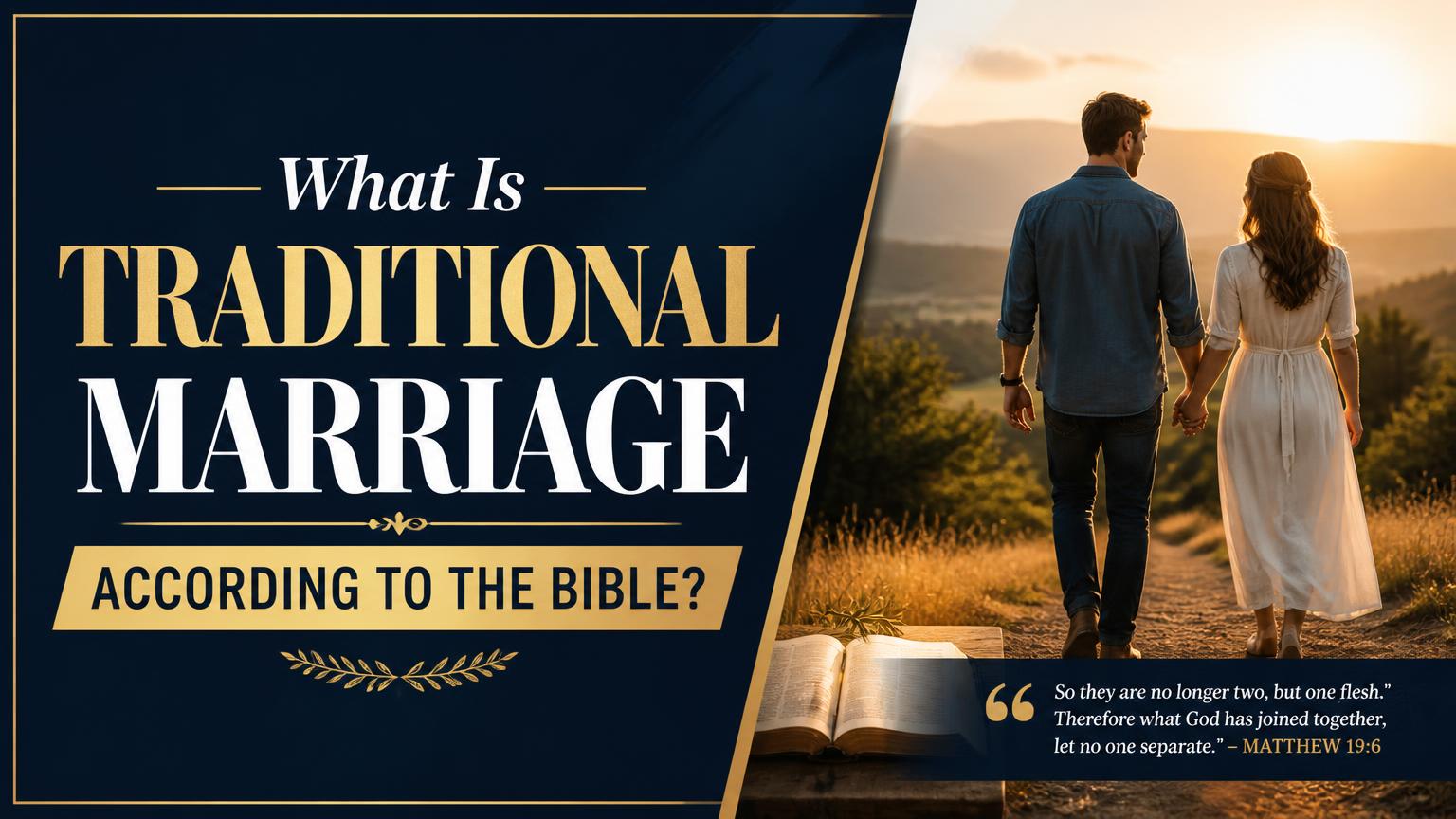
According to the traditional Christian reading of Scripture, marriage is a covenantal, lifelong union between one man and one woman. It is intended for faithful companionship, sexual union, family life, mutual help, and the formation of a household ordered under God. The Bible does not prescribe one universal wedding ceremony, but it consistently presents marriage as more than a private romance or temporary legal arrangement.
What Is Traditional Marriage According to the Bible?
A Covenant Between One Man and One Woman
The biblical pattern begins in creation. Genesis 1:27–28 presents humanity as male and female and connects marriage, family, and fruitfulness. Genesis 2:18–24 then describes the woman as a fitting companion for the man and concludes that a man leaves his parents, is joined to his wife, and the two become “one flesh.”
Traditional Christian interpretation understands this passage as establishing the basic structure of marriage:
- It joins a man and a woman.
- It creates a new family relationship.
- It involves exclusive personal commitment.
- It forms a “one flesh” union of body, life, and covenant.
- It is ordered toward faithful companionship and, ordinarily, family formation.
The Bible uses covenant language for marriage. Malachi 2:14 describes a wife as a man’s partner and “the wife of your covenant.” A covenant is more binding than an informal promise or temporary arrangement: it involves publicly declared obligations and faithfulness over time. Marriage therefore includes affection, but it cannot be reduced to affection. Biblical marriage calls spouses to remain loyal when emotions fluctuate or circumstances become difficult.
A Lifelong “One Flesh” Union
Jesus reaffirmed the Genesis pattern when discussing marriage and divorce. In Matthew 19:4–6, he referred to God creating humanity as male and female, cited Genesis 2:24, and concluded that what God has joined together should not be separated.
The phrase “one flesh” indicates an integrated union rather than merely sexual contact. Husband and wife share a household, responsibilities, bodily intimacy, economic life, and often children. They remain distinct persons, but marriage joins their lives in a uniquely comprehensive way.
This is why biblical teaching treats sexual faithfulness seriously. Adultery is not simply a violation of a private rule; it breaks the exclusivity of the marriage covenant and harms the trust on which the union depends. The command against adultery and the New Testament’s repeated call to sexual purity protect the marriage relationship from betrayal and exploitation.
“Lifelong” does not mean that Scripture ignores the reality of abuse, abandonment, or human sin. It means that marriage is entered as a permanent covenant rather than as a relationship maintained only while it remains convenient. Jesus criticized divorce motivated by hardness of heart, while other biblical passages address situations involving sexual unfaithfulness and abandonment. Christians differ in how they interpret the permitted grounds for divorce and remarriage, but the seriousness and permanence of the original covenant are broadly central to traditional biblical teaching.
Marriage Serves Companionship, Family, and Faithful Sexuality
The Bible presents several connected purposes for marriage rather than only one.
Companionship. Genesis 2:18 says that it is not good for the man to be alone. Marriage provides intimate partnership, shared responsibility, and mutual support. This does not mean that every unmarried person is incomplete; it means that marriage is one God-given form of human companionship.
Sexual union. Biblical marriage provides a covenantal setting for sexual intimacy. Hebrews 13:4 honors marriage and calls for sexual faithfulness within it. Sex is treated as powerful and meaningful, not as a morally insignificant act detached from commitment.
Family and fruitfulness. Genesis connects marriage with becoming fruitful and multiplying. Children are viewed as a blessing in passages such as Psalm 127:3–5, and parents receive responsibility for teaching and caring for them. Traditional biblical marriage therefore normally includes openness to family life, although having children is not what makes a marriage valid.
Mutual assistance. Husband and wife are expected to help one another steward life, work, resources, and faith. Marriage is not presented as a means for one person to use another, but as a covenant in which both contribute to the good of the household.
These purposes belong together. Children without covenantal faithfulness can be exposed to instability; sexuality without commitment can become exploitative; companionship without responsibility can become shallow. The biblical model connects intimacy with duty, freedom with fidelity, and family life with moral formation.
Husband and Wife Owe Each Other Love and Honor
Traditional biblical marriage includes differentiated language about husbands and wives, but it does not authorize cruelty, coercion, or contempt.
Ephesians 5:21–33 begins with a call to mutual submission in reverence for Christ. It then tells wives to respect their husbands and commands husbands to love their wives as Christ loved the church. The husband’s model is therefore not domination but sacrificial care. Christ’s love is self-giving, protective, and committed to the good of the other person.
The same principle appears in other passages. Colossians 3:19 tells husbands not to be harsh with their wives. First Peter 3:7 commands husbands to show consideration and honor. First Corinthians 7:3–4 describes husband and wife as having reciprocal obligations toward one another, including mutual authority over their bodies. These teachings challenge the idea that marriage gives one spouse unrestricted control over the other.
Traditional Christians differ on how to apply biblical teachings about authority and household roles. Some understand them as establishing distinct responsibilities, while others emphasize functional equality within the marriage. Both positions should be distinguished from abuse. Physical violence, intimidation, sexual coercion, manipulation, and financial control contradict the Bible’s commands to love, honor, protect, and serve.
The Biblical Pattern From Genesis to the New Testament
The Bible’s teaching on marriage develops across different historical settings, but its central pattern remains identifiable.
Genesis supplies the foundational account: male and female, leaving and cleaving, and becoming one flesh. Jesus appeals to that creation pattern rather than treating marriage as merely a social custom that can be redefined by changing circumstances. His teaching in Matthew 19 gives Genesis continuing authority for Christian understanding.
The New Testament also uses marriage to explain Christ’s relationship with the church. Ephesians 5:25–32 presents Christ’s sacrificial love as the model for a husband’s love and portrays marriage as a profound “mystery” pointing beyond itself. The comparison does not make marriage divine or place spouses on the same level as Christ. Instead, it gives marriage a spiritual purpose: the relationship should display covenant love, holiness, self-sacrifice, and faithful care.
The Bible does contain accounts of polygamy, including the marriages of Abraham, Jacob, David, and Solomon. These narratives should not automatically be treated as endorsements. Biblical history often records actions that Scripture does not approve, and these households frequently experience rivalry, injustice, or family conflict. Traditional Christian interpretation sees the creation account and Jesus’ appeal to “the two” becoming one flesh as the normative pattern, even though some Old Testament laws regulate rather than explicitly abolish polygamous practices.
What Traditional Biblical Marriage Does Not Mean
Children Are Not a Qualification for Marriage
Marriage is connected with fruitfulness, but infertility does not make a marriage illegitimate. Scripture honors children while also recognizing marriages in which children are not conceived. A couple’s covenant does not depend on reproductive success.
The Bible also gives singleness a positive place. Jesus spoke of people who remain unmarried for the sake of God’s kingdom, and Paul described singleness as a meaningful way to serve God with undivided attention in 1 Corinthians 7. Marriage is honorable, but it is not the universal measure of spiritual maturity, personal value, or completeness.
A Wedding Ceremony Is Not the Whole Definition
Biblical marriage involves public commitment, family and community recognition, and covenant obligations, but the Bible does not require a particular set of vows, clothing, music, venue, or cultural ritual. Wedding customs vary across biblical cultures and across Christian traditions.
This distinction matters because a religious ceremony by itself does not create a healthy biblical marriage. The substance of the covenant—truthfulness, fidelity, mutual responsibility, and lawful commitment—matters more than the style of the celebration.
“Headship” Does Not Mean Unlimited Power
Some traditional readings of Ephesians 5 describe the husband as the head of the wife. In the passage itself, however, this language is immediately shaped by Christ’s sacrificial example. It cannot reasonably be used to justify oppression or to silence a wife’s conscience.
Biblical authority is accountable authority. A husband who demands obedience while refusing sacrifice, tenderness, repentance, and responsibility is not following the model given in Ephesians 5. Likewise, a wife’s call to respect her husband does not require her to cooperate with sin or remain passive in the face of danger.
How Traditional Biblical Marriage Differs From Modern Definitions
The Bible treats marriage as a covenant with moral and spiritual obligations, whereas modern societies may define it primarily through personal autonomy, legal recognition, or emotional partnership. These ideas can overlap, but they are not identical.
A biblical marriage includes love, but love is understood as committed action rather than only romantic feeling. It includes legal and social recognition, but it is more than a government contract. It includes sexual intimacy, but sexual desire does not by itself establish a marriage. It includes personal fulfillment, but the spouses also owe one another fidelity and service.
Traditional Christian interpretation also understands the male-female structure of marriage as part of its definition, not merely as a historical detail. Christians and churches disagree about broader questions of sexual ethics and marriage, but the definition described here is the historic interpretation grounded primarily in Genesis 1–2, Jesus’ teaching in Matthew 19, and the marriage instructions in Ephesians 5 and related passages.
Conclusion
Traditional marriage according to the Bible is a public, lifelong covenant between one man and one woman, marked by exclusive sexual faithfulness, shared life, mutual responsibility, and openness to family. Its model is established in Genesis, reaffirmed by Jesus, and given deeper meaning through Christ’s sacrificial relationship with the church. It does not require a particular ceremony, guarantee children, or permit domination. Its central demand is covenant love expressed through faithfulness, honor, service, and perseverance.