
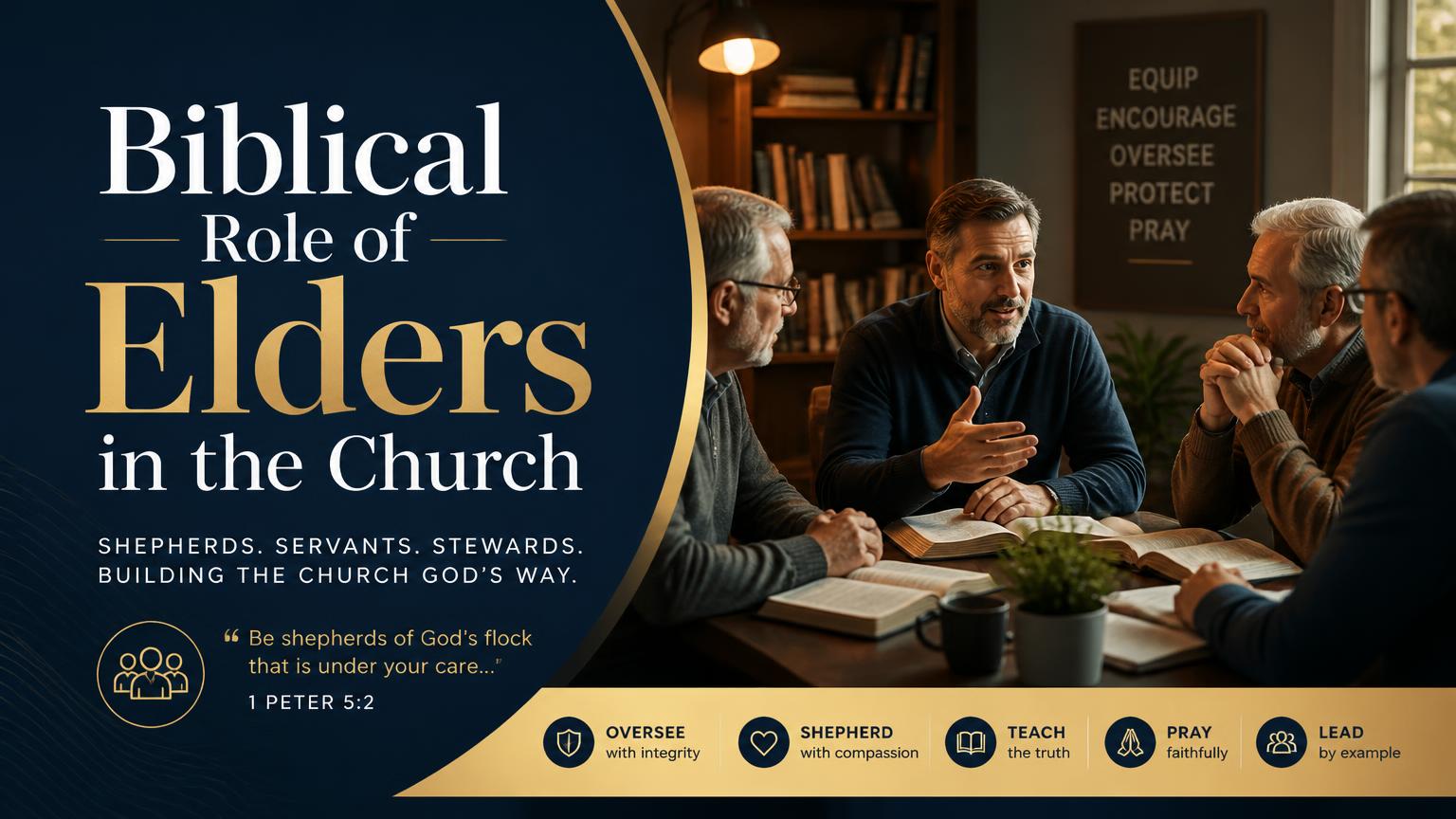
Elders are spiritually qualified men appointed to provide pastoral oversight, teaching, protection, and guidance for a local church under the authority of Jesus Christ. The New Testament presents elders as shepherds and overseers rather than corporate executives or religious rulers. Their authority is real, but it is limited by Scripture and exercised through service, example, prayer, and care for God’s people.
Biblical Role of Elders in the Church
The biblical role of elders combines spiritual leadership with pastoral responsibility. Elders are responsible for guiding the congregation toward faithfulness to Christ, preserving sound teaching, caring for members, and addressing spiritual danger.
Elders Shepherd God’s People
The central image for an elder is a shepherd. Paul instructed the elders of Ephesus to “pay careful attention” to themselves and to all the flock over which the Holy Spirit had placed them as overseers, adding that they were to shepherd the church of God (Acts 20:28). Peter likewise urged elders to shepherd God’s flock willingly and eagerly, not by domineering over people but by becoming examples (1 Peter 5:1–4).
Shepherding includes personal care, spiritual encouragement, correction, protection, and attention to the congregation’s condition. An elder does not merely manage meetings or approve budgets. He helps people follow Christ in the realities of suffering, temptation, family life, conflict, doubt, and Christian service.
The shepherd metaphor also places limits on leadership. The church belongs to God, not to its elders. Elders are entrusted with the flock, but they do not own it. Christ remains the “Chief Shepherd” (1 Peter 5:4), and every elder remains accountable to him.
Elders Teach and Guard Sound Doctrine
Elders must be able to teach. This qualification appears explicitly in 1 Timothy 3:2, and Titus 1:9 explains what that teaching involves: holding firmly to the trustworthy word, encouraging believers through sound doctrine, and refuting those who contradict it.
Teaching is more than delivering sermons. It includes:
- Explaining the meaning of Scripture accurately
- Applying biblical truth to daily life
- Equipping believers to grow in maturity
- Correcting error and harmful interpretations
- Helping the church distinguish Christian teaching from popular but unbiblical ideas
Doctrine matters because what a church believes shapes how it worships, treats people, handles suffering, understands salvation, and pursues holiness. Elders therefore protect the church by guarding the message entrusted to them. Their responsibility is not to invent new teaching but to preserve and faithfully apply the apostolic faith.
Elders Exercise Spiritual Oversight
The New Testament uses the language of oversight for elder leadership. The term translated “overseer” emphasizes responsibility for watching over the church. Elders help establish priorities, resolve disputes, provide direction, and ensure that the church’s life remains consistent with Scripture.
This oversight is spiritual rather than merely administrative. Practical decisions—such as choosing ministry priorities, responding to serious conflict, or caring for vulnerable members—require biblical wisdom, prayer, and pastoral judgment. Elders may delegate tasks, but they cannot delegate their responsibility to care for the church’s spiritual well-being.
Hebrews 13:17 describes leaders as people who “keep watch” over believers and will give an account. This does not grant elders unlimited power. It emphasizes the seriousness of their responsibility before God.
Elders Pray for and Care for the Church
Prayer is a central part of elder ministry. In Acts 6:4, the apostles distinguished their primary calling as devotion to prayer and the ministry of the word. James 5:14 instructs sick believers to call for the elders of the church so that the elders may pray over them and anoint them in the Lord’s name.
Elders bring the needs of the congregation before God, seek wisdom for difficult decisions, pray for spiritual restoration, and intercede for members experiencing illness or hardship. Their care should be personal enough that they know the people entrusted to them, while shared among a plurality of elders so that no single leader must carry every burden alone.
Elders Lead by Example
Biblical leadership depends on character, not charisma. Peter commands elders to be examples to the flock rather than domineering over it (1 Peter 5:3). Paul told Timothy to set an example in speech, conduct, love, faith, and purity (1 Timothy 4:12).
An elder’s private life therefore matters as much as his public ability. People learn from how he handles money, conflict, authority, marriage, parenting, disappointment, and repentance. An elder who teaches humility but demands personal status undermines his message. An elder who teaches holiness while tolerating hidden patterns of sin damages the church’s trust and witness.
Leading by example does not mean being flawless. It means demonstrating credible Christian maturity, receiving correction, practicing repentance, and showing that submission to Christ applies to the leader as much as to everyone else.
Qualifications for Elders
The primary biblical qualifications appear in 1 Timothy 3:1–7 and Titus 1:5–9. These passages emphasize tested character and faithful management of personal responsibilities more than professional achievement.
An elder should be:
- Above reproach
- Faithful and self-controlled
- Respectable and hospitable
- Able to teach
- Not controlled by alcohol
- Gentle rather than violent
- Not quarrelsome or domineering
- Free from a controlling love of money
- Faithful in managing his household
- Spiritually mature and not a recent convert
- Respected by outsiders
- Committed to sound doctrine
These qualifications are not a checklist for perfection, nor are they optional ideals. They describe the kind of life that makes spiritual leadership credible. “Above reproach” does not mean an elder has never sinned; it means there is no established pattern of serious, disqualifying conduct that contradicts his profession.
Household leadership is used as a test of observable responsibility. Paul argues that someone who cannot manage his own household may not be prepared to care for God’s church (1 Timothy 3:4–5). This does not mean an elder’s family must be problem-free. It means his leadership should be marked by faithfulness, care, and integrity rather than neglect or coercion.
The Question of Elders and Women
Christian traditions differ over whether the office of elder is restricted to qualified men or may be held by women. Those who restrict the office commonly appeal to 1 Timothy 2:11–3:7, where teaching and authority in the gathered church are discussed alongside qualifications for overseers, and to the male wording in passages such as 1 Timothy 3 and Titus 1. Complementarian churches understand these passages to assign the governing and teaching office of elder to men while affirming the importance and value of women’s ministries.
Egalitarian churches interpret these texts differently, emphasizing passages about women serving, teaching, and participating in ministry and arguing that the relevant restrictions addressed particular local problems rather than a universal office limitation.
The disagreement should not be reduced to whether a church values women. Both positions can affirm that women are essential to the church’s mission and possess spiritual gifts for ministry. Churches should state their interpretation honestly, apply it consistently, and avoid treating the question as a reason for contempt toward faithful Christians who reach a different conclusion.
How Elders Relate to Pastors, Overseers, and Deacons
The New Testament uses several related terms for church leadership. “Elder” emphasizes maturity and recognized spiritual leadership. “Overseer” emphasizes responsibility for supervision. “Pastor,” or shepherd, emphasizes care for the flock.
In Acts 20:17, Paul summons the elders of Ephesus; in Acts 20:28, he calls those same leaders overseers and tells them to shepherd the church. First Peter 5 also addresses elders as shepherds who oversee God’s flock. These passages strongly connect the three descriptions, even though Christian denominations organize the offices differently.
Some churches use “pastor” for a primary preaching elder, while others use it for all elders who shepherd the congregation. Some traditions have one senior pastor with additional elders; others have a team of elders who share authority. The titles themselves matter less than whether the church follows the biblical functions and qualifications.
Deacons have a distinct but complementary role. In Acts 6, the apostles give priority to prayer and the ministry of the word while other qualified servants address practical needs. First Timothy 3 gives separate qualifications for deacons. Deacons serve the church through practical ministry, while elders carry primary responsibility for spiritual oversight and teaching. The two ministries should cooperate rather than compete.
Why the New Testament Shows a Plurality of Elders
Local churches in the New Testament commonly had multiple elders. Paul and Barnabas appointed elders in the churches they established (Acts 14:23), Paul instructed Titus to appoint elders in every town (Titus 1:5), and James refers to “the elders” of the church in connection with prayer (James 5:14).
Plurality provides several benefits:
- Shared wisdom in difficult decisions
- Mutual accountability among leaders
- Protection against one-person domination
- Continuity when a leader is absent or disqualified
- Broader pastoral care for the congregation
- A visible demonstration that leadership belongs to the body of elders rather than one personality
Plurality does not require every elder to have identical gifts or responsibilities. One may devote more time to preaching, another to counseling, another to administration, and another to shepherding a particular group. Yet they share responsibility for the church’s direction and spiritual health.
Churches differ on how elders relate to the congregation’s final decision-making authority. Presbyterian systems typically place substantial authority in a graded structure of elders and councils. Congregational churches commonly treat the congregation as having final authority in major matters while elders provide spiritual leadership. Other churches use episcopal structures in which bishops exercise authority over multiple congregations. These arrangements should be evaluated in light of Scripture, accountability, and whether they enable faithful pastoral care rather than simply by organizational preference.
What Biblical Eldership Is Not
Biblical eldership is not personal rule. Jesus warned his disciples against copying rulers who “lord it over” others. Christian greatness is expressed through service (Mark 10:42–45). Elders therefore must not use spiritual language to demand unquestioned loyalty, silence legitimate concerns, or control members’ private decisions beyond biblical authority.
Eldership is also not merely a business board. Financial stewardship and organizational decisions matter, but elders are called to watch over souls, teach truth, cultivate holiness, and care for people. A church may have efficient administration and still fail in its pastoral calling.
Finally, eldership is not a reward for wealth, popularity, education, or long attendance. Paul’s qualifications focus on character, doctrine, and tested maturity. A gifted speaker who lacks self-control is not qualified simply because people enjoy listening to him.
How Churches Should Recognize and Support Elders
A church should recognize elders gradually rather than treating appointment as a popularity contest. Potential leaders should be observed in ordinary Christian service, family life, relationships, teaching, and responses to correction. Their doctrine should be examined, and their character should be tested over time.
The congregation also bears responsibility for supporting legitimate leaders. First Timothy 5:17–19 speaks of honoring elders who lead well and protecting them from careless accusations while still allowing credible accusations to be investigated. Support includes prayer, respect, honest communication, appropriate financial provision where applicable, and willingness to receive biblical instruction.
At the same time, accountability is essential. Elders should operate within clear biblical and church structures, make significant decisions transparently, welcome appropriate questions, and respond seriously to allegations of misconduct. Because spiritual authority can deeply affect people, claims of abuse or corruption must never be dismissed merely because the accused is a church leader.
Conclusion
The biblical role of elders is to shepherd, teach, protect, pray for, and oversee a local church under Christ’s authority. Their qualifications center on mature character and sound doctrine, and their leadership is meant to be shared, accountable, and expressed through service rather than control. A healthy eldership does more than organize church activity: it helps believers grow toward faithfulness, guards the gospel, and models the humility of the Chief Shepherd.