
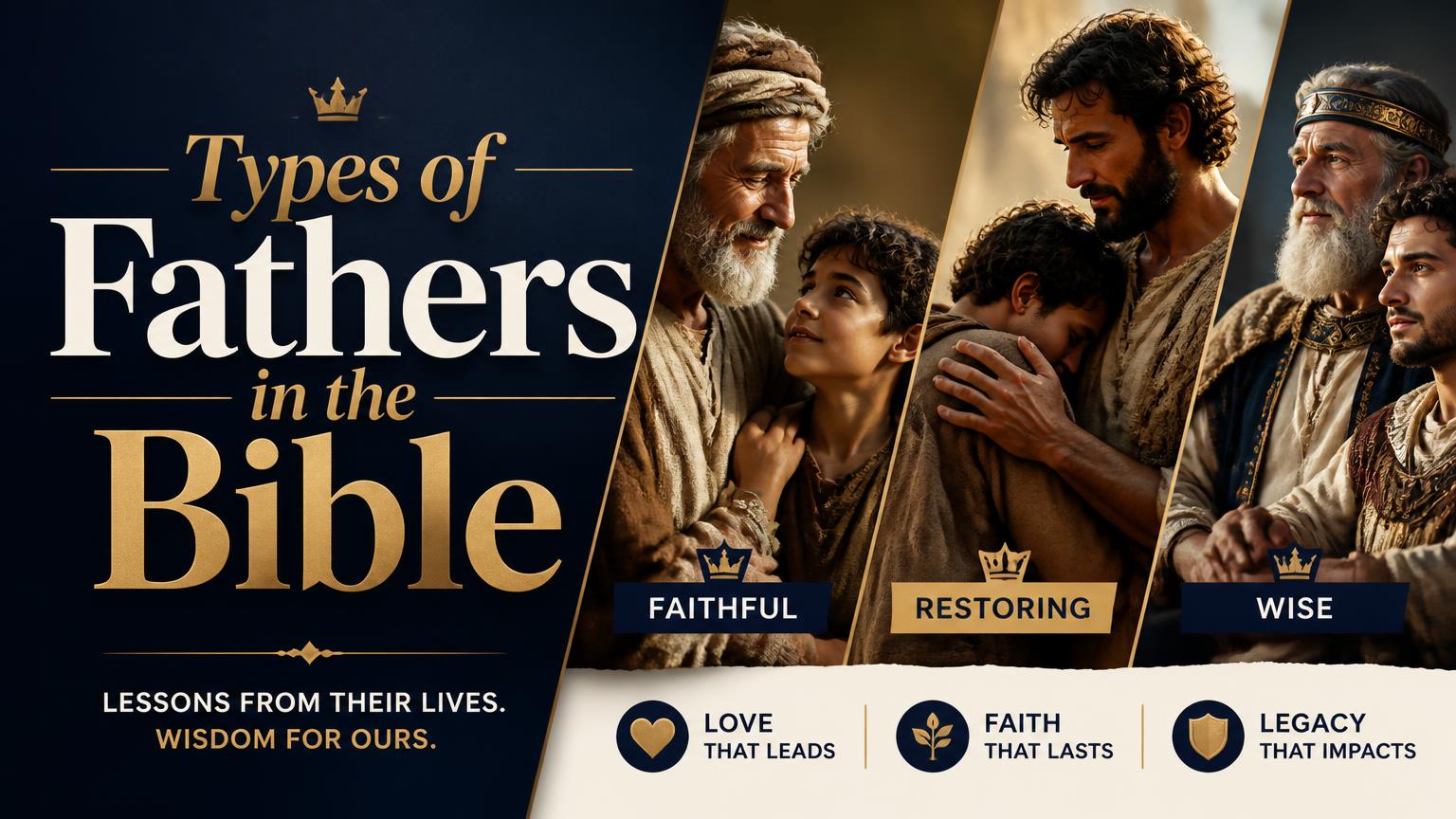
The Bible presents fatherhood in several recurring forms rather than one uniform model. It describes God as the perfect Father, biological fathers who preserve and teach their families, adoptive and guardian fathers who provide protection, spiritual fathers who disciple others, and flawed or destructive fathers whose failures warn readers what fatherhood should not become. These portraits show that biblical fatherhood involves more than producing children: it includes presence, protection, instruction, sacrificial love, correction, and faithful responsibility.
Types of Fathers in the Bible
The following categories are not an official biblical classification. They are useful ways to understand the different fatherly roles and examples found throughout Scripture. A single person may fit more than one category.
God as the Perfect Father
The highest model of fatherhood in the Bible is God himself. The Old Testament describes God as the Father of Israel, the protector of the vulnerable, and the giver of covenant identity. In the New Testament, Jesus teaches his disciples to pray, “Our Father in heaven” (Matthew 6:9), presenting God as both holy and personally accessible.
God’s fatherhood includes several qualities:
- Provision: Jesus teaches that the Father knows and supplies the needs of his children (Matthew 6:25–34).
- Compassion: “As a father shows compassion to his children, so the LORD shows compassion to those who fear him” (Psalm 103:13).
- Discipline: Hebrews 12:5–11 compares God’s corrective work to the discipline of a loving father. Biblical discipline is intended for growth and holiness, not humiliation or revenge.
- Adoption: Through faith in Christ, believers receive “the Spirit of adoption” and are able to call God “Abba, Father” (Romans 8:15; Galatians 4:4–7).
- Faithfulness: Unlike human fathers, God’s character does not fail through weakness, inconsistency, or death.
God’s fatherhood is not merely a sentimental image. It establishes the standard by which every human form of fatherhood is evaluated. Human fathers are called to reflect God’s care, truth, justice, and mercy, while recognizing that no human father can perfectly replace or represent God.
Covenant Fathers Who Pass On Faith
Some biblical fathers are presented primarily as guardians of a covenant promise and teachers of faith. Abraham is the clearest example. God chose him so that he would command his household to follow “the way of the LORD” by practicing righteousness and justice (Genesis 18:19).
Abraham’s role involved more than having Isaac. He was expected to transmit trust in God, obedience, worship, and a shared identity rooted in God’s promise. Isaac and Jacob continued this family and covenant story, although their families also reveal serious weaknesses, including favoritism, deception, and rivalry.
These examples show that a father’s influence extends beyond material inheritance. Fathers pass on patterns of worship, moral habits, family expectations, and assumptions about God. That influence can be constructive or damaging. The Bible therefore treats spiritual formation within the household as a serious responsibility rather than an automatic result of family membership.
Fathers Who Teach and Disciple
Biblical fatherhood includes instruction. Deuteronomy 6:6–7 calls parents to teach God’s commands continually—in ordinary conversation, at home, on the road, and throughout daily life. Instruction is portrayed as a way of forming character, not merely transferring information.
Proverbs repeatedly presents a father teaching his son to pursue wisdom, reject destructive choices, control desire, and fear the Lord. These passages reflect an ancient father-son setting, but their underlying principle applies more broadly: children need guidance that prepares them to make wise decisions when the parent is no longer present.
The New Testament extends this idea to spiritual relationships. Paul describes himself as a father to the Corinthian believers because he brought them the gospel and helped establish their faith (1 Corinthians 4:14–15). He also speaks to the Thessalonians of exhorting, encouraging, and charging them “as a father does his own children” (1 Thessalonians 2:11–12).
A teaching father does not simply demand obedience. He explains truth, models it, corrects errors, and prepares children for responsible maturity. Instruction without example becomes hypocrisy; affection without guidance leaves children without moral direction.
Fathers Who Protect and Provide
Protection and provision are central elements of biblical fatherhood. The father is often expected to secure the household’s physical needs, defend its vulnerable members, and accept responsibility for those under his care.
Joseph, the husband of Mary, illustrates protective fatherhood. Although he was not Jesus’ biological father, he accepted responsibility for Mary and the child Jesus. He obeyed God’s warnings, took the child to safety in Egypt, and provided a stable family setting in Nazareth (Matthew 1:18–25; 2:13–23).
The Bible also presents fathers responding urgently to danger. Jairus pleaded with Jesus to heal his seriously ill daughter (Mark 5:21–43), and the royal official in John 4:46–54 sought help for his dying son. Their actions show that fatherly responsibility includes active concern rather than detached authority.
Provision, however, is broader than earning money. It includes time, safety, attention, emotional steadiness, and practical care. First Timothy 5:8 emphasizes the responsibility to provide for one’s household, but biblical provision should not be reduced to financial support alone.
Adoptive and Guardian Fathers
The Bible includes fathers whose relationship to a child is established through protection, adoption, or guardianship rather than ordinary biological descent. Joseph’s care for Jesus is one example. Mordecai also raised Esther after she became an orphan, acting as a guardian and formative parental figure (Esther 2:7).
These accounts demonstrate that fatherhood in Scripture is defined partly by faithful action. A man becomes fatherly not only through biological connection but also through commitment, sacrifice, protection, and long-term care.
This distinction matters because Scripture repeatedly commands care for orphans and other vulnerable people. James 1:27 describes concern for orphans and widows as part of “pure and undefiled religion.” The biblical vision of fatherhood therefore leaves room for adoption, foster care, guardianship, and other forms of responsible family care.
Fathers Who Show Compassion and Restoration
The father in Jesus’ parable commonly called the prodigal son represents a father who responds to repentance with compassion and restoration (Luke 15:11–32). The story is ultimately about God’s mercy toward sinners, but the father’s actions also provide a powerful picture of restorative love.
He does not approve of the son’s rebellion. The younger son demands his inheritance, leaves home, wastes his resources, and returns in disgrace. Yet when the son turns back, the father runs to meet him, embraces him, restores him to the household, and celebrates his return.
This portrait corrects two opposite misunderstandings. Compassion does not mean pretending that wrongdoing never happened, and correction does not require permanent rejection. A wise father can hold together truth and mercy: he identifies sin honestly while remaining ready to welcome genuine repentance.
The father also addresses the resentment of the older son. His love is not limited to the child who has failed publicly; he seeks the self-righteous child who has remained physically near but emotionally distant. Biblical fatherhood therefore includes patient pursuit of different kinds of lostness.
Fathers Who Model Sacrifice
Many biblical fathers demonstrate love through costly obedience. Abraham’s near-sacrifice of Isaac in Genesis 22 is a difficult account, but it is not presented as permission for ordinary parents to harm their children. The narrative tests Abraham’s faith and ultimately emphasizes that God prohibits the sacrifice and provides a substitute.
Joseph’s willingness to accept social shame and personal uncertainty in order to protect Mary and Jesus is another form of sacrificial fatherly care. David also grieves deeply for Absalom, even after Absalom rebels against him and attempts to take his throne (2 Samuel 18:33).
These accounts show that fatherly love often involves surrendering comfort, reputation, control, or personal advantage for the good of a child. At the same time, sacrifice must be guided by wisdom. Biblical love does not mean enabling destructive behavior, ignoring justice, or allowing a child’s choices to control an entire household.
Fathers Whose Failures Provide Warnings
Scripture does not idealize human fathers. It records favoritism, passivity, poor judgment, anger, moral failure, and neglect so readers can recognize the consequences of distorted fatherhood.
- Isaac and Rebekah favored different sons, contributing to division between Jacob and Esau (Genesis 25:28).
- Jacob openly favored Joseph, provoking resentment among his other sons (Genesis 37:3–4).
- Eli failed to restrain his corrupt sons, Hophni and Phinehas, even though their behavior dishonored God and harmed worshipers (1 Samuel 2:12–17, 22–25).
- David loved his children but often failed to confront or govern family wrongdoing effectively. His household suffered from sexual violence, revenge, and rebellion (2 Samuel 13–18).
- Lot made choices that placed his family in a morally destructive environment (Genesis 13:10–13; 19).
- Manasseh led Judah into idolatry and even practiced child sacrifice, showing how a father’s spiritual corruption can damage an entire community (2 Kings 21:1–9).
These accounts are descriptions, not endorsements. The Bible often includes a person’s conduct to expose its consequences rather than to present it as a model. A father’s authority does not excuse favoritism, passivity, cruelty, or spiritual compromise.
What Biblical Fatherhood Requires
Although biblical fathers differ greatly, several responsibilities recur.
Presence and Relational Responsibility
Children need more than a father’s name or financial contribution. Biblical examples emphasize active involvement: teaching, listening, protecting, correcting, blessing, and sharing life. A father’s presence creates opportunities for trust and moral formation that distant authority cannot produce.
Instruction Without Provocation
Ephesians 6:4 tells fathers not to provoke their children to anger but to bring them up in “the discipline and instruction of the Lord.” Colossians 3:21 similarly warns parents not to become harsh or discouraging.
These passages hold authority and gentleness together. Fathers should correct wrongdoing, but arbitrary rules, humiliation, threats, favoritism, and unpredictable anger can produce resentment rather than wisdom. Discipline should clarify what is wrong, explain what is right, and seek restoration.
Justice, Mercy, and Consistency
A father should not use one standard for a favored child and another for everyone else. The failures of Isaac, Jacob, and David show that inconsistent leadership can intensify rivalry and weaken trust.
Justice does not mean treating every situation mechanically. Children may need different forms of guidance because of age, temperament, or circumstances. It does mean that correction and affection should not depend on favoritism or manipulation.
Spiritual Formation Through Example
Children often learn a father’s practical theology by watching him. They observe how he treats a spouse, responds to failure, handles money, speaks about others, receives correction, and practices worship. Abraham’s household was called to walk in righteousness and justice, not merely to repeat religious language.
A father who teaches biblical truth while practicing dishonesty undermines his own instruction. Conversely, a father who confesses sin, seeks forgiveness, serves others, and returns to God after failure gives children a credible picture of repentance.
Biological Fatherhood and Spiritual Fatherhood
The Bible distinguishes biological or legal family relationships from spiritual fatherhood, though the two can overlap. A biological father may disciple his children spiritually, while a person may also become a father-like guide to believers who are not his biological children.
Paul used fatherhood language for those he had evangelized and mentored, including Timothy, whom he called his “beloved and faithful child in the Lord” (1 Corinthians 4:17). This language describes spiritual investment, instruction, affection, and responsibility. It does not erase the authority of God as Father or justify controlling relationships.
Healthy spiritual fatherhood points people toward Christ rather than demanding unquestioning loyalty. Its purpose is maturity, truth, and service—not dependence on the personality of the mentor.
The Central Lesson of Biblical Fatherhood
The Bible’s types of fathers include ideal examples, mixed examples, guardians, teachers, providers, spiritual mentors, and destructive failures. Together they show that fatherhood is a stewardship of influence. It involves bringing children toward wisdom and faith through protection, instruction, correction, compassion, and consistent example.
Human fathers may fail seriously, and Scripture does not minimize that reality. Yet their failures do not define God’s character. The Bible directs people to the perfect Father while calling human fathers to reflect his holiness and mercy in the ordinary responsibilities of family life.