
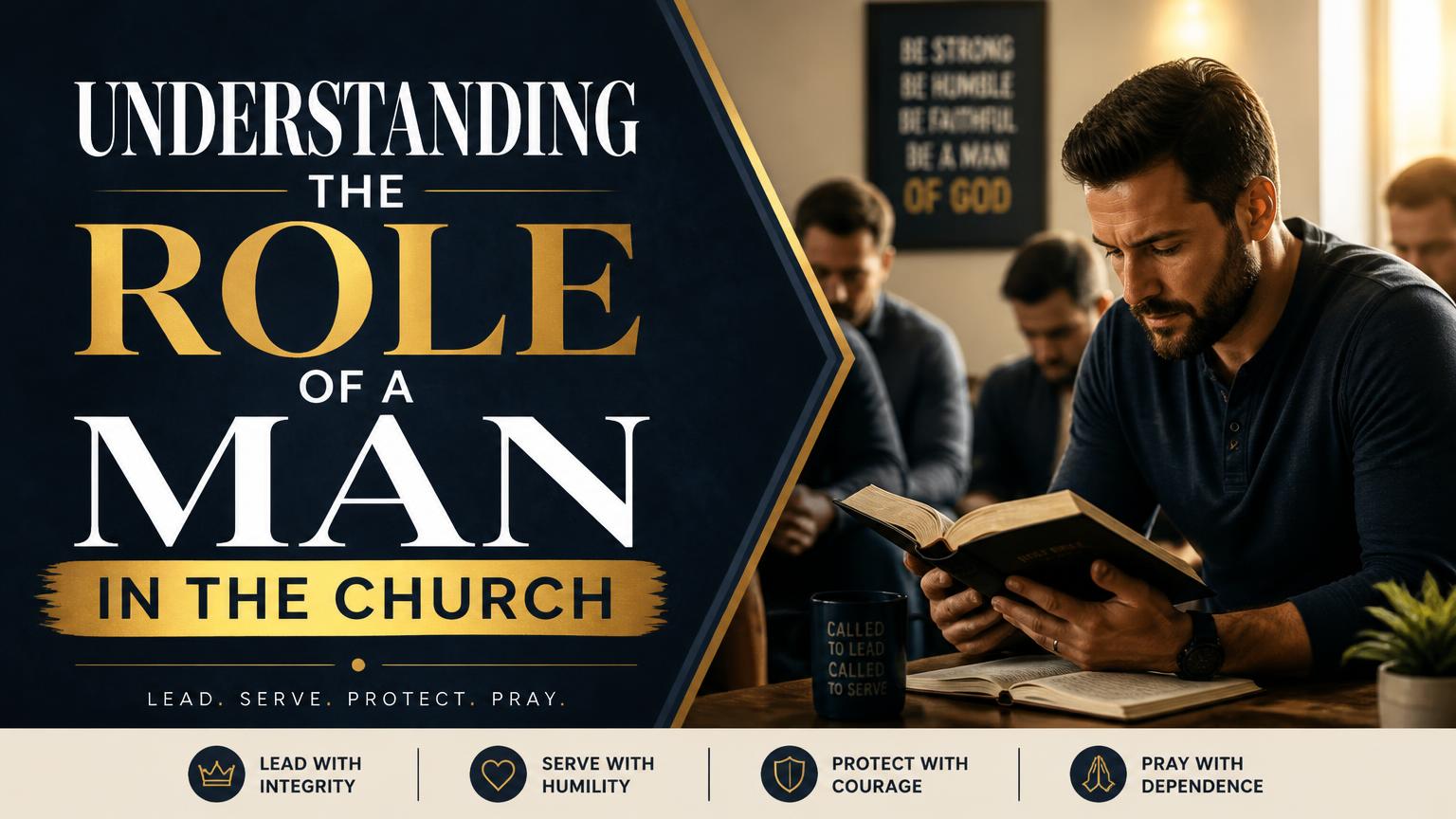
A man’s role in the church is not defined by status, control, or a single set of duties. In the New Testament, Christian men are called to follow Christ, grow in holiness, serve others, use their spiritual gifts, protect the unity of the church, and accept leadership responsibilities when properly qualified and entrusted with them. The details of formal church office differ among Christian traditions, but faithful service and Christlike character are central across them.
The Role of a Man in the Church
The role of a man in the church begins with discipleship rather than authority. A man is first a follower of Jesus and a member of Christ’s body. His responsibilities flow from that identity: worshiping God, loving other believers, seeking holiness, serving according to his gifts, and helping the church fulfill its mission.
Begin With Identity in Christ and Shared Christian Calling
Men do not have a different standard of salvation or spiritual worth from women. Galatians 3:28 teaches that all believers are one in Christ, while 1 Corinthians 12 describes the church as one body with many members. These passages establish a shared dignity and shared dependence on God’s grace.
A man’s first responsibilities therefore include:
- Trusting and obeying Jesus Christ
- Participating faithfully in the life of the church
- Growing in prayer, Scripture, wisdom, and character
- Repenting of sin and pursuing practical holiness
- Encouraging and serving other believers
- Sharing the gospel through words and conduct
This corrects the idea that a man’s importance in church depends on preaching, public visibility, or holding an office. A man who quietly cares for people, teaches his children, welcomes newcomers, visits the sick, gives generously, or serves in an unseen ministry is not occupying a lesser spiritual role. Christian service is measured by faithfulness, not prominence.
Serve Through Character and Holiness
The New Testament places strong emphasis on the kind of man a Christian becomes. The qualifications for overseers and deacons in 1 Timothy 3 and Titus 1 focus heavily on qualities such as self-control, faithfulness, humility, hospitality, sound judgment, and a good reputation.
These qualifications show that leadership is not primarily a platform for personality or ability. Character protects the church from manipulation and gives credibility to its teaching. A gifted speaker who lacks integrity can damage people; a less prominent man who consistently demonstrates patience, honesty, and self-control can strengthen the congregation deeply.
Christian character also includes responsible treatment of power. A man’s strength, knowledge, financial resources, social influence, or physical presence should be used to protect and serve rather than intimidate or dominate. Jesus rejected worldly models of authority when He taught that greatness among His followers is expressed through service (Mark 10:42–45).
Use God-Given Gifts to Build Up the Church
Every Christian receives gifts for serving others. First Peter 4:10 instructs believers to use those gifts as stewards of God’s grace, and 1 Corinthians 12 explains that different gifts contribute to the health of the whole body.
A man may serve through:
- Teaching or explaining Scripture
- Evangelism and discipleship
- Pastoral care and encouragement
- Administration and organization
- Music, prayer, or practical support
- Giving and financial stewardship
- Hospitality and welcoming
- Mentoring younger believers
- Caring for people in crisis
- Serving the wider community
The key question is not, “What position can I obtain?” but, “How has God equipped me to help others mature in Christ?” Giftedness should be joined to humility, accountability, and the needs of the local congregation. A man may have a genuine ability but still need training, correction, or the church’s confirmation before taking on a particular responsibility.
Lead as a Servant Where Leadership Is Entrusted
Many churches understand Scripture to reserve the offices of elder or pastor for qualified men. They commonly appeal to passages such as 1 Timothy 2:11–15, 1 Timothy 3:1–7, and Titus 1:5–9. In this view, qualified male elders bear particular responsibility for teaching doctrine, guarding the church, shepherding its members, and providing spiritual oversight.
Other churches interpret these passages differently and recognize women as eligible for pastoral or elder leadership. They point to women who served significantly in the early church, including Priscilla, Phoebe, Junia, and the women who proclaimed Christ’s resurrection. They also emphasize that the New Testament gives spiritual gifts and ministry responsibilities to the whole body of Christ.
These traditions should not be reduced to caricatures. Christians disagree over how particular biblical passages should be interpreted, but both sides should affirm that leadership must be exercised with humility, competence, accountability, and concern for the church’s spiritual welfare.
Where a man is entrusted with leadership, biblical authority is never permission for control. Ephesians 5:25 commands husbands to love their wives as Christ loved the church, and Jesus’ example defines leadership through sacrifice. A church leader should teach truth, protect vulnerable people, receive correction, share responsibility, and make decisions for the good of the congregation rather than personal status.
Strengthen the Home Without Limiting the Church to the Home
For married men and fathers, the church-related calling includes responsibility toward the household. Ephesians 5 presents a husband’s love as self-giving care, not entitlement. First Timothy 3 connects a leader’s ability to manage his household well with his suitability for church oversight, because persistent failure in close relationships can reveal problems in judgment, integrity, or responsibility.
This does not mean that every man must be married or have children to serve meaningfully. Jesus was unmarried, and Paul encouraged some believers to remain single for undivided service to God. Widowers, single men, and men without children can mentor younger believers, support families, serve the vulnerable, and contribute substantially to church life.
A healthy Christian approach also avoids placing all family and ministry responsibility on men. Husbands and wives are fellow heirs of God’s grace, and parents share the task of raising children in faith. A man’s leadership at home should make faithful service easier for others, not silence their gifts or shift every burden onto them.
Protect Unity and Honor the Contributions of Women
A faithful man does not measure his spiritual importance by occupying more space than women. The New Testament presents women as fellow workers, teachers in appropriate contexts, prophets, patrons, missionaries, servants, and leaders in various forms of ministry. Whatever a church’s position on ordained office, women’s work is not secondary or optional.
Men help protect unity when they:
- Listen before asserting authority
- Reject sexist jokes, harassment, and intimidation
- Encourage women’s legitimate gifts and contributions
- Share practical responsibilities
- Receive correction from women and other believers
- Refuse to use biblical language to excuse abuse
- Distinguish biblical conviction from personal preference
The principle is simple: authority that resembles Christ makes other people stronger and more faithful. Authority that isolates, diminishes, or controls people contradicts the character of the One it claims to represent.
Formal Church Offices and the Broader Calling of Men
Not every man is called to become a pastor, elder, or deacon. Formal office involves recognized responsibility, doctrinal soundness, tested character, and the affirmation of the local church. First Timothy 3 and Titus 1 describe qualifications rather than offering a route to prestige.
The broader calling of Christian men is wider than church office. A man may serve faithfully without holding a title, while a man holding a title may fail if he lacks humility and love. Church membership, discipleship, prayer, generosity, hospitality, and care for neighbors are not lesser forms of Christianity. They are ordinary expressions of belonging to Christ.
This distinction also prevents a common error: treating leadership ambition as evidence of spiritual maturity. A desire to serve may be good, but a desire for recognition can corrupt ministry. Jesus repeatedly directed His followers away from status-seeking and toward sacrificial service.
What Faithful Male Participation Looks Like in Practice
A man who wants to serve his church well can begin with ordinary, accountable actions:
- Join the life of a local church. Worship regularly, build relationships, and accept pastoral or communal accountability.
- Study Scripture for obedience, not merely information. Biblical knowledge should produce wisdom, repentance, and love.
- Identify and develop spiritual gifts. Ask mature believers where they see usefulness, then seek training and opportunities to serve.
- Care for people who cannot repay you. Visit the lonely, support the grieving, welcome outsiders, and help meet practical needs.
- Practice integrity in private life. Sexual faithfulness, financial honesty, self-control, and truthful speech matter as much as public ministry.
- Receive correction without defensiveness. Teachable men are safer leaders and more useful servants.
- Mentor without creating dependence. Help younger believers grow toward maturity rather than making them dependent on one personality.
- Use authority proportionately. Lead where responsibility has genuinely been entrusted, and do not claim authority that belongs to the church, a spouse, or God alone.
These practices turn abstract ideas about Christian manhood into visible patterns of service.
Common Misunderstandings About Men in the Church
“A man’s role is simply to be in charge.”
Biblical leadership is accountable, sacrificial, and directed toward the good of others. Control, coercion, and domination are not evidence of spiritual authority.
“Only public ministry counts.”
The New Testament compares the church to a body in which unseen parts are indispensable. Practical care, prayer, generosity, administration, and hospitality are genuine ministry.
“Every man should become a church leader.”
Leadership is a calling requiring qualification and recognition, not a universal requirement for male believers.
“Men must be emotionally silent.”
Scripture includes lament, confession, grief, compassion, and friendship. Emotional honesty can support spiritual maturity when it is joined to self-control and responsibility.
“Protecting the church means protecting male privilege.”
Christian protection means guarding people from false teaching, exploitation, abuse, and neglect. It does not mean shielding influential men from accountability.
Conclusion
The role of a man in the church is best understood as a call to Christlike discipleship and service. Men are to grow in holiness, use their gifts, strengthen families and congregations, care for the vulnerable, and lead humbly wherever the church entrusts them with responsibility. Christian traditions differ over certain offices and leadership boundaries, but no biblical model permits pride, coercion, or neglect. A faithful man uses his strength and influence to help others know Christ, mature in faith, and serve God more fully.