
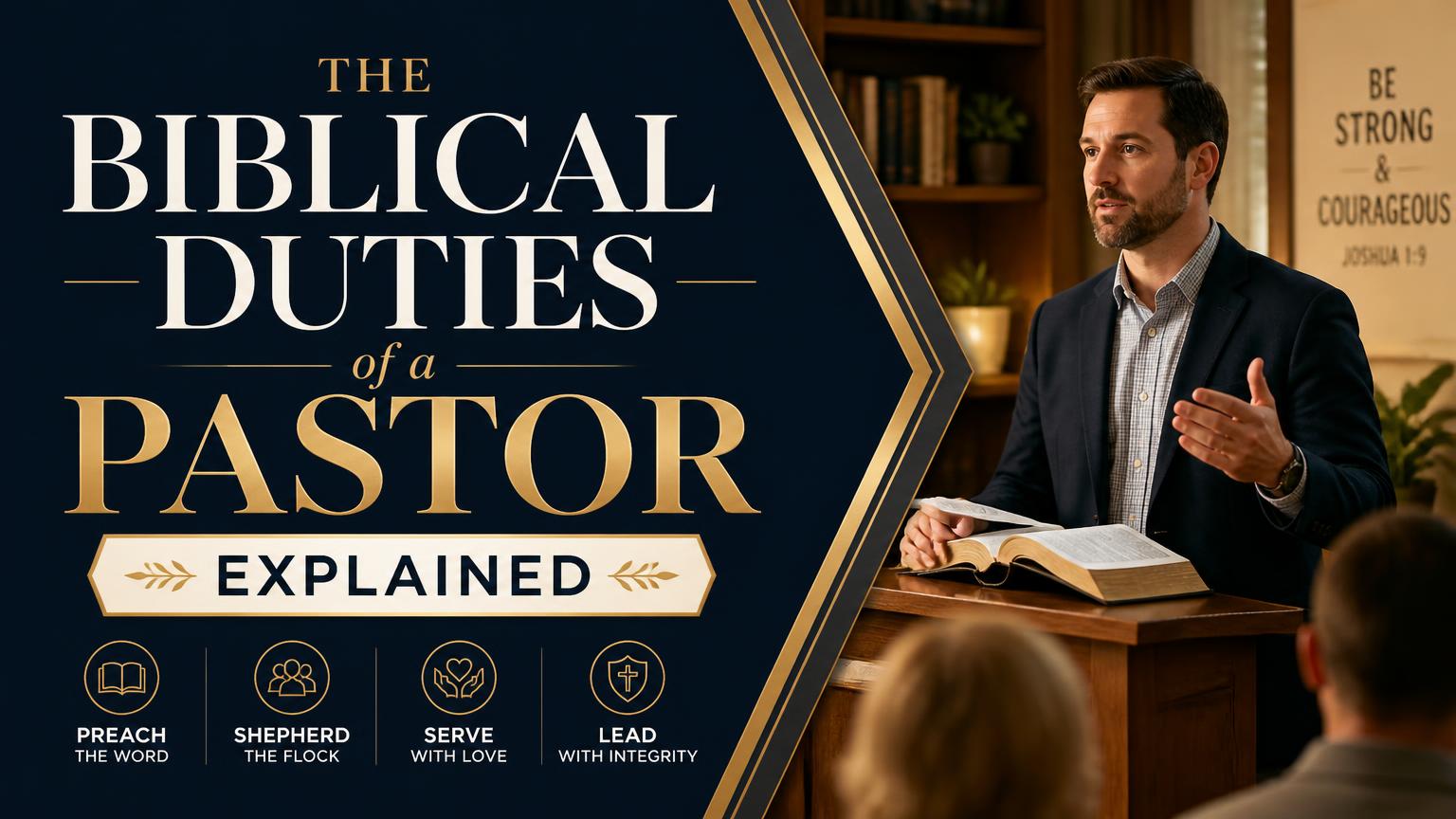
A pastor’s biblical duties are centered on shepherding Christ’s people: teaching God’s Word, guarding sound doctrine, caring for souls, leading with humility, praying for the church, equipping believers for ministry, and modeling faithful Christian character. The New Testament presents pastoral ministry as a sacred stewardship rather than merely a preaching position or administrative job.
The Bible does not provide one single job description labeled “pastor.” Instead, it describes pastoral work through the related responsibilities of shepherds, elders, and overseers. Churches differ in how they organize these offices, but the core duties remain substantially consistent.
Biblical Duties of a Pastor
Shepherd the People of God
The primary duty of a pastor is to shepherd the church. Jesus described Himself as “the good shepherd” who knows His sheep and lays down His life for them (John 10:11–15). Pastors serve under Christ, the Chief Shepherd, and care for people who ultimately belong to Him.
Paul told the elders of Ephesus to “pay careful attention” to themselves and to all the flock over which the Holy Spirit had made them overseers (Acts 20:28). Peter likewise instructed elders to shepherd God’s flock willingly, eagerly, and by example rather than by domineering over others (1 Peter 5:1–4).
Shepherding includes:
- Knowing and caring about the people in the congregation
- Offering spiritual encouragement and comfort
- Visiting and praying with those who are suffering
- Helping believers grow in faith and obedience
- Protecting vulnerable members from spiritual harm
- Seeking restoration when someone wanders from the truth
- Addressing conflict, sin, and discouragement with wisdom and grace
This responsibility is personal, not merely organizational. A pastor is not called only to manage gatherings or deliver sermons. He is called to care for people as souls entrusted to his oversight.
Preach and Teach God’s Word
Pastors must faithfully explain Scripture and apply it to the life of the church. Paul charged Timothy to “preach the word” with patience, correction, rebuke, and encouragement (2 Timothy 4:1–5). An overseer must also be “able to teach” and must hold firmly to the trustworthy message so that he can encourage believers and refute error (1 Timothy 3:2; Titus 1:9).
Biblical teaching involves more than communicating information. A pastor should:
- Explain what the biblical text means.
- Connect its teaching to the gospel and the whole counsel of God.
- Correct misunderstandings and false doctrine.
- Apply Scripture to conduct, worship, relationships, suffering, and hope.
- Call believers to repentance, faith, holiness, and perseverance.
The goal is spiritual maturity, not simply increased knowledge. Pastors teach so that Christians may become stable in truth, grow into Christlikeness, and practice the faith in everyday life.
Because teachers bear serious responsibility, James warns that not many should become teachers, knowing that they will be judged more strictly (James 3:1). Faithful pastoral teaching therefore requires accuracy, humility, preparation, and submission to Scripture.
Guard the Church From False Teaching
A pastor must protect the congregation from teachings that distort the gospel or lead people away from faithful obedience. Paul warned the Ephesian elders that false teachers would arise, even from among the church’s own leaders (Acts 20:29–31). Titus 1:9 connects sound doctrine with the ability to refute those who contradict it.
This does not mean that every disagreement is a threat requiring public confrontation. Christian pastors must distinguish between:
- Essential truths of the gospel
- Important but secondary doctrinal differences
- Personal preferences and cultural traditions
- Genuine false teaching that harms faith and godliness
Doctrinal protection requires both theological clarity and pastoral wisdom. A pastor should not create unnecessary controversy, but neither should he remain silent when teaching denies Christ, corrupts Scripture, excuses sin, or exploits believers.
Pray for and With the Church
Prayer is a central pastoral responsibility. When the early church faced competing practical needs, the apostles emphasized their commitment to “prayer and the ministry of the word” (Acts 6:4). Paul repeatedly described praying for the churches under his care, giving thanks for them, asking God to strengthen them, and interceding for their spiritual growth.
Pastoral prayer may include:
- Interceding for the congregation’s faith and holiness
- Praying for the sick, grieving, tempted, and discouraged
- Seeking wisdom for decisions and leadership
- Confessing dependence on God rather than personal ability
- Giving thanks for God’s work in the church
- Praying for evangelistic opportunity and boldness
Public prayer is important, but private intercession is equally significant. A pastor’s ministry cannot be sustained by communication skills, organizational talent, or constant activity. Prayer acknowledges that only God gives spiritual life and growth.
Lead Through Servant Oversight
The terms elder and overseer describe a form of spiritual leadership that includes responsibility, accountability, and direction. Hebrews 13:17 calls believers to respect faithful leaders who watch over their souls, while 1 Thessalonians 5:12–13 urges the church to recognize those who labor among them and are over them in the Lord.
Biblical authority is real, but it is not authoritarian. Jesus rejected the self-serving model of leadership that seeks status and control. He taught that greatness in His kingdom is expressed through serving others (Mark 10:42–45). Peter similarly instructed elders not to domineer over those entrusted to them (1 Peter 5:3).
Pastoral oversight therefore includes:
- Establishing faithful priorities for the congregation
- Making decisions consistent with Scripture
- Coordinating the church’s ministries
- Addressing harmful behavior and serious conflict
- Working with other leaders and members
- Accepting accountability for the spiritual direction of the church
A pastor leads by persuasion grounded in truth, sacrificial service, prayer, and example—not by demanding unquestioned personal loyalty.
Equip Believers for Their Ministry
Pastors are not meant to perform every ministry themselves. Ephesians 4:11–12 teaches that Christ gives shepherds and teachers to equip the saints for the work of ministry and to build up the body of Christ.
This means pastoral success is not measured only by how much a pastor personally does. A pastor should help members discover and use their gifts, mature in responsibility, and serve one another. Equipping may involve:
- Training teachers, counselors, leaders, and ministry volunteers
- Helping believers understand spiritual gifts
- Encouraging family discipleship and personal Bible study
- Providing opportunities for service and evangelism
- Developing younger or emerging leaders
- Teaching the congregation to care for one another
A church becomes dependent on one personality when the pastor does everything. Biblical pastoral ministry strengthens the whole body so that every member can contribute according to the grace God has given.
Care for the Weak, Correct the Straying, and Restore the Sinful
Pastors must address the different spiritual conditions found within a congregation. Paul instructed the Thessalonians to admonish the idle, encourage the discouraged, help the weak, and be patient with everyone (1 Thessalonians 5:14). These responsibilities require discernment because the same response will not help every person.
Someone who is rebellious may need loving correction. Someone who is grieving may need patient comfort. Someone who is spiritually weak may need practical support and companionship. Someone trapped in sin may need truthful confrontation combined with a path toward repentance and restoration.
Church discipline, when necessary, should aim at restoration and the protection of the church, not humiliation or revenge. Galatians 6:1 calls spiritually mature believers to restore a person caught in transgression with gentleness while remaining watchful over themselves.
Pastoral care also has limits. A pastor is not a substitute for medical, psychiatric, legal, or financial professionals when specialized help is needed. Wise shepherding includes recognizing those limits and helping people obtain appropriate support.
How Pastor, Elder, and Overseer Relate
In the New Testament, “pastor” comes from a word meaning shepherd. The word appears explicitly as a ministry role in Ephesians 4:11, while the related verb “to shepherd” describes the work of elders and overseers.
Several passages connect these terms. In Acts 20:17, Paul calls for the elders of the Ephesian church; he then tells them that the Holy Spirit made them overseers and commands them to shepherd the church (Acts 20:28). In 1 Peter 5:1–4, elders are instructed to shepherd God’s flock and exercise oversight.
Many Christian traditions therefore understand the local pastor as an elder entrusted with particular responsibility for shepherding and teaching. Other traditions distinguish several leadership roles more sharply. The exact structure varies, but the biblical functions remain clear: spiritual care, teaching, oversight, protection, and example.
Qualifications That Shape Pastoral Duties
Pastoral duties cannot be separated from pastoral character. The qualifications in 1 Timothy 3:1–7 and Titus 1:5–9 emphasize qualities such as:
- Above reproach
- Self-controlled and respectable
- Faithful in marriage
- Hospitable
- Able to teach
- Not quarrelsome or greedy
- Patient and gentle
- Spiritually mature
- Respected by outsiders
- Capable of managing his household well
These qualifications do not describe perfection. They describe a pattern of credible, tested, repentant faith. A pastor may have weaknesses, but his life should not contradict the gospel he teaches.
Character matters because pastoral influence extends beyond the pulpit. A person may communicate brilliantly while still being unfit to shepherd others if he is proud, manipulative, dishonest, uncontrolled, or spiritually immature. The New Testament places moral credibility alongside teaching ability rather than treating it as optional.
What Pastoral Ministry Does Not Mean
The biblical model corrects several common misconceptions.
A pastor is not the church’s owner. Christ is the Head of the church, and pastors are servants and stewards.
A pastor is not required to do every task. The congregation is a body in which members serve one another with different gifts (1 Corinthians 12:4–27).
A pastor is not merely a public speaker. Preaching is central, but shepherding also includes prayer, personal care, correction, leadership, and training others.
A pastor is not beyond accountability. Scripture warns leaders about judgment and responsibility, and churches should provide appropriate moral, doctrinal, and organizational accountability.
A pastor is not expected to be omnipresent or emotionally available without limits. Even faithful ministry requires rest, shared leadership, wise boundaries, and dependence on God.
The Relationship Between Pastors and the Congregation
Pastors have particular responsibilities, but the New Testament also gives every Christian duties that overlap with pastoral care. Believers are called to encourage one another, bear one another’s burdens, teach and admonish one another, practice hospitality, serve with spiritual gifts, and make disciples.
The pastor equips the congregation, while the congregation participates actively in ministry. This shared responsibility protects the church from two opposite errors: expecting one leader to carry the entire ministry, or treating pastoral leadership as unnecessary.
Healthy pastoral ministry produces a church that knows Scripture, depends on Christ, cares for suffering people, resists false teaching, and serves beyond the pastor’s personal capacity.
Conclusion
The biblical duties of a pastor are best understood as the work of a shepherd under Christ’s authority. A pastor teaches and protects the truth, prays for the church, cares for people, leads without domination, restores the wandering, equips believers for ministry, and demonstrates the character he asks others to pursue. These duties are demanding because they involve souls, doctrine, leadership, and example. They are also limited by the New Testament’s broader vision: the pastor shepherds and equips, while the entire church serves as the body of Christ.