
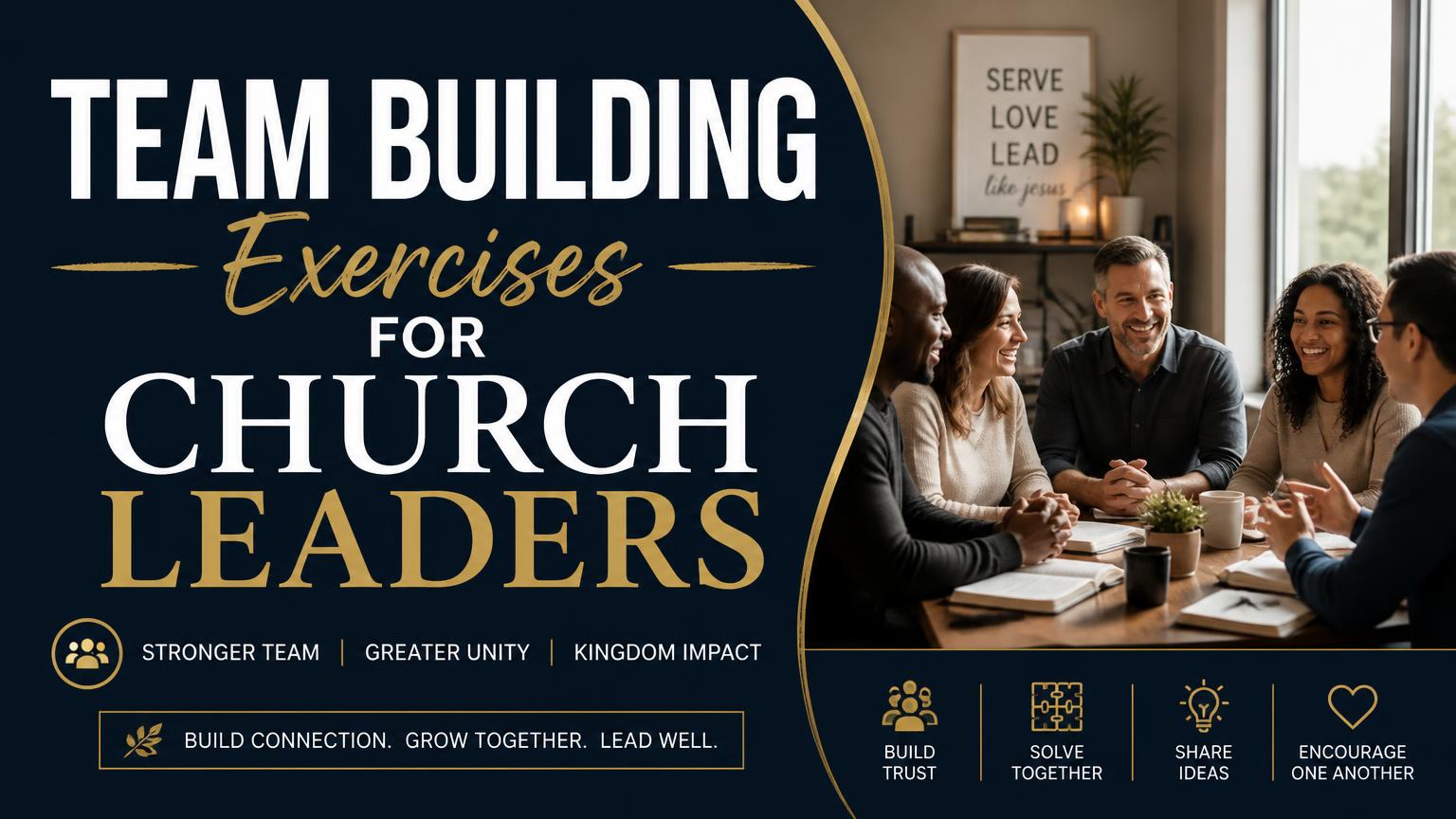
Church leadership teams need more than shared beliefs and regular meetings. They also need trust, clear communication, healthy disagreement, defined responsibilities, and the ability to make decisions together. The best team building exercises for church leaders therefore connect relational development with the real work of ministry rather than functioning as entertainment disconnected from church life.
Effective exercises are purposeful, inclusive, and followed by honest discussion. They should help leaders understand one another, clarify the church’s mission, practice collaboration, and identify habits that either strengthen or weaken their team.
Team Building Exercises for Church Leaders
The following exercises work with pastors, elders, deacons, ministry directors, staff members, and key volunteers. Adapt the timing and level of personal disclosure to the group’s size, maturity, and pastoral context.
Shared Mission Mapping
Purpose: Align leaders around the church’s mission and identify how each ministry contributes to it.
Time: 45–60 minutes
Materials: Large paper or a whiteboard, markers, and sticky notes
Write the church’s mission or central ministry aim in the middle of a board. Ask participants to identify the primary outcomes the church hopes to see—for example, discipleship, evangelism, congregational care, leadership development, worship, or service to the community.
Next, have each leader place their ministry or area of responsibility around those outcomes. Draw connections between ministries that depend on one another. For example, children’s ministry may connect with parent discipleship, pastoral care, volunteer development, and Sunday worship.
Discuss:
- Where is the team already working toward the same goal?
- Which ministries are operating in isolation?
- Where do responsibilities overlap?
- What important ministry outcome has no clear owner?
- What would better collaboration look like in practice?
This exercise turns a general statement about unity into a visible picture of shared responsibility. It can also reveal why conflict or inefficiency exists: two leaders may be pursuing different priorities, or several people may assume that someone else is responsible for the same task.
Listening Without Fixing
Purpose: Build attentive listening and reduce the tendency to interrupt, advise, or solve problems prematurely.
Time: 25–35 minutes
Group size: Pairs, followed by a group debrief
Give each person five minutes to answer a prompt such as:
- What has been energizing you in ministry recently?
- What has been difficult for you as a leader?
- What do you wish the leadership team understood better?
- Where do you need support?
The listener may ask clarifying questions but should not interrupt, correct, offer solutions, or redirect the conversation. Afterward, the listener summarizes what they heard, and the speaker confirms or corrects the summary. Then switch roles.
Debrief with questions such as:
- What made listening difficult?
- When did you feel genuinely understood?
- What assumptions did you notice in yourself?
- How might this change the way the team handles pastoral or operational concerns?
James 1:19 connects spiritual maturity with being “quick to hear, slow to speak, slow to anger.” The exercise does not suggest that leaders should avoid giving counsel. It teaches them to understand the person and the situation before attempting to resolve it.
Gifts, Roles, and Responsibility Mapping
Purpose: Clarify leadership strengths, avoid unnecessary duplication, and identify gaps in responsibility.
Time: 45 minutes
Materials: A role worksheet or three columns labeled “Strengths,” “Responsibilities,” and “Support Needed”
Ask each leader to identify:
- The abilities or experiences they contribute
- The responsibilities they currently carry
- The responsibilities they believe they should carry
- The work that drains them or falls outside their strengths
- The support they need from other leaders
Compare the responses as a team. The goal is not to rank people or assign ministry value according to personality. It is to understand how gifts and responsibilities can serve the church more wisely.
Romans 12:4–8 describes a community with different gifts functioning together as one body. That principle has a practical implication: unity does not require identical roles. A healthy team makes room for different contributions while ensuring that essential work is covered.
The discussion should also address limits. A person may be capable of doing something without being the right person to own it. Likewise, a leader’s spiritual gift does not eliminate the need for training, accountability, or collaboration.
Ministry Scenario Decision Lab
Purpose: Practice collaborative decision-making before a real crisis exposes weaknesses in the team.
Time: 45–60 minutes
Present a realistic, non-confidential scenario, such as:
- A major volunteer shortage threatens an important ministry.
- A church member raises a serious concern about a ministry practice.
- Attendance has declined, but leaders disagree about the cause.
- A building project is exceeding its budget.
- Two ministry leaders have conflicting expectations about shared space or volunteers.
Give the team a limited amount of time to reach a preliminary response. Assign one observer to note how the group communicates. The observer can track who speaks, whether dissent is welcomed, whether facts are separated from assumptions, and whether the team clarifies who will act.
Afterward, discuss:
- What information did the team need but not have?
- Did the group define the actual problem before proposing solutions?
- How were minority opinions handled?
- Did the team confuse consensus with unanimous agreement?
- Who has authority to make the final decision?
- What communication should follow the decision?
This exercise is especially useful because many leadership problems are process problems rather than personality problems. A team may care deeply about the church yet still make poor decisions if it lacks agreed procedures for gathering information, weighing risks, disagreeing, and communicating outcomes.
Constructive Feedback Practice
Purpose: Help leaders give and receive correction without accusation, avoidance, or defensiveness.
Time: 35–45 minutes
Teach a simple pattern:
- Describe the observable behavior.
- Explain its effect on the team or ministry.
- State the needed change.
- Invite the other person’s perspective.
- Agree on a next step.
For example: “When schedule changes are made without informing the worship and children’s teams, volunteers receive conflicting instructions. We need a consistent communication process. What is making that difficult, and what process should we use?”
Use hypothetical or low-risk examples first. Do not require participants to expose unresolved personal conflicts in a group exercise. The purpose is to practice clarity and humility, not to stage a confrontation.
Ephesians 4:15 speaks of “speaking the truth in love.” Truth without love can become harsh control; love without truth can become avoidance. Healthy feedback protects relationships by addressing problems while they are still manageable.
The Trust-Building Timeline
Purpose: Help leaders understand experiences that shaped their communication patterns, fears, and expectations.
Time: 45–60 minutes
Group size: Six to twelve people is usually manageable
Each participant draws a simple timeline of significant leadership experiences. They may include a formative mentor, a painful conflict, a successful ministry season, a failure, or a transition. Participants share only what they are comfortable disclosing.
After each person shares, others should respond with appreciation or a brief question rather than analysis. The group can then discuss:
- What experiences have influenced how we lead?
- What situations make us cautious or defensive?
- What helps us feel safe enough to speak honestly?
- What should the team understand about one another’s leadership histories?
This exercise can deepen empathy, but it requires care. Leaders should not be pressured into revealing trauma, confidential pastoral information, or unresolved personal matters. A facilitator should establish confidentiality and explain that trust grows through consistent behavior over time, not through forced disclosure in a single meeting.
Collaborative Service Project
Purpose: Strengthen cooperation by placing leaders in a practical ministry setting together.
Time: Two to four hours
Choose a project that serves a real need: preparing a community meal, repairing a church facility, assembling care packages, visiting shut-ins in appropriate pairs, supporting a local ministry, or organizing a congregation-wide service effort.
Assign mixed teams rather than allowing leaders to work only with their usual colleagues. Give each team a clear outcome, a time limit, and enough freedom to make ordinary decisions. Afterward, debrief the work:
- How did the team divide responsibilities?
- Who took initiative, and how was that received?
- What happened when the plan changed?
- Did the team value the task more than the people doing it?
- What leadership behaviors should carry into regular ministry?
Service can reveal collaboration patterns that remain hidden in meetings. However, a service project should benefit actual people rather than use vulnerable individuals as props for team development. Coordinate with established organizations and respect their needs, policies, and dignity.
How to Make Church Leadership Exercises Effective
An exercise becomes useful through its design and follow-through, not through novelty. Before choosing one, identify the leadership problem it should address. “We need team building” is too broad. The real issue may be unclear authority, weak listening, unresolved conflict, poor communication, or lack of shared direction.
Set expectations before beginning:
- Explain the purpose and approximate time.
- Distinguish confidentiality from secrecy about serious misconduct or safeguarding concerns.
- Give participants permission to pass on personal questions.
- Establish respectful discussion norms.
- Use a facilitator who can interrupt domination, personal attacks, or unproductive debate.
Always include a debrief. Without one, participants may remember the activity but miss its meaning. Ask what happened, why it happened, and what the team should do differently in ordinary ministry. Then record one or two concrete commitments, assign responsibility, and revisit them at a later meeting.
Exercises should also match the group’s actual trust level. A new team may begin with mission mapping or listening practice. A team recovering from conflict may need facilitated reconciliation or governance work before attempting highly personal activities. A church with serious allegations, abuse concerns, or entrenched power struggles needs qualified pastoral, legal, or professional help—not a recreational exercise presented as a solution.
What Team Building Cannot Replace
Team building exercises can improve communication and clarify patterns, but they cannot substitute for sound church leadership structures. A healthy leadership team also needs:
- Clear decision-making authority
- Written role descriptions
- Financial and safeguarding controls
- Regular evaluation
- Biblical and ethical accountability
- Processes for handling complaints and conflict
- Appropriate pastoral and professional support
Nor should “unity” be used to silence legitimate disagreement. Philippians 2:1–4 calls believers toward humility and concern for others, but Christian unity is not identical to uniformity or unquestioning agreement. Leaders can disagree about methods, budgets, or priorities while remaining committed to one another and to the church’s mission.
The aim is not to eliminate every difference. It is to create a team capable of handling differences truthfully, respectfully, and responsibly.
Choosing the Right Exercise
A simple matching approach can help:
- Lack of shared direction: Use Shared Mission Mapping.
- Interruptions or poor listening: Use Listening Without Fixing.
- Overlapping or neglected responsibilities: Use Gifts, Roles, and Responsibility Mapping.
- Confusing or slow decisions: Use the Ministry Scenario Decision Lab.
- Avoidance or harsh correction: Use Constructive Feedback Practice.
- Low empathy or guarded relationships: Use the Trust-Building Timeline.
- Siloed ministries: Use a Collaborative Service Project.
Begin with the least intrusive exercise that addresses the actual need. Build trust through repeated, credible practices rather than expecting one retreat or activity to transform the team.
Effective team building exercises for church leaders connect spiritual formation with practical leadership. They help people listen, clarify responsibility, make decisions, address conflict, and serve together. Their lasting value comes when the insight gained in the exercise becomes a consistent pattern in meetings, ministry decisions, pastoral care, and everyday relationships.