
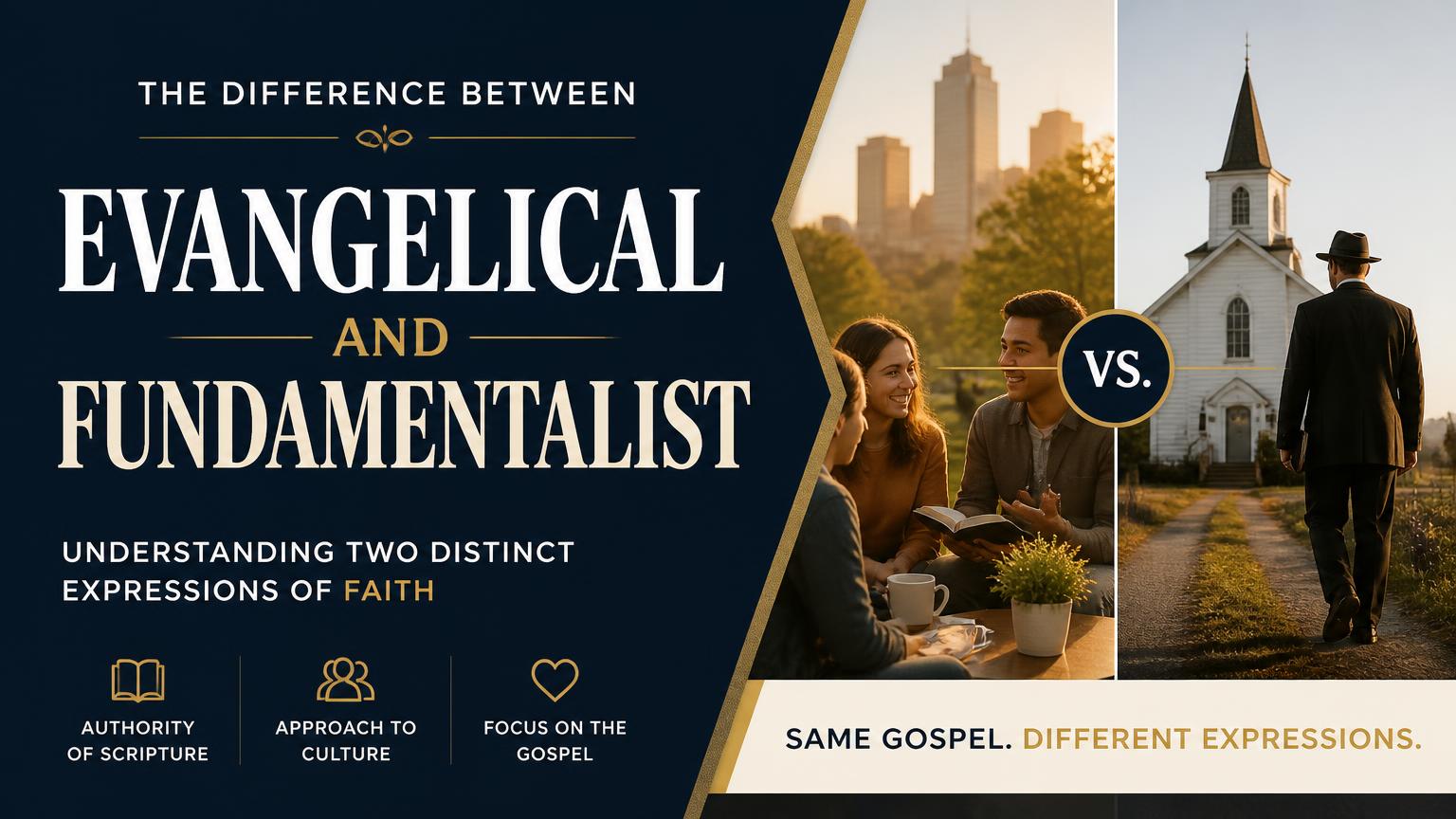
Evangelical and fundamentalist are related terms, but they are not interchangeable. Evangelical usually describes a broad Protestant movement centered on the authority of the Bible, personal conversion through faith in Jesus Christ, the significance of Christ’s death and resurrection, and active proclamation of the gospel. Fundamentalist usually describes a more separatist movement that arose to defend historic Christian doctrines against theological liberalism and to resist cooperation with churches or institutions considered doctrinally compromised.
The categories overlap, especially in conservative Protestantism, but they differ in history, emphasis, institutional relationships, and how they respond to theological and cultural change.
What Is the Difference Between Evangelical and Fundamentalist?
Evangelical Means Gospel-Centered Protestant Christianity
The word evangelical comes from the Greek term euangelion, meaning “good news” or “gospel.” In modern Protestant usage, it generally refers to Christians and churches that emphasize:
- The authority and trustworthiness of the Bible
- The need for personal conversion or being “born again”
- Salvation through faith in Jesus Christ
- The importance of Christ’s atoning death and bodily resurrection
- Evangelism and missions
- The relevance of Christianity to personal and public life
Evangelicalism is a broad coalition rather than a single denomination. It includes Baptists, Pentecostals, non-denominational churches, Presbyterians, Anglicans, Methodists, and other Protestant traditions. These groups may disagree about baptism, spiritual gifts, church government, worship, women in ministry, or political questions while still sharing a broadly evangelical identity.
The label therefore tells you something important about a church’s central theological commitments, but it does not answer every question about that church.
Fundamentalist Emphasizes Doctrinal Defense and Separation
Christian fundamentalism developed in the early twentieth century, particularly among Protestants who opposed theological liberalism. Liberal theologians and churches were questioning or reinterpreting doctrines such as biblical inspiration, the virgin birth of Jesus, Christ’s miracles, and the bodily resurrection. In response, conservative leaders published collections of essays such as The Fundamentals, published between 1910 and 1915.
Fundamentalists insisted that certain doctrines were essential to Christianity. Lists varied, but commonly emphasized:
- The inspiration and authority of Scripture
- The deity of Christ
- Christ’s virgin birth
- His substitutionary death
- His bodily resurrection
- The reality of biblical miracles
Fundamentalism was not defined only by what its adherents believed. It was also shaped by how they related to other Christians. Many fundamentalists stressed separation from churches, seminaries, denominations, and Christian leaders who denied essential doctrines or cooperated closely with those who did.
Consequently, fundamentalism often includes a strong concern for doctrinal boundaries, church purity, cultural separation, and opposition to compromise.
The Two Categories Overlap
Many fundamentalists hold the beliefs commonly associated with evangelicalism: biblical authority, conversion, the cross, the resurrection, evangelism, and missions. Historically, fundamentalists were part of the wider conservative Protestant response to liberal theology, from which modern evangelicalism also developed.
However, the relationship is not perfectly simple:
- An evangelical is not necessarily a fundamentalist.
- A fundamentalist may describe himself as evangelical in the broad sense of believing and proclaiming the gospel.
- Many fundamentalists use “evangelical” only for non-fundamentalist conservatives and reject the label for themselves.
- Many evangelicals regard fundamentalism as one particular, more separatist form of conservative Protestantism.
A useful summary is that evangelicalism is generally a broad gospel-centered movement, while fundamentalism is a more boundary-conscious movement that emphasizes defending essential doctrine and separating from perceived compromise.
The Most Visible Differences Are Often Cultural
Theological and institutional differences are more fundamental than differences in clothing, music, or Bible translation. Still, fundamentalist churches have often been recognized by particular cultural practices, such as:
- Strict separation from secular culture
- Strong opposition to alcohol, dancing, certain forms of entertainment, or particular styles of dress
- Preference for traditional worship
- Use of the King James Version in some churches
- Independent or separatist church structures
- Opposition to ecumenical cooperation
These practices are not universal requirements of fundamentalism. Some fundamentalist churches use modern translations or contemporary technology, while some evangelical churches maintain highly traditional worship and strict behavioral standards. A church’s music or clothing policy alone cannot reliably determine whether it is fundamentalist.
How Evangelicalism and Fundamentalism Developed
Fundamentalism Emerged From Conflict Over Modern Theology
In the nineteenth and early twentieth centuries, developments in biblical scholarship, philosophy, science, and culture challenged traditional Protestant assumptions. Some Christian thinkers adapted doctrines to fit modern intellectual frameworks. Others believed these adaptations undermined the faith itself.
Fundamentalists responded by defending what they regarded as the nonnegotiable foundations of Christianity. Their concern was not merely that people held different opinions; it was that denying doctrines such as the resurrection or the divine authority of Scripture changed the nature of Christianity.
This explains why fundamentalism has historically placed so much weight on doctrinal precision and separation. Separation was intended to protect churches from teaching that fundamentalists believed would eventually erode Christian faith.
New Evangelicalism Sought a Different Strategy
By the 1940s, some conservative Protestants believed fundamentalism had become too isolated from scholarship, broader Christian cooperation, and engagement with society. Leaders associated with what became known as new evangelicalism sought to maintain conservative theology while participating more actively in academic institutions, missions, culture, and public discussion.
Organizations such as the National Association of Evangelicals, founded in 1942, reflected this broader coalition. Evangelicals generally continued to affirm historic Christian doctrine but were more willing than separatist fundamentalists to cooperate with Christians from other traditions and to engage institutions outside their immediate circles.
This historical divide still influences how churches use the labels today.
Key Differences Between Evangelicals and Fundamentalists
| Dimension | Evangelical | Fundamentalist |
|---|---|---|
| Main emphasis | Gospel proclamation, conversion, biblical authority, and mission | Defense of essential doctrine and separation from perceived compromise |
| Relationship to other churches | Often willing to cooperate across denominations | More likely to limit cooperation based on doctrine or association |
| Approach to culture | May engage, reform, or critique culture in different ways | Often stresses distance from practices viewed as spiritually harmful |
| Institutional identity | Broad movement across many denominations | Often found in independent or tightly defined conservative churches |
| Meaning of the label | Usually positive self-identification | Positive self-identification for some; rejected or used critically by others |
| Political identity | Varies widely, despite common stereotypes | Also varies; politics is not the defining feature |
These are general patterns rather than rules. Individual churches can depart significantly from them.
What the Labels Do Not Tell You
Evangelical Does Not Mean Politically Conservative
In the United States, “evangelical” is often treated as a political category, especially in election reporting. That usage can obscure the term’s religious meaning. Evangelicals may hold conservative, centrist, or progressive political views. They may disagree about immigration, economic policy, war, racial justice, environmental issues, or the relationship between church and state.
Political alignment may be associated with particular evangelical networks, but it does not define evangelical theology.
Fundamentalist Does Not Simply Mean “Extreme”
In ordinary speech, fundamentalist can mean rigid, intolerant, or fanatical. That usage differs from the historical Christian meaning. Some fundamentalist churches may display harsh or authoritarian behavior, but those traits are not the definition of fundamentalism.
The term originally referred to a movement defending core doctrines. Its later associations with separatism, strict cultural rules, and combative rhetoric developed in particular historical and denominational settings. A fair assessment should distinguish the movement’s stated theology from criticisms of how some leaders or churches have practiced it.
Neither Label Identifies Every Belief
Knowing that a church is evangelical or fundamentalist does not by itself tell you:
- Whether it believes in Calvinism or Arminianism
- Its position on baptism
- Whether it is charismatic
- Its view of women in church leadership
- Its position on end-times interpretation
- Its preferred Bible translation
- Its worship style
- Its political commitments
- How it handles authority and accountability
Those questions require examining the church’s statement of faith, teaching, leadership structure, and actual practices.
How to Evaluate a Church Using These Terms
Because the labels are used differently, examine several features rather than relying on a church’s name. Ask:
What does the church teach about Scripture?
Does it affirm biblical inspiration and authority? How does it interpret difficult passages?What does it teach about the gospel?
Look for its understanding of sin, grace, faith, Christ’s death, resurrection, and salvation.How does it relate to other churches?
Does it cooperate across denominational lines, or does it practice formal separation from certain churches and ministries?What issues does it treat as essential?
Every church has boundaries, but fundamentalist churches often define and enforce them more explicitly.How are authority and disagreement handled?
A church’s leadership structure, accountability, and treatment of dissent may reveal more than its public label.
The New Testament itself centers Christian identity on the gospel of Christ’s death and resurrection—summarized, for example, in 1 Corinthians 15:3–4—and on the call to make disciples in Matthew 28:18–20. The labels “evangelical” and “fundamentalist” describe later movements and strategies for defending and expressing that faith; they are not substitutes for examining what a church actually believes and practices.
Conclusion
The difference between evangelical and fundamentalist is primarily one of scope, history, and approach. Evangelicalism is a broad Protestant movement focused on the gospel, personal conversion, biblical authority, and mission. Fundamentalism arose within conservative Protestantism to defend essential doctrines and commonly adds a stronger emphasis on separation from theological and cultural compromise.
There is substantial overlap, so the terms should not be treated as exact opposites. The most reliable distinction is not whether a church is conservative or traditional, but how it defines essential doctrine, relates to other Christians, and responds to the surrounding culture.