
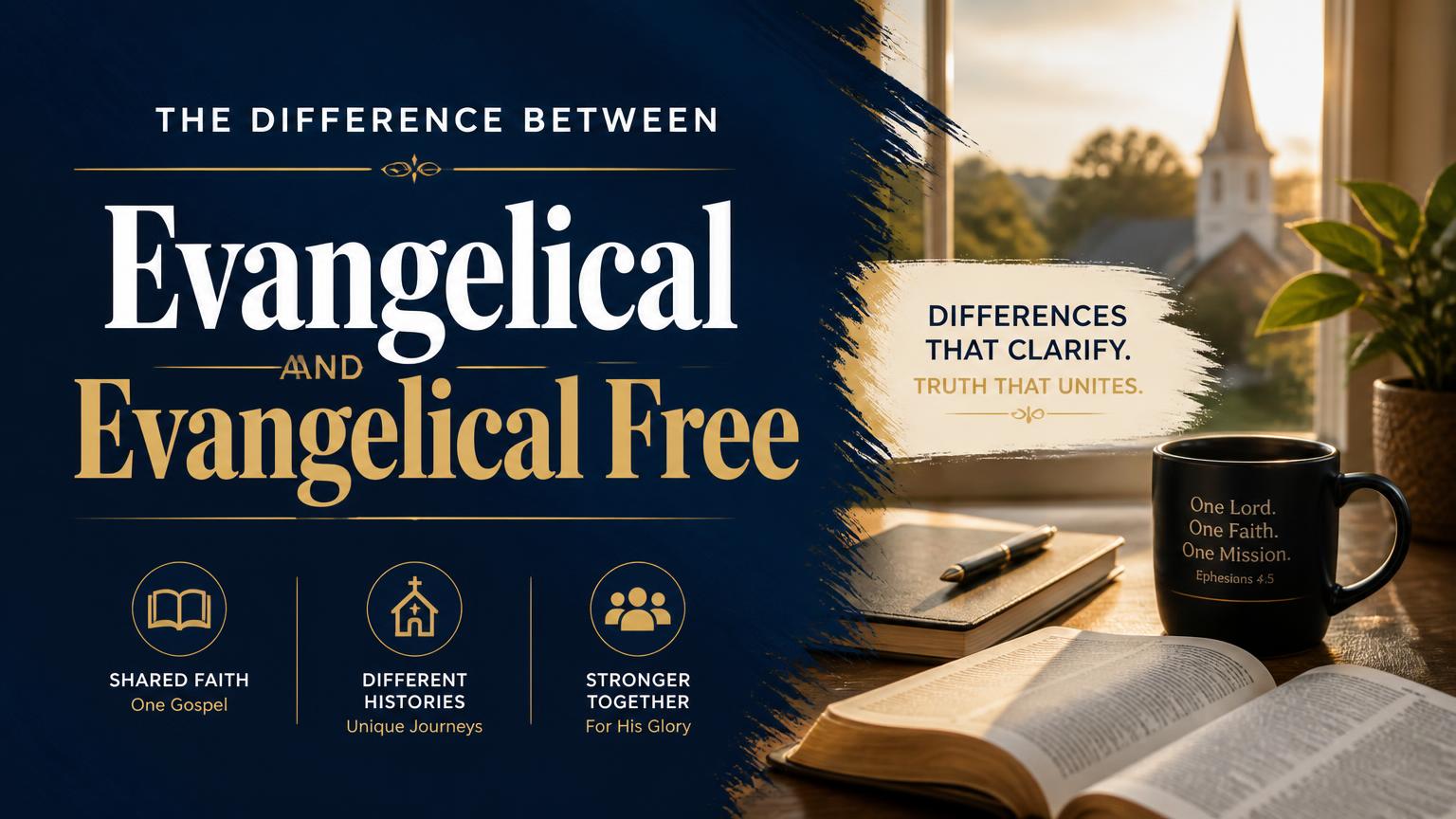
The difference between evangelical and Evangelical Free is primarily the difference between a broad Christian identity and a specific church tradition or denominational affiliation. Evangelical generally describes churches and Christians centered on the authority of Scripture, the saving work of Jesus Christ, personal conversion, and the proclamation of the gospel. Evangelical Free usually refers to a church connected with the Evangelical Free Church of America (EFCA) or a related Evangelical Free fellowship.
An Evangelical Free church is therefore generally evangelical, but most evangelical churches are not Evangelical Free.
What Is the Difference Between Evangelical and Evangelical Free?
Evangelical Describes a Broad Christian Movement
“Evangelical” comes from a Greek word related to euangelion, meaning “good news” or “gospel.” In Christianity, the term usually refers to a theological and spiritual emphasis rather than to one centralized denomination.
Evangelical churches commonly emphasize:
- The Bible as God’s authoritative Word
- One God in three persons: Father, Son, and Holy Spirit
- The deity, death, bodily resurrection, and return of Jesus Christ
- Humanity’s need for reconciliation with God
- Salvation by God’s grace through faith in Christ
- Personal conversion or being “born again”
- Evangelism and Christian mission
- The importance of applying Christian faith in everyday life
The gospel at the center of evangelical faith is the announcement that Jesus died for sins and was raised from the dead. Paul summarizes this message in 1 Corinthians 15:3–4. Salvation is understood as God’s gift rather than something earned through moral achievement, a point reflected in Ephesians 2:8–9.
Because evangelicalism is a broad movement, evangelical churches can differ significantly in worship style, baptismal practice, church government, views on spiritual gifts, and positions on social or ethical questions. There is no single worldwide evangelical governing body that defines every evangelical church.
Evangelical Free Usually Identifies a Church Affiliation
“Evangelical Free” usually identifies a particular church tradition. In the United States, the most common reference is the Evangelical Free Church of America, often abbreviated EFCA.
The EFCA is an association of autonomous local churches. It has a shared Statement of Faith, districts, national ministries, credentialing processes, and cooperative missions, but its local congregations retain substantial authority over their own ministry and governance.
The word “free” does not mean free from Christian doctrine, free from accountability, or opposed to organized church life. It traditionally refers to the idea that local churches should be free from state control and should retain freedom in matters not regarded as essential to the gospel. Churches voluntarily associate with one another rather than functioning under a bishop or a centralized hierarchy.
Evangelical Free Churches Share Evangelical Core Beliefs
An Evangelical Free church normally affirms the central convictions associated with historic evangelical Christianity. These include belief in:
- The Trinity
- The inspiration and authority of the Bible
- The reality and seriousness of human sin
- Jesus Christ as fully God and fully human
- Christ’s atoning death and resurrection
- Salvation through faith in Jesus Christ
- The Holy Spirit’s work in believers and the church
- The visible and worldwide church
- Christ’s future return
The EFCA’s Statement of Faith provides a doctrinal center for its churches. This gives Evangelical Free churches more formal theological definition than the word evangelical provides by itself.
That does not mean every EFCA congregation looks or worships the same. Local churches may differ in music, preaching style, ministry structure, outreach methods, and their interpretation of certain secondary doctrines.
“Free” Refers to Church Government and Doctrinal Liberty
The “free” in Evangelical Free historically carries two related ideas.
First, Evangelical Free churches generally practice a form of congregational church government. The local congregation, often through its members and elected leaders, participates in major decisions. Pastors and elders provide spiritual leadership, but the church is not governed by a bishop or a centralized denominational authority in the way some Episcopal or hierarchical denominations are.
Second, Evangelical Free churches have traditionally emphasized liberty in matters where faithful Christians may disagree. This is often expressed through the principle of unity in essential beliefs while allowing appropriate freedom in secondary matters.
That freedom has limits. It does not mean that every belief is equally acceptable or that doctrine does not matter. The shared Statement of Faith establishes essential commitments, while local churches may have different policies or convictions on issues that fall outside that central confession.
How Evangelical and Evangelical Free Compare
| Category | Evangelical | Evangelical Free |
|---|---|---|
| Meaning | A broad theological identity or movement | A specific church tradition or affiliation |
| Central beliefs | Usually centered on Scripture, conversion, Christ’s saving work, and evangelism | Shares evangelical convictions through a formal Statement of Faith |
| Organization | May belong to many different denominations or networks | Usually connected to the EFCA or another Evangelical Free fellowship |
| Church government | May be congregational, presbyterian, episcopal, or another form | Commonly emphasizes local church autonomy and congregational governance |
| Worship and practice | Highly varied | Also varied from congregation to congregation |
| Relationship between the terms | A broad category | A particular expression within evangelical Christianity |
The comparison is not between two entirely separate kinds of Christianity. It is more like comparing a broad classification with one identifiable tradition within that classification.
Where Evangelical Free Churches Came From
Evangelical Free churches developed partly from Scandinavian immigrant and revival movements in North America. These Christians valued biblical preaching, personal faith in Christ, evangelism, voluntary church membership, and independence from state-established churches.
In the United States, two major Evangelical Free bodies merged in 1950 to form the Evangelical Free Church of America. The resulting association preserved a cooperative structure while allowing local congregations significant independence.
This history helps explain why EFCA churches combine shared doctrine with local variety. They are connected by common beliefs and ministries, but they are not intended to function as identical congregations governed in every detail by a central office.
What an Evangelical Free Church May Look Like
There is no single worship style that identifies an Evangelical Free church. One congregation may use contemporary music and informal preaching, while another may have a more traditional service. Both may belong to the same broader association.
A local Evangelical Free church may emphasize:
- Expository or topical preaching
- Small groups and discipleship
- Global missions
- Community outreach
- Youth and family ministry
- Church planting
- Reformed, Arminian, or other evangelical theological emphases within accepted boundaries
- Different approaches to baptism and communion
- Different perspectives on spiritual gifts and ministry leadership
These examples should not be treated as a universal rule for every EFCA congregation. Local church constitutions, leaders, members, and regional relationships all influence practice. Someone evaluating a particular church should read its statement of faith and ask how it handles issues that matter to them.
Common Misunderstandings About the Terms
“Evangelical” Does Not Name One Denomination
A church can be evangelical and belong to a Baptist, Methodist, Presbyterian, Pentecostal, non-denominational, or other tradition. The label describes a theological orientation more than a specific organizational structure.
For that reason, two churches that both call themselves evangelical may differ in baptism, worship, leadership, spiritual gifts, or views on predestination.
“Evangelical Free” Does Not Mean Non-Denominational
Evangelical Free churches are often locally autonomous, but they are not necessarily isolated or non-denominational. An EFCA congregation belongs to a wider association that provides fellowship, missions, church-planting support, pastoral credentialing, training, and cooperative ministries.
A better description is that Evangelical Free churches are associated but locally governed.
“Free” Does Not Mean Theologically Unrestricted
The term does not mean that a church can reject any doctrine and still remain Evangelical Free in the normal organizational sense. Evangelical Free churches share a recognized doctrinal foundation.
The freedom applies especially to local governance and to differences over issues that do not overturn the central gospel. It is freedom within a theological and relational framework, not total independence from doctrine or Christian accountability.
Evangelical Does Not Automatically Describe a Political Position
In public discussion, “evangelical” is sometimes used as a cultural or political category. That usage can obscure the term’s theological meaning. A church may identify as evangelical because of its beliefs about the Bible, salvation, Jesus Christ, and mission without endorsing a particular political party or policy agenda.
Political and cultural uses of the word vary by country and context, so a church’s actual beliefs should be examined rather than inferred from the label alone.
How to Evaluate a Specific Church
If you are deciding whether an Evangelical Free church is a good fit, the name provides useful but incomplete information. Review the church’s statement of faith and ask practical questions such as:
- What does the church teach about the authority and interpretation of the Bible?
- How does it explain salvation and the gospel?
- How are pastors, elders, and other leaders selected?
- What role do members have in major decisions?
- What does the church believe about baptism and communion?
- How does it understand spiritual gifts and ministry leadership?
- How does the local church relate to the EFCA or another Evangelical Free association?
- Which beliefs are considered essential, and where does the church permit disagreement?
These questions matter because the same broad label can conceal meaningful differences in doctrine and practice. The local congregation’s teaching and life are more informative than the name alone.
The simplest answer is that evangelical is a broad Christian identity, while Evangelical Free usually identifies a specific association of churches, especially the Evangelical Free Church of America. Evangelical Free churches generally share evangelical beliefs about Scripture, salvation, Jesus Christ, and mission, while also emphasizing autonomous local congregations and liberty in secondary matters. Thus, Evangelical Free is best understood as one organized expression of evangelical Christianity, not as an alternative to it.