
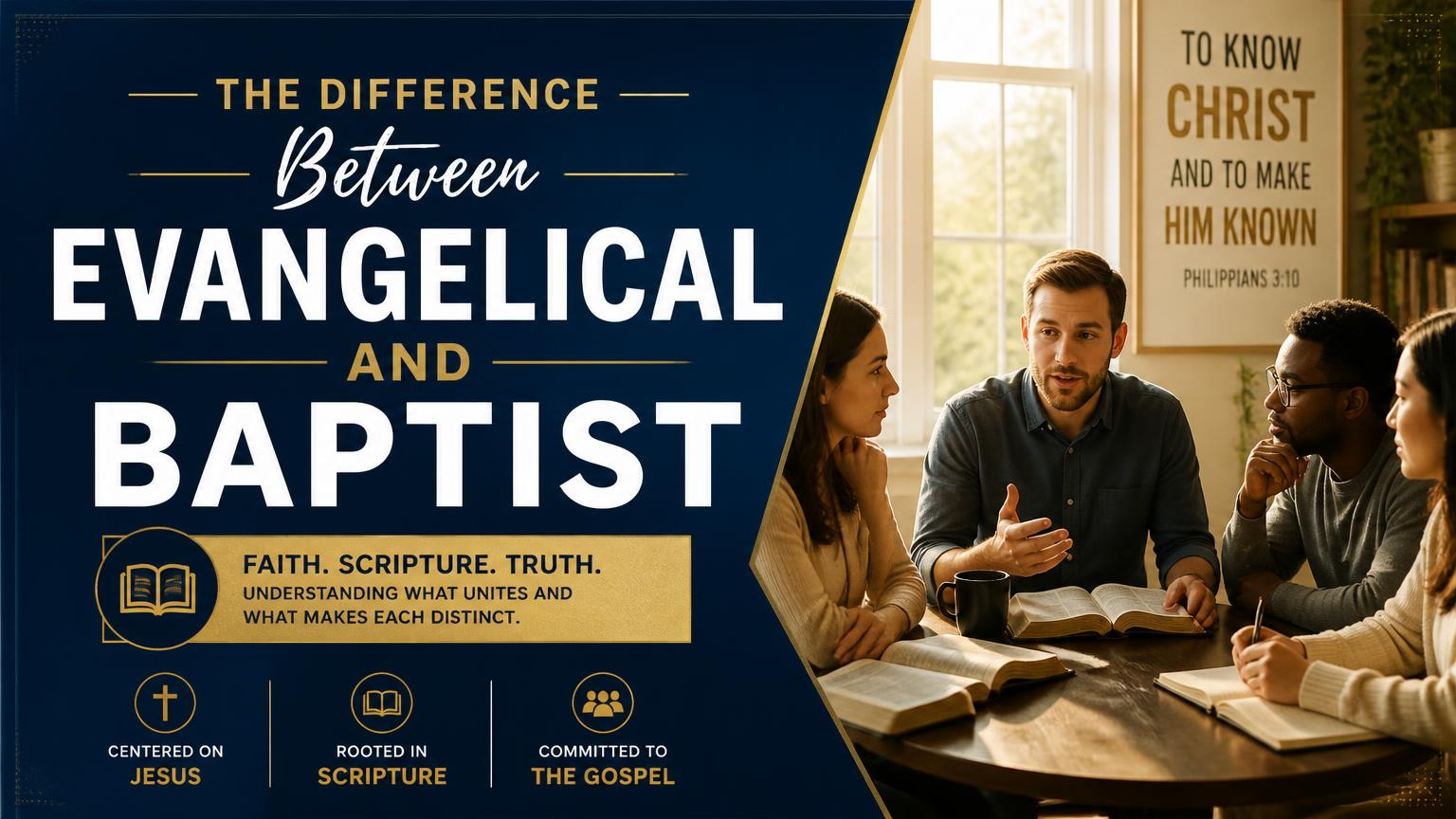
The difference between evangelical and Baptist is mainly one of category. Evangelical usually describes a broad Christian movement centered on the authority of the Bible, personal conversion, the gospel of Jesus Christ, and evangelism. Baptist identifies a particular Protestant tradition with distinctive teachings about believer’s baptism, church membership, congregational governance, and the independence of local churches.
The two terms overlap substantially: most Baptist churches are evangelical, but not every evangelical Christian is Baptist. A Baptist church may also differ from another Baptist church on subjects such as predestination, spiritual gifts, women in ministry, and the end times.
What Is the Difference Between Evangelical and Baptist?
Evangelicalism Describes a Broad Christian Movement
“Evangelical” comes from a Greek word meaning “gospel” or “good news.” In contemporary Christianity, evangelical generally refers to churches and Christians who emphasize several convictions:
- The Bible is authoritative for faith and Christian life.
- Human beings need reconciliation with God through Jesus Christ.
- Jesus’ death and resurrection are central to the gospel.
- People should personally respond to Christ in repentance and faith.
- Christians are called to share the gospel and serve others.
A commonly used historical description identifies four features of evangelicalism: conversionism—the necessity of personal conversion; activism—active Christian living and mission; biblicism—a strong emphasis on the Bible; and crucicentrism—the centrality of Christ’s crucifixion.
These features describe a movement rather than a single denomination. Evangelicals may belong to Baptist, Presbyterian, Methodist, Anglican, Pentecostal, non-denominational, or other churches. They may also disagree about baptism, church government, predestination, spiritual gifts, and the role of women in church leadership.
Baptist Identifies a Protestant Tradition
“Baptist” refers to a family of churches that developed in the seventeenth century among English Separatists and related Protestant movements. Baptists are known especially for teaching that baptism should be administered to those who personally profess faith in Christ, rather than to infants.
The name reflects this emphasis, although Baptists typically explain their practice as believer’s baptism, not simply as baptism by a particular method. Most Baptist churches practice baptism by immersion because they understand the New Testament pattern to connect baptism with personal faith and union with Christ. Passages such as Acts 2:41 and Acts 8:12 describe people believing and then being baptized.
Baptist churches commonly emphasize several other convictions:
- Local churches are responsible for their own governance.
- Church membership should consist of people who credibly profess Christian faith.
- Baptism and the Lord’s Supper are ordinances commanded by Christ rather than rituals that automatically convey salvation.
- Every Christian has direct access to God through Christ, without a separate priestly class.
- Religious liberty and freedom of conscience are important Christian principles.
These convictions are often called Baptist distinctives. They do not mean that all Baptist churches are identical. Baptist associations and denominations vary considerably in doctrine and practice.
Most Baptists Are Evangelical, but the Terms Are Not Synonyms
A Baptist church is often evangelical because it affirms the gospel, biblical authority, personal conversion, and the need to proclaim Christ. In that sense, “Baptist” supplies a more specific denominational identity within the wider evangelical world.
The relationship can be represented this way:
- Evangelical is a broad theological and ecclesial category.
- Baptist is a particular Protestant tradition.
- Many Baptists are evangelical.
- Many evangelicals are not Baptist.
- Some churches called Baptist may not fit every modern definition of evangelical.
For example, an evangelical Presbyterian may strongly affirm conversion and gospel preaching while baptizing infants and governing the church through elders and presbyteries. An evangelical Baptist may reject infant baptism and place final authority for local church decisions in the congregation.
Baptism Is the Clearest Practical Difference
The most visible distinction concerns who should be baptized and what baptism signifies.
Baptists generally teach that baptism follows a person’s conscious faith in Christ. A person is baptized because he or she has already professed faith, not in order to become a Christian. Romans 6:3–4 connects baptism with identification with Christ’s death and resurrection, while Baptist interpretation commonly sees the sequence in Acts—belief followed by baptism—as supporting believer’s baptism.
Evangelicals hold different views because evangelicalism includes multiple traditions. Some evangelical churches practice only believer’s baptism; others baptize infants as a sign of inclusion in the covenant community. Some baptize by immersion, while others use pouring or sprinkling.
This distinction should not be confused with the question of whether baptism saves. Most evangelical and Baptist traditions reject the idea that a person earns salvation through the ceremony. They generally understand salvation as God’s grace received through faith, consistent with Ephesians 2:8–9. Their disagreement concerns the meaning, recipients, timing, and administration of baptism.
Church Government Also Distinguishes Baptist Churches
Baptist churches generally practice congregationalism, meaning that the local congregation has substantial authority over its leaders, membership, finances, discipline, and major decisions. Pastors and elders may provide spiritual leadership, but the local church is not normally governed by a bishop or a regional hierarchy with direct authority over it.
Evangelical churches use several forms of government. Depending on the tradition, an evangelical church may be:
- Congregational, with authority vested in the local church
- Presbyterian, governed through elders and regional assemblies
- Episcopal, governed through bishops
- Independent or non-denominational, with a locally defined structure
Baptist congregationalism is not merely an administrative preference. It is connected to Baptist convictions about the spiritual responsibility of the gathered church, the priesthood of all believers, and the freedom of local congregations under Christ’s authority. Baptists differ, however, over how much authority pastors, elders, deacons, and church members should exercise.
Baptists Usually Speak of Ordinances
Baptists commonly describe baptism and the Lord’s Supper as ordinances: practices commanded by Jesus for the church to observe. They generally do not use the word “sacrament” in the same way that Roman Catholic, Eastern Orthodox, Anglican, or some Protestant traditions do.
The terminology reflects a theological distinction. Baptists usually emphasize that baptism and the Lord’s Supper are signs of God’s grace and acts of obedience, but they do not mechanically produce salvation. Other Christian traditions may also reject a mechanical understanding while still using “sacrament” to describe how God works through these practices.
Evangelicals are divided on this point because they come from different church traditions. An evangelical Baptist, evangelical Presbyterian, and evangelical Anglican may all affirm the gospel while using different language and holding different views of the ordinances or sacraments.
What Evangelicals and Baptists Commonly Believe
The Gospel Is Central to Both
Most evangelical and Baptist churches affirm the central Christian message summarized in passages such as 1 Corinthians 15:1–4: Jesus Christ died for sins, was buried, was raised from the dead, and appeared to his followers.
They generally teach that:
- There is one God in three persons: Father, Son, and Holy Spirit.
- Jesus Christ is fully divine and fully human.
- Humanity is affected by sin and needs reconciliation with God.
- Jesus’ death and resurrection provide the basis for forgiveness and salvation.
- Salvation is received through God’s grace and personal faith, not human merit.
- The Bible is the authoritative written Word of God.
- Jesus will return and bring final judgment and restoration.
The wording and emphasis can vary, but these beliefs form much of the common theological ground between evangelical and Baptist churches.
Both Emphasize Personal Conversion
Evangelicals commonly stress the need for a personal response to Christ. Baptists generally do the same, which is why Baptist churches often invite people to repent, believe, and publicly confess faith before baptism.
This emphasis does not necessarily mean every evangelical or Baptist church describes conversion in the same way. Some stress a decisive moment of “being born again,” while others describe conversion as a process that becomes clear through faith, repentance, and lifelong discipleship. The shared point is that Christian identity is not understood merely as cultural affiliation or participation in religious ceremonies.
Both Emphasize Scripture, Though They Interpret It Differently
Baptists and evangelicals usually affirm biblical authority, but agreement on authority does not guarantee agreement on interpretation. They may differ over:
- The relationship between the Old and New Covenants
- Women’s roles in church leadership
- The meaning of spiritual gifts
- The relationship between divine sovereignty and human freedom
- The timing and nature of Christ’s return
- Ethical questions involving marriage, sexuality, and public life
Therefore, “evangelical” and “Baptist” do not by themselves settle every theological question. A church’s confession of faith and actual teaching provide more precise information than its label alone.
Important Differences Within Each Group
Baptists Differ on Calvinism and Arminianism
Baptists have historically included both Calvinist and non-Calvinist perspectives. Some Baptist churches affirm doctrines associated with Reformed theology, including unconditional election and perseverance of the saints. Others emphasize human responsibility, free response to the gospel, and the possibility of resisting grace.
The same division exists among evangelicals more broadly. A person cannot determine a church’s position on salvation simply from the word “Baptist” or “evangelical.”
Evangelicals Differ on Baptism and Communion
Because evangelicalism spans several traditions, it has no single official position on baptism. Some evangelicals practice infant baptism; others practice only believer’s baptism. Some view baptism primarily as a public testimony, while others give it a stronger covenantal or sacramental significance.
The Lord’s Supper also receives different interpretations. Churches may understand it as a memorial, a means of spiritual nourishment, or a sacramental participation in Christ’s presence. Baptist churches typically emphasize remembrance and obedience, while still differing over the precise meaning of Christ’s presence during Communion.
Political and Cultural Usage Can Obscure the Meaning
In some countries, especially the United States, “evangelical” is used as a political or sociological category. That usage does not always correspond exactly to the theological meaning of evangelical Christianity. A person may identify as evangelical because of family background, church affiliation, or political identity without sharing the movement’s historic doctrinal commitments.
Similarly, Baptist denominations differ in their political engagement and cultural positions. The label “Baptist” does not by itself indicate a particular political ideology. Theological identity, denominational affiliation, and political behavior should be distinguished rather than treated as interchangeable.
How to Tell What a Particular Church Believes
A church’s name provides a useful starting point, but it is not enough to establish its beliefs. To understand a specific evangelical or Baptist church, examine:
- Its statement of faith: Look for its teaching about Scripture, salvation, baptism, Communion, and the church.
- Its baptism practice: Ask whether it baptizes infants, professing believers, or both, and whether it requires immersion.
- Its church government: Determine whether authority rests with the congregation, elders, bishops, or a denominational structure.
- Its view of salvation: Find out whether it is Calvinist, Arminian, or somewhere between those categories.
- Its approach to Scripture: A church may affirm biblical authority while differing over interpretation and application.
- Its teaching in practice: Sermons, membership requirements, worship, and discipleship often reveal more than a formal label.
Two churches may both call themselves evangelical while disagreeing over baptism and church government. Two Baptist churches may share believer’s baptism while differing sharply over salvation, worship, or social ethics.
Conclusion
The difference between evangelical and Baptist is primarily the difference between a broad movement and a specific Protestant tradition. Evangelical Christianity emphasizes the gospel, biblical authority, personal conversion, and Christian mission. Baptist Christianity shares those commitments in many cases but adds distinctive teachings about believer’s baptism, congregational church government, and local church autonomy.
The terms therefore overlap without being identical. Most Baptists are evangelical, but evangelical Christians may belong to many other traditions. To understand a particular church accurately, look beyond the label to its teaching on Scripture, salvation, baptism, Communion, and the structure of the church.