
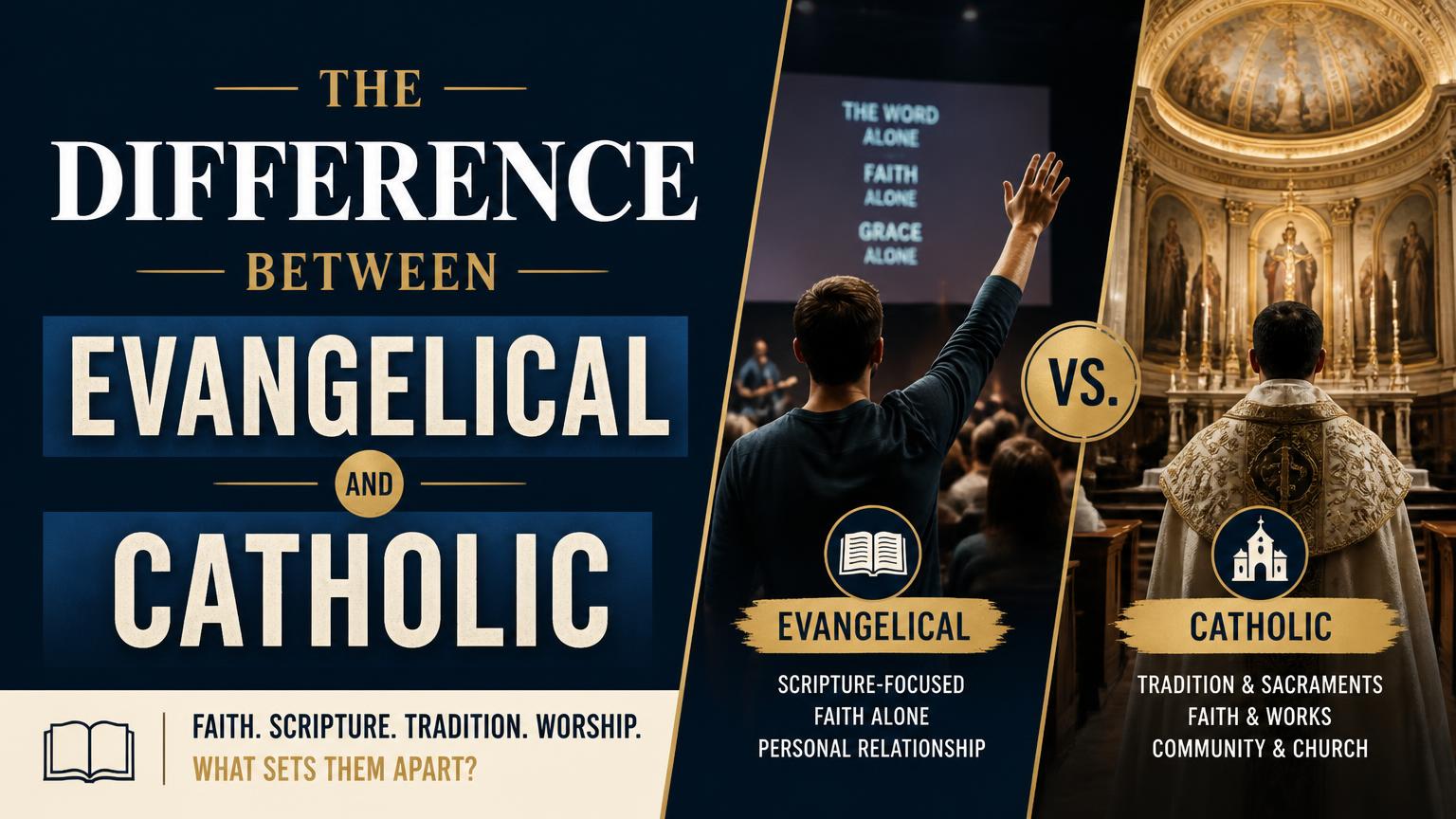
Evangelicals and Catholics are both Christian traditions centered on Jesus Christ, the Bible, and the belief that salvation comes through God’s grace. The main difference is how they understand authority, the church, salvation, sacraments, worship, and the role of Mary and the saints. “Evangelical” describes a broad Protestant movement rather than one unified church, while “Catholic” usually refers to the worldwide Roman Catholic Church in communion with the pope.
What Is the Difference Between Evangelical and Catholic?
The clearest distinction is this: evangelical Christianity generally treats the Bible as the highest and final authority for doctrine, while Catholic Christianity receives divine revelation through both Scripture and Sacred Tradition, authentically interpreted by the Church’s teaching office, or Magisterium.
That difference affects beliefs about salvation, baptism, communion, church leadership, worship, and Christian practice. The following comparison describes broad patterns; individual evangelical denominations and congregations can differ considerably.
Evangelical and Catholic Describe Different Kinds of Identity
“Evangelical” is not the name of a single denomination. Evangelicals may belong to Baptist, Pentecostal, Reformed, independent, non-denominational, Anglican, or other Protestant churches. Despite their differences, evangelical movements commonly emphasize:
- The authority and trustworthiness of the Bible
- Personal conversion or being “born again”
- Salvation through faith in Jesus Christ
- The death and resurrection of Christ as central to the gospel
- The importance of evangelism and sharing the Christian faith
Catholic refers primarily to membership in the Catholic Church, a worldwide communion with a defined creed, sacramental system, episcopal leadership, and the pope as its visible head. The Catholic Church includes diverse cultural and liturgical traditions, but its official doctrine is centrally defined.
The terms can overlap in one limited sense: “evangelical” can simply mean committed to proclaiming the gospel, and Catholics are also called to evangelize. In ordinary theological comparison, however, “evangelical” usually means Protestant evangelical, not Catholic.
Authority: Scripture, Tradition, and the Magisterium
Most evangelicals affirm sola Scriptura, meaning that Scripture is the final infallible standard for Christian faith and practice. This does not necessarily mean that evangelicals reject history, creeds, pastors, or theological tradition. Rather, those authorities remain subordinate to the Bible and can be corrected by it.
Evangelicals often appeal to passages such as 2 Timothy 3:16–17, which describes Scripture as inspired and useful for teaching and correction. They generally believe that every Christian has the responsibility to read and understand the Bible, although trained teachers and church communities help with interpretation.
Catholics also affirm that the Bible is inspired and authoritative. Catholic teaching, however, holds that Scripture and Sacred Tradition together transmit the “deposit of faith.” The Magisterium—the pope and bishops teaching in communion with him—has the responsibility to interpret that deposit authoritatively.
Catholics may emphasize passages such as 2 Thessalonians 2:15, which refers to traditions taught by word and letter, and 1 Timothy 3:15, which calls the church the pillar and foundation of truth. Evangelicals and Catholics interpret these texts differently because they begin with different assumptions about the church’s authority.
The biblical canon also differs. Most evangelical Protestant Bibles contain 66 books, while Catholic Bibles include several additional Old Testament books, commonly called the Deuterocanonical books, such as Tobit, Judith, Wisdom, Sirach, Baruch, and 1 and 2 Maccabees.
Salvation: Faith, Grace, and Works
Both traditions teach that human beings need God’s grace and that salvation is possible only through Jesus Christ. The disagreement is largely about how justification and sanctification relate to one another.
Evangelicals generally teach that a sinner is justified—declared righteous before God—through faith in Christ, not through good works as a basis for acceptance. Good works are understood as the result and evidence of genuine faith. Evangelical traditions differ over issues such as predestination, free will, and whether a true believer can permanently fall away, but they usually distinguish justification from the lifelong process of sanctification.
Catholic teaching also rejects the idea that people can save themselves independently of God’s grace. Catholics believe justification begins through God’s grace, ordinarily received in baptism, and involves an inner transformation of the person. Faith must become active in love, and Christians cooperate with grace through a life of obedience, repentance, and charity.
This does not mean that Catholic doctrine teaches people can purchase or earn salvation apart from Christ. Catholic theology attributes every saving grace to God and understands good works as possible because grace is already at work. The evangelical-Catholic difference is therefore not simply “faith versus works.” Both affirm faith and grace; they differ over whether justification is primarily a once-for-all declaration received through faith or also includes an ongoing transformation in which believers cooperate with grace.
Baptism, Communion, and the Sacraments
Catholic Christianity recognizes seven sacraments: baptism, confirmation, the Eucharist, penance or reconciliation, anointing of the sick, holy orders, and marriage. Sacraments are understood as effective signs of grace established by Christ and entrusted to the Church.
Most evangelical churches recognize baptism and the Lord’s Supper as the two ordinances directly commanded by Christ. Many call them ordinances rather than sacraments to stress that they do not function as automatic channels of saving grace. Evangelical views vary, however. Some churches teach that baptism is primarily a public confession of faith, while others believe it conveys a genuine spiritual blessing or grace.
Catholics baptize infants as well as converts because they understand baptism as incorporation into Christ and the Church, cleansing from original sin, and the beginning of Christian life. Evangelical churches differ: Baptist and many non-denominational churches practice believer’s baptism, while some evangelical Lutherans, Anglicans, and Reformed churches baptize infants.
The Eucharist is another major distinction. Catholics believe that bread and wine become the body and blood of Christ in substance, while their outward appearances remain. This teaching is commonly called transubstantiation. The Mass is understood as the sacramental making-present of Christ’s one sacrifice, not as a separate repetition of Calvary.
Evangelical beliefs about communion range from a symbolic memorial to various understandings of Christ’s spiritual or real presence. Most evangelical churches do not accept the Catholic doctrine of transubstantiation.
Church Leadership and Worship
The Catholic Church has bishops, priests, and deacons, with the pope serving as bishop of Rome and a universal pastoral leader. Catholic bishops are understood to stand within apostolic succession, and priests have a distinctive sacramental role, particularly in celebrating the Eucharist and hearing confessions.
Evangelical churches have no single worldwide governing structure. Leadership may rest with pastors, elders, bishops, denominational authorities, or congregational members, depending on the tradition. Evangelicals generally reject the idea that a special priesthood is required to mediate between believers and God, emphasizing the priesthood of all believers. Some evangelical traditions nevertheless retain formal clergy and historic episcopal structures.
Catholic worship follows a structured liturgy centered on the Mass, the church calendar, Scripture readings, prayers, and the Eucharist. Evangelical worship varies widely but commonly includes preaching, congregational singing, prayer, Bible reading, and communion. Some evangelical churches are highly informal, while others use ancient liturgical forms. Worship style alone, therefore, does not always reveal the theological difference.
Mary, the Saints, and Prayer
Catholics honor Mary as the mother of Jesus and give her a unique place among the saints. Catholic doctrine includes teachings such as the Immaculate Conception and the Assumption. Catholics distinguish veneration of Mary and the saints from adoration, which belongs to God alone. They may ask saints to pray for them in much the same way that Christians ask living believers for prayer.
Most evangelicals respect Mary as the mother of Jesus and a model of faith but do not accept the distinctive Catholic Marian doctrines. They generally pray directly to God through Jesus Christ and do not invoke departed saints as intercessors.
This difference reflects the two traditions’ different understandings of the church and the communion of saints. It is not accurate to say that Catholics worship Mary, but it is also inaccurate to portray Catholic devotion to Mary as merely an alternative style of evangelical prayer.
What Evangelicals and Catholics Share
Despite substantial disagreements, evangelicals and Catholics share central Christian convictions, especially within historic mainstream Christianity. Both generally affirm:
- One God in three persons: Father, Son, and Holy Spirit
- The full deity and humanity of Jesus Christ
- The virgin birth, sinless life, death, and bodily resurrection of Jesus
- The reality of human sin and the necessity of divine grace
- The future return of Christ and final judgment
- The importance of Scripture and Christian moral transformation
- Baptism, prayer, worship, and the mission to make disciples
These shared beliefs are expressed in historic creeds such as the Nicene Creed. At the same time, shared creedal language does not erase differences over authority, justification, sacraments, and church structure.
Why These Differences Matter
The distinctions affect practical Christian life rather than merely theological vocabulary. They influence how Christians answer questions such as:
- Who has authority to settle doctrinal disputes?
- What happens spiritually in baptism and communion?
- How should a person understand confession and forgiveness?
- Is the church primarily a visible sacramental institution, a gathered community of believers, or both?
- How should Christians relate to Mary, saints, tradition, and church history?
- What does it mean to be justified and to grow in holiness?
They also affect church membership and participation. Catholics ordinarily receive the Eucharist within Catholic communion, while evangelical churches usually invite baptized believers according to their own communion policies. A person comparing churches should therefore examine the congregation’s actual teaching rather than relying only on the labels “evangelical” or “Catholic.”
Common Misunderstandings About Evangelicals and Catholics
“Catholics believe they earn salvation through good works.”
Catholic teaching begins with God’s grace and insists that salvation comes through Christ. Catholics do believe that grace transforms believers and that acts of love and obedience matter in the Christian life.
“Evangelicals all believe exactly the same things.”
Evangelicalism includes significant differences concerning baptism, communion, predestination, church government, spiritual gifts, and eternal security.
“Catholics worship Mary and the saints.”
Catholic theology distinguishes adoration of God from honor given to Mary and the saints. Evangelicals generally reject invoking saints, but “worship” is not the Catholic description of that practice.
“Evangelicals reject all tradition.”
Most evangelicals reject tradition as an infallible authority equal to Scripture, but they may value creeds, historical theology, denominational confessions, and inherited worship practices.
The difference between evangelical and Catholic Christianity is therefore best understood as a set of connected theological differences, not a contrast between “Bible-believing Christians” and people who ignore the Bible. Both appeal to Scripture and confess Christ, but they place Scripture, tradition, the church, salvation, and the sacraments into different systems of authority and practice.