
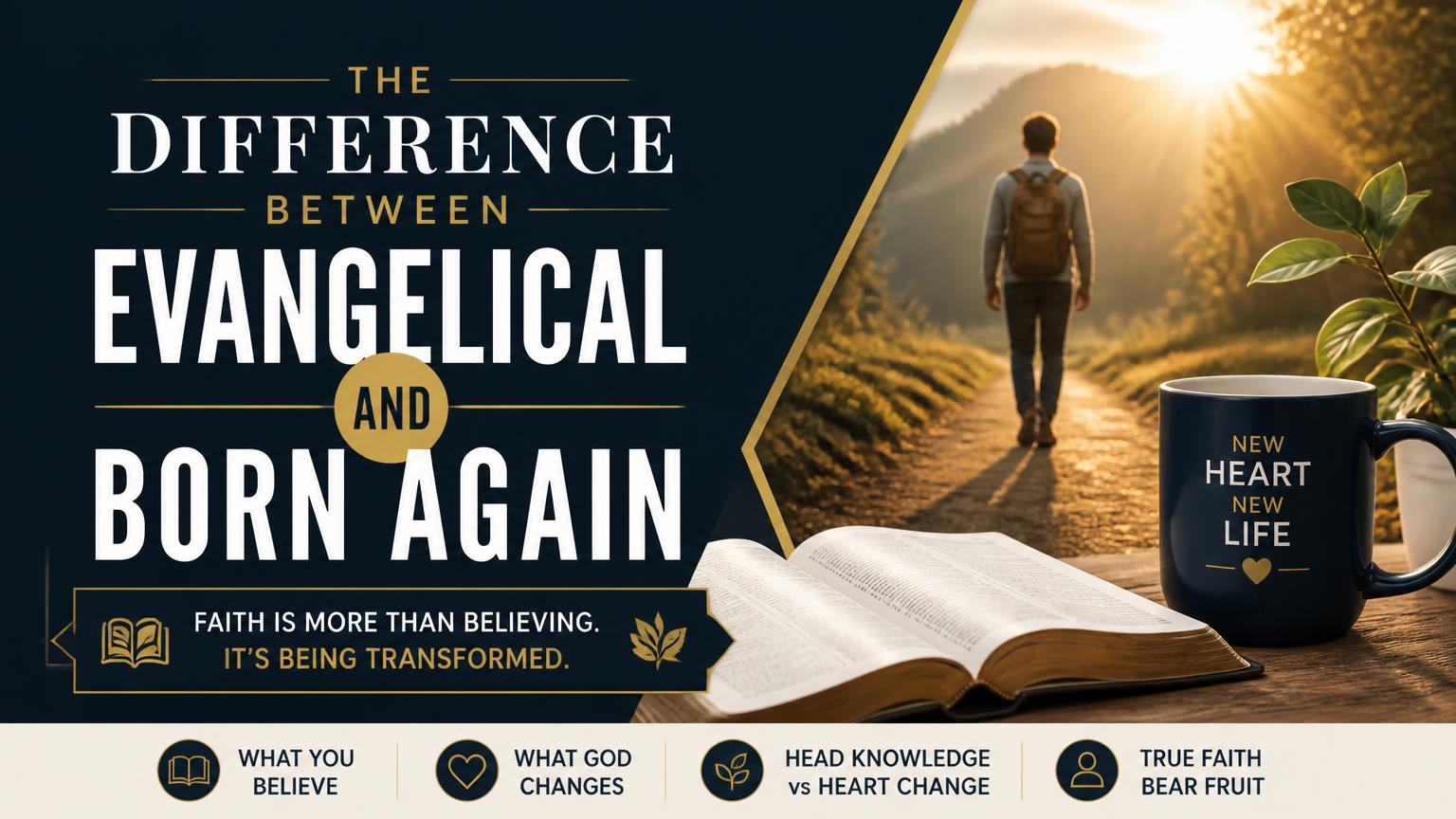
“Evangelical” and “born again” are related Christian terms, but they do not mean the same thing. Evangelical usually describes a Christian tradition, movement, or theological identity centered on the gospel, the authority of Scripture, conversion, and sharing Christian faith. Born again describes spiritual regeneration—the new life God gives a person through faith in Jesus Christ.
A person may accurately be both evangelical and born again, but the two labels answer different questions: “Evangelical” identifies a tradition or community; “born again” describes a person’s spiritual transformation.
What Is the Difference Between Evangelical and Born Again?
Evangelical Describes a Christian Identity or Movement
The word evangelical comes from the Greek term for “gospel” or “good news.” In contemporary Christianity, it commonly refers to Christians and churches that emphasize several connected convictions:
- The Bible is the authoritative foundation for Christian faith and practice.
- Jesus Christ’s death and resurrection are central to salvation.
- A person must personally respond to God through faith and repentance.
- Christians are called to proclaim the gospel and live out its implications.
- Conversion and a personal relationship with Christ matter, rather than merely belonging to a Christian culture or institution.
Evangelicalism is not one denomination. Evangelical Christians may belong to Baptist, Presbyterian, Methodist, Pentecostal, independent, Anglican, or other churches. Their beliefs about baptism, spiritual gifts, church government, and worship may differ, while they share a strong emphasis on the gospel and personal faith in Christ.
The term also has political and cultural uses, especially in the United States. Those uses can make “evangelical” sound like a political category, but its original and theological meaning concerns Christian belief and practice—not membership in a political party.
Born Again Describes Spiritual Regeneration
“Born again” comes from Jesus’ conversation with Nicodemus in John 3. Jesus told him, “Unless one is born again” or “born from above,” he cannot see the kingdom of God (John 3:3). The underlying Greek expression can carry both meanings: being born anew and receiving life from above.
In Christian theology, being born again refers to God’s work of bringing a spiritually separated person into new life. It includes a changed relationship with God, a turning from sin, trust in Christ, and the beginning of a transformed way of living. It is not simply adopting Christian morals, attending church, or experiencing a powerful emotional moment.
Jesus used the language of birth to show that salvation is more than self-improvement. A person does not cause physical birth through personal effort; similarly, spiritual life is ultimately God’s gift. This does not remove the importance of faith and repentance. Rather, it means that genuine Christian conversion involves both God’s gracious action and a person’s sincere response.
The Two Terms Operate on Different Levels
The clearest distinction is this:
| Term | Main Question It Answers | Basic Meaning |
|---|---|---|
| Evangelical | What Christian tradition or outlook does someone identify with? | A gospel-centered Christian identity or movement |
| Born again | Has someone experienced spiritual renewal through Christ? | New spiritual life through God’s saving work |
“Evangelical” is primarily a category of identity, theology, and community. “Born again” is primarily a description of spiritual conversion and regeneration.
That distinction explains why the terms overlap without being interchangeable. Someone might identify as evangelical but use “conversion,” “new birth,” or “being saved” instead of “born again.” Conversely, someone may describe themselves as born again without belonging to an evangelical church or movement.
Evangelicals Generally Affirm the New Birth
Most evangelical churches teach that a person must be spiritually renewed through God’s grace. They may explain this using different terms, including:
- Conversion
- Regeneration
- New birth
- Salvation
- Receiving Christ
- Becoming a new creation
- Being indwelt by the Holy Spirit
These terms overlap, though theological traditions may distinguish them more precisely. For example, some describe regeneration as God giving spiritual life, while conversion emphasizes a person’s repentance and faith. In everyday speech, however, “born again” often refers to the whole experience of becoming a Christian.
Because evangelical Christianity emphasizes personal conversion, born-again language is especially common among evangelicals. Still, evangelical and born again remain different concepts.
What Does “Born Again” Mean Biblically?
Jesus Connected the New Birth With Seeing God’s Kingdom
Nicodemus was a religious leader who knew the Scriptures and followed Jewish religious practices. Yet Jesus told him that religious knowledge and outward status were not enough. He needed to be born again.
Jesus then connected this new birth with the work of the Holy Spirit:
“Unless one is born of water and the Spirit, he cannot enter the kingdom of God.” —John 3:5
Christian traditions interpret “water and the Spirit” differently. Some connect it with cleansing and renewal, others with baptism, and others with the prophetic promise of spiritual cleansing in passages such as Ezekiel 36:25–27. Despite these differences, the central point is widely recognized: entering God’s kingdom requires divine spiritual renewal, not merely religious affiliation.
The New Birth Produces a Changed Life
The New Testament describes believers as having been “born again” through God’s living word (1 Peter 1:23) and as becoming a “new creation” in Christ (2 Corinthians 5:17). These statements do not mean that Christians become instantly perfect or never struggle with sin. They mean that conversion changes the direction and foundation of a person’s life.
The results may include:
- Trust in Jesus Christ
- Repentance from sin
- A growing desire to obey God
- Love for other Christians
- A changed understanding of identity and purpose
- Increasing evidence of the Holy Spirit’s work
Growth is usually progressive. A person may genuinely be born again while still needing maturity, correction, healing, and deeper understanding. Christian transformation is not measured by a flawless life but by a continuing movement toward faithfulness.
Being Born Again Is More Than a Religious Label
The phrase can be misused when it becomes a badge of superiority or a substitute for examining one’s life. Jesus’ teaching points to dependence on God, not spiritual self-congratulation.
Likewise, being born again does not necessarily mean that someone can identify the exact date, hour, or emotional experience of conversion. Some people describe a dramatic moment of faith; others grow gradually in Christian understanding and later recognize that they have entrusted themselves to Christ. The intensity of the memory is not the final measure of spiritual reality.
How Do Evangelical and Born-Again Christians Relate?
A Person Can Be Both Evangelical and Born Again
A person who belongs to an evangelical church and has personally trusted Christ may appropriately be described in both ways. For example, an evangelical Christian might say, “I am born again because I have received new life through faith in Jesus.”
In this case:
- Evangelical identifies the person’s Christian community and theological framework.
- Born again describes the person’s experience and spiritual condition.
The terms complement each other rather than compete.
A Person May Use One Term Without the Other
Not every Christian who believes in the new birth uses the phrase “born again.” Some churches prefer language such as baptismal regeneration, conversion, sanctification, or union with Christ. In traditions that emphasize baptism and the church’s sacramental life, “born again” may be understood differently from the way it is commonly used in evangelical revival settings.
Similarly, not everyone who calls themselves evangelical uses the phrase consistently or means exactly the same thing by it. Some use it to describe theological convictions; others use it as a denominational, cultural, or political identity. Therefore, the labels should be clarified rather than assumed to have one universal meaning.
Evangelical Does Not Automatically Mean Spiritually Transformed
Calling oneself evangelical does not, by itself, prove that a person has been born again. A person can adopt a Christian identity, attend an evangelical church, or affirm evangelical doctrines without personally trusting Christ or displaying evidence of spiritual renewal.
This does not mean that Christians can perfectly judge another person’s spiritual condition. It means that an external label and an inward relationship with God are not identical. The New Testament repeatedly connects authentic faith with its fruit, while also recognizing that spiritual growth takes time.
Common Misunderstandings About the Two Terms
“Born Again” Does Not Mean Becoming Physically Reborn
Jesus was speaking about spiritual life, not reincarnation or literal physical birth. The new birth is a work of God in which the Holy Spirit renews a person’s relationship with God.
“Born Again” Does Not Mean Sinless
New birth begins a transformed life; it does not eliminate every temptation, weakness, or failure immediately. Christians continue to repent, grow, and depend on God’s grace.
“Evangelical” Does Not Mean a Single Denomination
Evangelicalism includes many denominations and independent churches. Shared emphasis on the gospel does not mean complete agreement on every doctrine or practice.
“Evangelical” Does Not Simply Mean “Evangelistic”
An evangelistic Christian actively shares the gospel. An evangelical Christian may also be evangelistic, but “evangelical” usually refers more broadly to a theological tradition or identity. The words are related, but they are not exact synonyms.
Why the Distinction Matters
The distinction prevents two opposite errors. First, it avoids treating evangelicalism as merely a personal emotional experience. Evangelicalism includes doctrines, churches, practices, and a historical movement. Second, it prevents people from reducing the new birth to church membership or a denominational label.
The biblical emphasis is not on choosing the most impressive title. It is on the gospel of Jesus Christ, genuine faith, repentance, and the renewing work of the Holy Spirit. Labels can help explain a person’s beliefs, but they cannot replace the spiritual reality those beliefs are meant to describe.
The difference between evangelical and born again is therefore a difference between Christian identity and spiritual transformation. Evangelical usually describes a gospel-centered movement or tradition; born again describes receiving new spiritual life through God’s work in Christ. Many Christians are both, but neither term should be treated as an exact substitute for the other.