
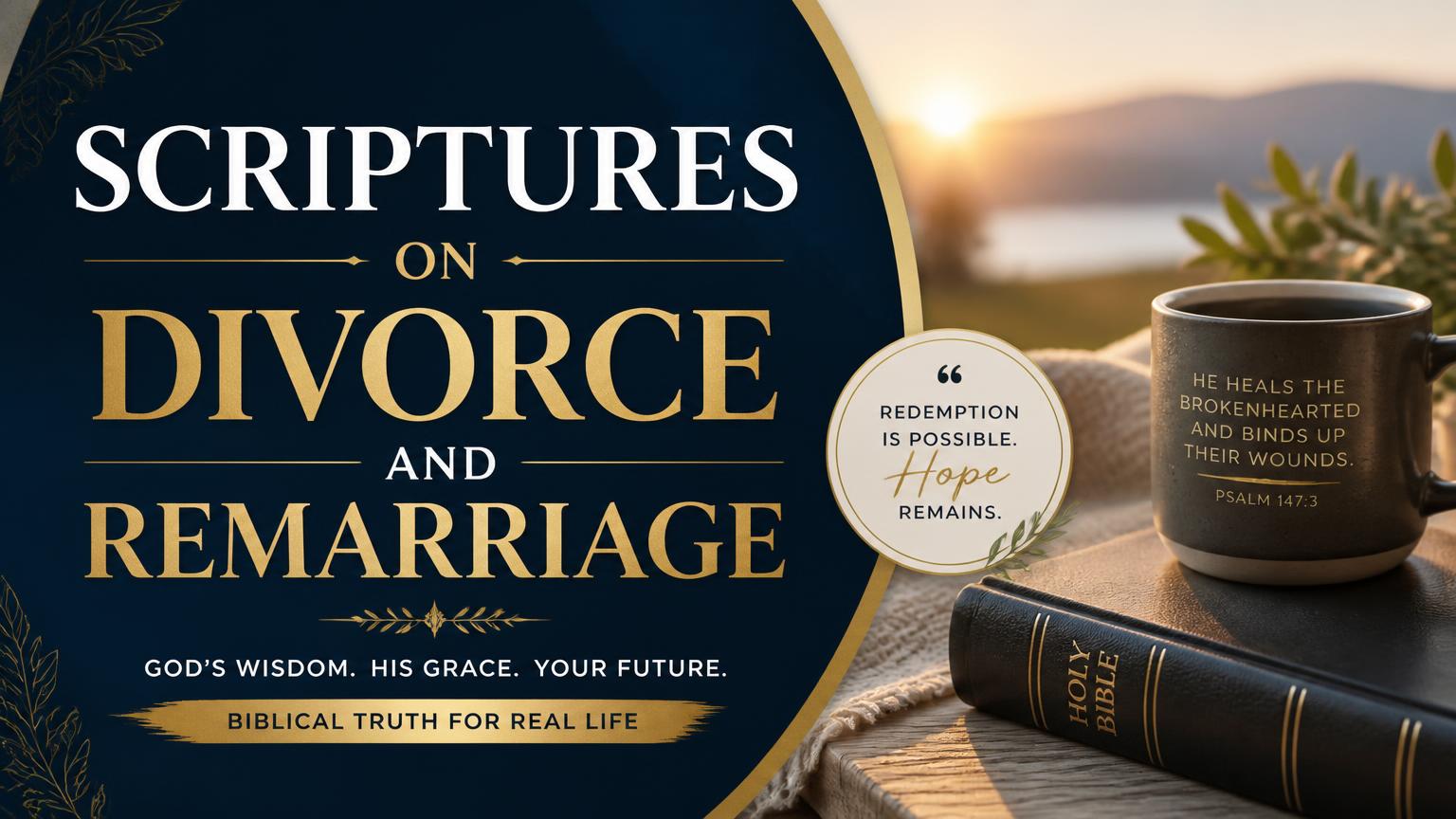
The Scriptures on divorce and remarriage present marriage as a lifelong covenant while recognizing that human sin can severely damage it. Jesus condemns casual, selfish divorce; Matthew records an exception involving sexual immorality, and Paul addresses abandonment by an unbelieving spouse. The Bible explicitly permits remarriage after a spouse’s death, while Christian traditions differ over how broadly the other passages permit remarriage after divorce.
Scriptures on Divorce and Remarriage
Marriage as a Lifelong, One-Flesh Covenant
The Bible’s starting point is God’s design for marriage, not divorce. Genesis 2:24 describes marriage as a union in which a man and woman become “one flesh.” Jesus uses this passage in Matthew 19:4–6 and Mark 10:6–9 to explain that marriage is more than a legal arrangement or temporary partnership. It is a covenantal union intended to endure.
Jesus concludes, “What therefore God has joined together, let not man separate” (Matthew 19:6). The statement emphasizes the seriousness of breaking a marriage covenant. It does not mean every marriage is healthy or that a person must remain physically exposed to violence or coercion. It does mean that divorce should never be treated as morally insignificant or pursued merely for convenience, preference, or personal advantage.
Malachi 2:13–16 also describes marriage as a covenant and condemns men who deal treacherously with “the wife of your youth.” The passage connects marital faithlessness with violence, betrayal, and spiritual unfaithfulness. The familiar statement “God hates divorce” reflects the passage’s concern, although English translations differ over the precise wording of Malachi 2:16. The clear emphasis is that God hates covenant treachery and the harmful treatment of a spouse—not that God rejects people who have experienced divorce.
Old Testament Law Regulates Divorce Rather Than Commands It
Deuteronomy 24:1–4 describes a man giving his wife a certificate of divorce and addresses what happens if she later marries another man. The passage regulates an existing practice; it does not present divorce as God’s ideal or command husbands to divorce their wives.
Jesus makes this distinction in Matthew 19:7–8. When the Pharisees ask why Moses permitted divorce, Jesus replies that Moses allowed it because of the hardness of people’s hearts, but that divorce was not the original pattern “from the beginning.” In other words, civil regulation of divorce does not equal moral approval of every divorce.
The law protected a divorced woman from being treated as though a previous marriage could simply be resumed after a subsequent marriage had ended. It also shows that Scripture addresses the realities of broken relationships without presenting those realities as the goal of creation.
Jesus’ Teaching and the Exception for Sexual Immorality
Jesus addresses divorce in Matthew 5:31–32 and Matthew 19:3–9. He rejects the idea that a man can dismiss his wife casually by issuing a certificate and then avoid responsibility for the consequences. In Matthew, Jesus says that divorcing a wife except for “sexual immorality” and marrying another woman results in adultery; he gives a similar teaching regarding a man who divorces his wife.
The Greek term translated “sexual immorality” is porneia, a broad term for serious sexual sin. Many Christians understand Matthew’s exception to include marital sexual unfaithfulness and believe it permits the innocent spouse to seek divorce and, in appropriate circumstances, remarry. Others argue that porneia may refer to an unlawful or invalid sexual union, possibly connected to the Jewish betrothal context, rather than ordinary adultery within a valid marriage.
The exception clause is therefore significant, but it should not be turned into an automatic command to divorce. Jesus does not say that a betrayed spouse must end the marriage. Repentance, forgiveness, and restoration may sometimes be possible. The passage establishes that sexual betrayal is a serious covenant violation and that Matthew does not present divorce and remarriage as equally sinful in every circumstance.
Mark 10:2–12 and Luke 16:18 record Jesus’ strong teaching on divorce without mentioning Matthew’s exception. Christians interpret this difference in two main ways. Some take Mark and Luke as stating an absolute rule, while others understand Matthew as supplying an exception that the shorter accounts do not repeat. The Gospels agree on the central point: divorce and remarriage must not be used to legitimize unfaithfulness or evade the obligations of marriage.
Paul on Separation and Abandonment
First Corinthians 7 gives the most detailed New Testament instruction about separation and marriage in a difficult, real-life setting.
In 1 Corinthians 7:10–11, Paul repeats Jesus’ command that a wife should not separate from her husband and that a husband should not divorce his wife. If separation occurs, Paul says the person should remain unmarried or be reconciled, assuming reconciliation is possible and safe.
Paul then addresses marriages in which one spouse is a Christian and the other is not. If the unbelieving spouse is willing to remain, the Christian should not initiate divorce merely because of the religious difference. But if the unbelieving spouse leaves, Paul says, “let it be so”; the brother or sister is “not enslaved” in such circumstances, because God has called believers to peace (1 Corinthians 7:12–16).
Christians disagree about whether “not enslaved” explicitly permits remarriage. Many Protestant interpreters understand it as a second ground for divorce and remarriage: sexual immorality in Matthew and willful abandonment in 1 Corinthians. Others believe Paul permits the separation but does not clearly release the abandoned spouse to marry again. The text plainly rejects forcing a Christian to preserve a marriage at any cost when the unbelieving spouse has definitively abandoned it; the debate concerns the precise implications for a subsequent marriage.
Paul also teaches that a person is “bound” to a spouse while that spouse lives but is free to marry after the spouse’s death, provided the new marriage is “in the Lord” (1 Corinthians 7:39). Romans 7:2–3 uses a similar marriage-bond analogy, though its immediate purpose is to explain a theological point about the law rather than to provide a complete doctrine of divorce.
The Bible’s Main Principles Taken Together
The relevant passages establish several principles:
- Marriage is intended to be faithful, exclusive, and lifelong.
- Divorce is not presented as God’s original design.
- God condemns betrayal, oppression, abandonment, and hard-hearted treatment within marriage.
- Matthew identifies sexual immorality as an exception to Jesus’ general teaching on divorce.
- Paul addresses abandonment by an unbelieving spouse and calls believers to peace.
- Remarriage after a spouse’s death is explicitly permitted.
- The Bible does not treat every divorce as morally identical.
These principles must be held together. Emphasizing lifelong marriage without acknowledging abuse or abandonment can burden people whom Scripture does not command to remain in danger. Emphasizing exceptions without Jesus’ teaching on covenant faithfulness can turn serious grounds for divorce into excuses for self-interest.
What Do These Scriptures Mean for Remarriage?
Remarriage After the Death of a Spouse
The clearest case is remarriage after death. Romans 7:2–3 and 1 Corinthians 7:39 state that the marriage bond ends when a spouse dies. A widow or widower is free to marry again, with Paul encouraging marriage “in the Lord”—that is, marriage consistent with Christian faith and discipleship.
Remarriage After Sexual Immorality
Many Christians conclude from Matthew 5:32 and Matthew 19:9 that a spouse who has been sexually betrayed may divorce and remarry without committing adultery. This interpretation sees Jesus’ exception as releasing the faithful spouse from the marriage covenant.
Other interpreters stress that Jesus does not directly say, “The innocent spouse may remarry.” They therefore allow separation or divorce in cases of sexual immorality but remain cautious about remarriage. Still others interpret porneia more narrowly and do not apply it to every instance of adultery.
Because the passage is debated, responsible pastoral guidance should consider the facts, the meaning of the original marriage, genuine repentance, attempts at restoration, and the teaching of the person’s church tradition rather than applying a single phrase mechanically.
Remarriage After Abandonment
Those who interpret 1 Corinthians 7:15 as permission for remarriage generally reason that Paul’s phrase “not enslaved” contrasts with the continuing marital obligation described earlier in the chapter. If the unbelieving spouse has abandoned the marriage, the Christian is not required to maintain a relationship that the other spouse has already rejected.
Other interpreters understand “not enslaved” to mean that the believer is not required to pursue or force reconciliation, while the marriage bond remains. Both positions seek to honor Paul’s command to pursue peace, but they differ over whether freedom from the obligation to preserve the relationship includes freedom to marry again.
Remarriage After an Unbiblical Divorce
The most difficult case involves a divorce that did not arise from sexual immorality or abandonment. Some churches teach that the original marriage bond continues and therefore permit remarriage only after the former spouse dies. Others believe that a divorce obtained wrongly may still become a permanently changed situation in which remarriage can be considered, particularly where reconciliation is impossible and repentance has occurred.
Scripture calls people to confess sin and pursue reconciliation where possible, but it does not provide a single detailed procedure for every modern divorce. A person’s history, the former spouse’s current marriage, abuse, abandonment, legal obligations, and the welfare of children can all affect what faithfulness requires. Forgiveness does not always mean restoring the former relationship, and reconciliation requires more than verbal regret.
Why Christians Interpret These Passages Differently
The main disagreement does not arise because Christians ignore the Bible. It comes from different answers to several interpretive questions:
- What does Matthew’s exception mean? Some apply it to marital adultery; others limit it to unlawful unions or betrothal violations.
- How should Mark and Luke be read alongside Matthew? Some regard their wording as absolute; others view it as a shortened account that does not repeat every qualification.
- What does “not enslaved” mean in 1 Corinthians 7:15? The phrase may describe freedom from the marriage obligation, or it may mean freedom from the duty to prevent separation.
- How should Jesus’ ideal relate to pastoral cases? Some traditions emphasize the continuing bond of the first marriage, while others give greater weight to the destructive effects of covenant-breaking.
- What authority should church tradition have? Roman Catholic, Eastern Orthodox, and Protestant churches have developed different pastoral and legal practices, even when they affirm the seriousness of Jesus’ teaching.
The most restrictive position usually permits remarriage only after death. A common Protestant position permits remarriage after sexual immorality or abandonment. Other traditions allow remarriage in additional tragic circumstances while treating it as a concession to human brokenness rather than the ideal.
Applying Biblical Teaching With Truth and Compassion
Biblical teaching about divorce should never be used to pressure someone to remain with a violent, sexually abusive, or coercively controlling spouse. Scripture condemns violence and calls Christians to protect the vulnerable; passages such as Psalm 11:5, Ephesians 5:25–29, and Colossians 3:19 oppose cruelty and self-serving domination. Physical safety may require immediate separation and assistance from trusted people, civil authorities, domestic-violence professionals, or qualified counselors.
Safety and divorce are related but not identical questions. A person may need protection before deciding whether divorce is permissible, and a church should not treat forced proximity as proof of forgiveness or faithfulness. Likewise, repentance should be evaluated by sustained change, truthfulness, accountability, and willingness to accept consequences—not by promises made under pressure.
Those considering divorce or remarriage should examine:
- whether sexual betrayal or abandonment has occurred;
- whether there is danger, coercion, or ongoing abuse;
- whether repentance is genuine and demonstrated;
- whether reconciliation is realistically possible;
- whether a former spouse has entered another marriage;
- how children and legal responsibilities will be affected;
- how the person’s church tradition understands the relevant passages.
Pastoral counsel should be biblically grounded, compassionate, and informed by the facts. No single verse should be used as a weapon against a wounded person or as a shortcut around responsibility.
Conclusion
The Scriptures on divorce and remarriage affirm that marriage is a lifelong covenant, condemn casual divorce and covenant betrayal, and recognize circumstances in which a marriage has been seriously broken. Matthew identifies sexual immorality as an exception to Jesus’ general teaching, while 1 Corinthians 7 addresses abandonment and the call to peace. Remarriage after death is explicit; remarriage after divorce requires more careful interpretation and differs among Christian traditions. The faithful application of these passages combines conviction about marriage with protection, repentance, justice, and compassion.