
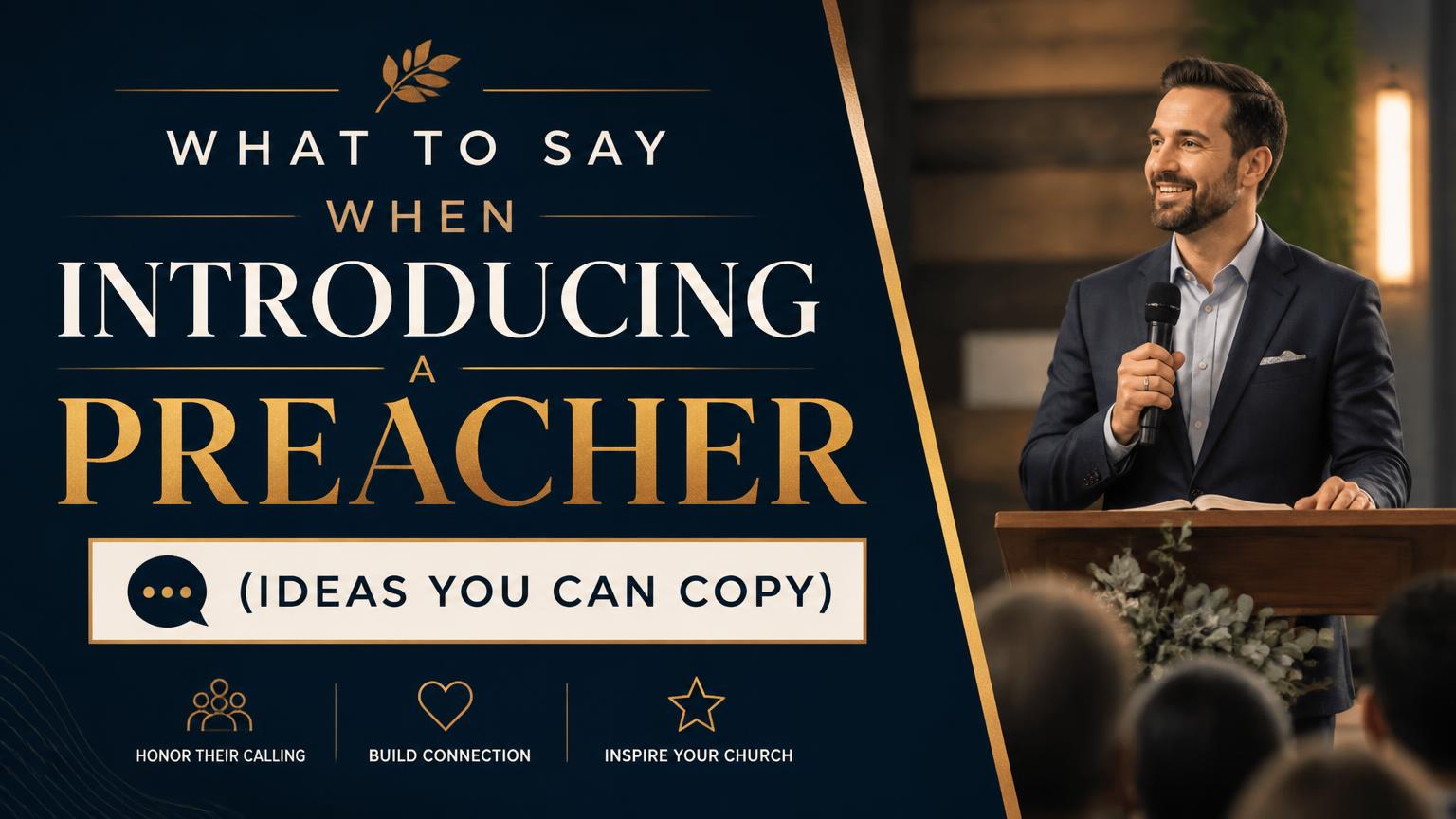
Introducing a preacher well takes less than a minute, but the words matter. A good introduction welcomes the congregation, establishes the preacher’s connection or credibility, identifies the message, and gives the speaker a clear invitation to begin. It should honor the preacher without drawing attention away from the sermon or implying that human credentials are the source of spiritual authority.
What to Say When Introducing a Preacher
The most reliable introduction follows this order:
- Welcome the congregation and acknowledge the occasion.
- State the preacher’s name and role.
- Mention one or two relevant details about their ministry or relationship to the church.
- Introduce the sermon topic or Scripture passage, if known.
- Invite the preacher to speak.
A typical introduction might sound like this:
“Good morning, everyone. We are pleased to welcome Pastor Daniel Lewis, who serves as the senior pastor of Grace Community Church. He has been a faithful Bible teacher and friend to our congregation. This morning, he will bring a message from Philippians 4 on finding peace in Christ. Please join me in welcoming Pastor Lewis.”
Keep most introductions between 30 seconds and one minute. The preacher’s message—not the introduction—should be the main event.
A Short and Simple Introduction
Use a short introduction when the preacher is well known to the congregation or when the service schedule is tight.
“Our preacher this morning is Pastor Michael Grant. He will be sharing a message from God’s Word. Please welcome Pastor Grant.”
Or:
“We are glad to have Reverend Sarah Thomas with us today. She will lead us in considering what it means to follow Christ faithfully. Let us welcome her.”
A short introduction is not inadequate. If everyone already knows the speaker, repeating a long biography can feel unnecessary and may reduce the time available for worship or preaching.
A Warm Introduction for a Guest Preacher
A visiting preacher usually needs a little context. Explain who the person is, why they have been invited, and what connection they have to the church or occasion.
“Today we are delighted to welcome Reverend James Carter. Reverend Carter serves as pastor of New Hope Baptist Church and has encouraged many churches through his preaching and pastoral ministry. We are grateful that he is here to share God’s Word with us. Please welcome Reverend Carter.”
If the guest is connected to a special event, make that connection clear:
“As part of our missions emphasis, we are pleased to welcome Dr. Elena Ruiz, who has served with international ministry partners for more than a decade. She will speak about the church’s calling to serve and make disciples among the nations. Please receive Dr. Ruiz warmly.”
Avoid overstating the person’s accomplishments. A concise, accurate description is more respectful than exaggerated praise.
An Introduction for a Pastor or Regular Preacher
When introducing the church’s own pastor, focus on the message and the congregation’s relationship with the pastor rather than reciting a résumé.
“Pastor Williams will bring today’s message from Mark 10. As he opens this passage, let us listen carefully and ask how Christ is calling us to live. Please welcome Pastor Williams.”
Another option is:
“We are thankful for Pastor Johnson’s faithful ministry among us. He will continue our series in the Gospel of John this morning. Let us prepare our hearts to hear God’s Word.”
If the pastor is already expected to preach every week, a formal introduction may not be necessary. A simple transition such as “Pastor, we are ready to hear the message” may be more natural.
An Introduction for an Ordination, Anniversary, or Special Service
Special services often require the introduction to explain why the preacher has been invited.
“We are gathered today to celebrate this church’s 75th anniversary and to give thanks for God’s faithfulness. Our guest preacher, Bishop Andrew Moore, has served in pastoral ministry for more than 25 years and has a long relationship with this congregation. He will bring the anniversary message. Please welcome Bishop Moore.”
For an ordination service:
“We are grateful to welcome Reverend Thomas Reed, who will preach during this ordination service. His ministry and teaching will help us reflect on the calling and responsibilities of Christian leadership. Please receive him warmly.”
The purpose of these details is to serve the occasion, not to turn the introduction into a complete history of the preacher.
An Introduction for a Youth or Children’s Service
Use language that is clear and engaging without becoming patronizing.
“We are happy to welcome Pastor Olivia Brown, who works with children and families in our community. Today she will teach us what the Bible says about trusting God. Let’s give her a warm welcome.”
For teenagers:
“Our speaker today is Marcus Lee, a youth pastor who helps students apply their faith to everyday decisions. He will speak about living faithfully at school, at home, and among friends. Please welcome Marcus.”
The introduction can help young listeners understand why the preacher’s message relates to them.
An Introduction for an Online or Hybrid Service
In an online service, identify the preacher clearly and give viewers enough context to follow the transition.
“Thank you for joining us today. Our message will be brought by Pastor Rachel Kim, who serves at River Church and has been part of our online ministry this year. She will speak from Psalm 23 about God’s guidance and care. Pastor Rachel, we welcome you.”
If the preacher is joining remotely, explain that briefly:
“We are pleased to welcome Reverend David Allen, joining us from Birmingham. He will share today’s message on Christian hope. Reverend Allen, thank you for being with us.”
The Essential Parts of a Strong Introduction
Welcome the Congregation
Begin by addressing the people gathered:
- “Good morning, church.”
- “We are grateful to be together today.”
- “It is a joy to welcome everyone to this service.”
- “Thank you for joining us for this special occasion.”
This establishes a warm tone and helps the congregation shift attention toward the sermon.
Name the Preacher Clearly
Use the preacher’s preferred name and title. Confirm the pronunciation beforehand, especially for a guest. If the person prefers a first name rather than a title, follow that preference.
Say:
“Please welcome Pastor Angela Brooks.”
Avoid uncertain phrases such as “I think our speaker is…” or repeatedly using an incorrect title. Accuracy communicates respect.
Give Relevant Context
Mention details that help listeners understand the preacher’s connection to the occasion:
- current pastoral role
- ministry or teaching responsibility
- relationship to the congregation
- reason for the invitation
- relevant experience connected to the sermon
One or two details are usually enough. A biography belongs in a printed program or separate presentation, not in a lengthy spoken introduction.
Identify the Message
If the topic or Scripture passage is known, mention it:
“He will continue our study of Romans 8.”
“She will speak about forgiveness and reconciliation.”
“Today’s message comes from Matthew 5.”
This prepares the congregation to listen and connects the preacher’s appearance to the service.
Create a Clear Transition
End with a direct invitation:
- “Please welcome Pastor Lee.”
- “Let us receive Reverend Carter.”
- “Pastor, we invite you to come and share the message.”
- “Let us turn our attention to God’s Word.”
If the congregation normally applauds, invite a welcome naturally. If the tradition is quieter, use an appropriate transition instead of requiring applause.
What to Avoid When Introducing a Preacher
Do Not Give an Overly Long Biography
A long list of degrees, positions, awards, and accomplishments can make the introduction feel like a résumé reading. Include only information that helps the congregation understand the preacher or the occasion.
Do Not Make the Introduction About Yourself
Avoid lengthy stories about how you met the preacher or how much you personally admire them. A brief personal connection can be meaningful, but it should support the introduction rather than dominate it.
Do Not Preach Before the Preacher
The person introducing the speaker should not explain the entire sermon, deliver a second sermon, or tell the congregation what conclusions it must reach. Provide orientation, then leave room for the preacher to develop the message.
Do Not Use Embarrassing Humor
Jokes about the preacher’s age, appearance, preaching length, private life, or past mistakes can create discomfort and weaken the sense of welcome. Humor is appropriate only when it is clearly harmless, relevant, and familiar to the speaker.
Do Not Make Unsupported Spiritual Claims
Avoid statements such as “This is the greatest preacher in the country” or “God has given this person a message that will change every life here.” Such claims are exaggerated and place pressure on both the preacher and the congregation.
Instead, say:
“We are grateful for this opportunity to hear the Word of God through Pastor Ellis’s ministry.”
This honors the preacher while recognizing that the sermon’s authority does not depend on dramatic praise.
Ready-to-Use Introduction Templates
General Church Service
“Good morning, everyone. We are pleased to welcome [Name], who serves as [role or church]. Today, [he/she/they] will speak on [topic or passage]. We are grateful to have [him/her/them] with us. Please welcome [Name].”
Visiting Minister
“It is a privilege to welcome [Title and Name] to our church. [He/She/They] serves as [role] at [church or organization] and has ministered in [relevant area]. Today, [Name] will bring a message from [passage or topic]. Let us receive [him/her/them] warmly.”
Conference or Retreat
“Our next speaker is [Name], who serves as [role]. [Name] has particular experience in [relevant ministry area] and will address [topic]. Please welcome [Name] as [he/she/they] comes to speak.”
When You Know Little About the Preacher
“We are glad to welcome [Title and Name] today. [Name] has been invited to share God’s Word with us, and the message will focus on [topic or passage, if known]. Please join me in welcoming [Name].”
Do not invent credentials or personal details. If necessary, ask the preacher or event organizer for a short approved biography.
Introducing a Preacher After a Song or Testimony
“Thank you for that ministry. We will now hear the message from Pastor [Name], who will speak from [passage or topic]. Let us give our attention to the Word and welcome Pastor [Name].”
A Practical Checklist Before the Service
Before introducing the preacher, confirm:
- the correct name and pronunciation
- the preferred title
- the preacher’s current role
- the sermon topic or Scripture passage
- the reason for the invitation
- the desired length of the introduction
- whether the preacher prefers any particular wording
- how the service normally transitions to preaching
Write the introduction down rather than relying entirely on memory. Speak slowly, make eye contact with the congregation, and pronounce the preacher’s name confidently. If you make a small mistake, correct it briefly and continue without drawing unnecessary attention to it.
A good introduction is accurate, warm, brief, and purposeful. It welcomes the preacher, prepares the congregation to listen, and then gets out of the way so the sermon can begin.