
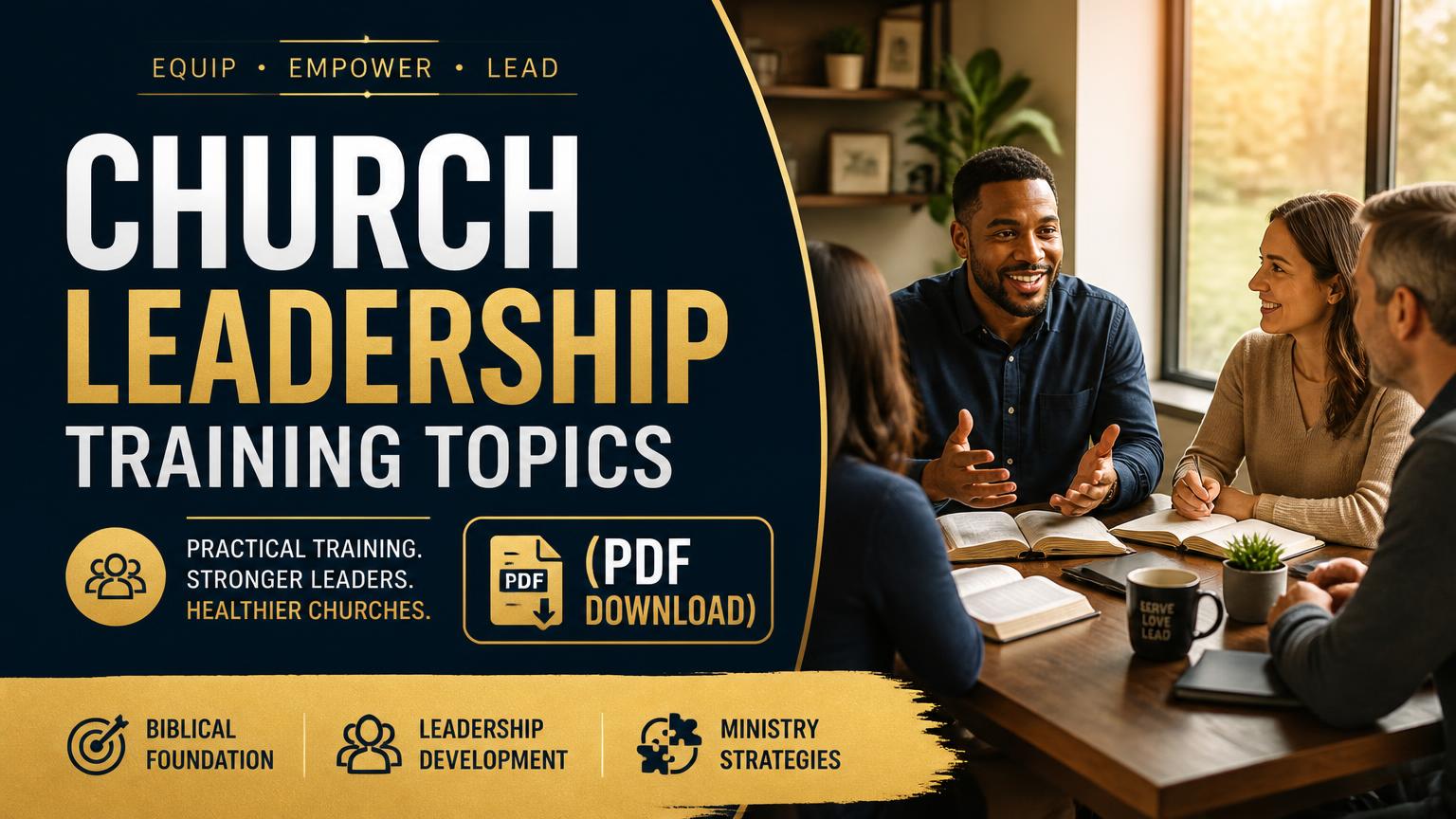
A useful Church Leadership Training Topics PDF should equip leaders in more than administration. It should develop biblical character, spiritual maturity, sound judgment, relational skill, ministry competence, and accountability. The outline below is organized as a PDF-ready curriculum for pastors, elders, deacons, ministry directors, small-group leaders, and emerging church leaders.
Church Leadership Training Topics PDF
Biblical Identity and Calling
Church leadership begins with identity and calling, not position. Leaders serve because Christ has entrusted them with responsibility for His people, not because leadership provides status or control.
Key topics include:
- The nature and mission of the church
- The biblical meaning of Christian leadership
- Spiritual gifts and ministry roles
- The qualifications for elders and overseers in 1 Timothy 3:1–7 and Titus 1:5–9
- The ministry of deacons in Acts 6:1–7 and 1 Timothy 3:8–13
- The relationship between calling, gifting, character, and confirmation by the church
- The difference between spiritual authority and personal power
Ephesians 4:11–16 presents leaders as servants who equip believers for ministry and help the church mature in Christ. This means leaders should measure success by the health and growth of the people they equip, not merely by attendance, visibility, or institutional expansion.
Character, Integrity, and Spiritual Formation
A leader’s public ministry cannot be separated from private character. The qualifications in 1 Timothy 3 and Titus 1 emphasize self-control, faithfulness, hospitality, sound judgment, and a good reputation because leadership magnifies both strengths and weaknesses.
Training should address:
- Personal holiness and obedience
- Prayer, Scripture reading, worship, and spiritual disciplines
- Emotional maturity and self-awareness
- Honesty in finances, relationships, and communication
- Sexual integrity and appropriate boundaries
- Handling criticism, disappointment, and recognition
- Repentance, confession, restoration, and accountability
- Avoiding burnout and unhealthy dependence on ministry success
John 15:1–5 teaches that fruitful ministry depends on abiding in Christ. Spiritual practices do not earn God’s favor or guarantee easy ministry; they keep leaders dependent on Christ rather than functioning from exhaustion, ambition, or technique.
Character training should also acknowledge that mature leaders are not sinless leaders. A healthy church establishes processes for confession, correction, restoration, and—when necessary—removal from leadership.
Servant Leadership and Humility
Jesus directly rejected leadership modeled on domination. In Mark 10:42–45, He contrasts worldly authority with servant leadership and identifies His own life as the pattern: “the Son of Man came not to be served but to serve.”
This topic can include:
- Leading by serving rather than controlling
- Listening before making decisions
- Sharing credit and accepting responsibility
- Exercising authority without intimidation
- Practicing humility in disagreement
- Protecting vulnerable people from misuse of power
- Setting boundaries without becoming harsh or distant
John 13, where Jesus washes His disciples’ feet, shows that humility is not merely an attitude. It becomes visible through actions that place the good of others ahead of personal prestige. Servant leadership does not mean avoiding difficult decisions or allowing harmful behavior to continue. It means using authority for the protection, growth, and mission of the church rather than for personal advantage.
Vision, Mission, and Spiritual Discernment
Leaders need to help a church understand what it is called to do and how it should make decisions. Training should distinguish among:
- Mission: the church’s enduring biblical purpose
- Vision: a contextual picture of how the church may pursue that mission
- Values: the convictions that shape its behavior and priorities
- Goals: specific, measurable steps toward a ministry objective
The Great Commission in Matthew 28:18–20 places disciple-making at the center of the church’s mission. Acts 6:1–7 also demonstrates the importance of wise priorities: leaders responded to a practical need while protecting the church’s ministry of prayer and the word.
Discernment training should cover prayerful decision-making, evaluating opportunities, listening to the congregation, examining available resources, and recognizing the difference between biblical conviction and personal preference. A compelling vision should not depend entirely on one leader’s personality. It should be understandable, biblically grounded, and capable of being carried by the wider church.
Teaching, Discipleship, and Spiritual Care
Church leaders shape people through what they teach, model, reinforce, and permit. Training should therefore include:
- Interpreting and applying Scripture responsibly
- Teaching for transformation rather than information alone
- Building a culture of discipleship
- Mentoring emerging leaders
- Developing small groups and ministry pathways
- Praying with people and offering wise pastoral care
- Recognizing when a situation requires a qualified counselor, physician, or other professional
- Maintaining confidentiality while addressing safety concerns
James 3:1 warns that teachers are judged more strictly, underscoring the responsibility involved in public instruction. Second Timothy 2:2 describes a multiplying pattern in which faithful people teach others who can teach still more. Effective leadership training therefore prepares leaders to develop disciples and future leaders, not merely to perform ministry tasks themselves.
Leaders also need training in the limits of pastoral care. Prayer and spiritual support are essential, but they do not replace professional treatment for serious mental-health, medical, legal, or abuse-related situations.
Communication, Conflict, and Reconciliation
Many leadership failures arise not from lack of vision but from poor communication. Leaders should learn to communicate decisions clearly, explain reasons without disclosing inappropriate confidential information, and create channels through which people can raise concerns.
Important skills include:
- Active listening
- Giving and receiving constructive feedback
- Clarifying assumptions
- Addressing problems early
- Speaking truth with love, as described in Ephesians 4:15
- Distinguishing facts, interpretations, and emotions
- Facilitating difficult meetings
- Apologizing without defensiveness
Matthew 18:15–17 provides a framework for addressing personal offenses directly and progressively. It should not be used as a reason to suppress reports of abuse, threats, criminal conduct, or serious safeguarding concerns. Those matters may require immediate reporting to appropriate authorities or specialist organizations according to local law and church policy.
Conflict training should distinguish between ordinary disagreement, persistent relational dysfunction, doctrinal dispute, misconduct, and abuse. These situations do not require identical responses.
Team Building, Delegation, and Volunteer Development
Healthy leaders do not attempt to perform every ministry themselves. They build teams with clear responsibilities, appropriate support, and shared ownership.
Training topics include:
- Identifying spiritual gifts and practical abilities
- Recruiting and onboarding volunteers
- Writing clear role descriptions
- Delegating outcomes rather than merely assigning tasks
- Coaching and evaluating ministry leaders
- Encouraging collaboration across ministries
- Developing successors
- Recognizing contributions without creating unhealthy favoritism
Exodus 18:17–23 shows Moses receiving counsel to share leadership responsibility, while 1 Corinthians 12 describes the church as one body with many members and functions. Delegation is therefore more than an efficiency technique. It reflects a biblical understanding that ministry belongs to the whole body of Christ.
Delegation should include authority, resources, and clarity. Assigning responsibility without giving a person the ability to make necessary decisions often produces frustration rather than development.
Governance, Stewardship, and Accountability
Church leadership requires trustworthy systems as well as good intentions. Training should explain how decisions are made, who has authority in different areas, and how leaders remain accountable.
Relevant topics include:
- Elder, pastoral, diaconal, staff, and congregational responsibilities
- Church bylaws and denominational structures
- Financial oversight and budget stewardship
- Separation of financial duties
- Accurate records and transparent reporting
- Handling conflicts of interest
- Safeguarding children and vulnerable adults
- Background checks and volunteer screening where appropriate
- Documented procedures for complaints and discipline
- Compliance with applicable civil law
Second Corinthians 8:20–21 emphasizes taking care to do what is right “not only in the Lord’s sight but also in the sight of man.” Financial and organizational transparency protect both the church’s witness and the people it serves. Accountability is not a lack of trust; it is a practical safeguard against temptation, misunderstanding, and the concentration of unchecked power.
Mission, Evangelism, and Community Engagement
Church leaders should be able to connect internal church health with outward mission. Training may cover:
- Sharing the gospel clearly and respectfully
- Equipping members for everyday witness
- Understanding the local community
- Serving neighbors without treating service as a substitute for proclamation
- Working with community organizations wisely
- Practicing cultural humility
- Evaluating outreach by faithfulness and lasting fruit, not only event attendance
Acts 1:8 connects the church’s witness with the empowering work of the Holy Spirit. Mission is not simply a marketing strategy or a program category. It involves forming a people who embody and proclaim the gospel in their homes, workplaces, neighborhoods, and wider communities.
Leaders should also discuss ethical partnership: churches need to clarify expectations, protect the dignity of people receiving assistance, and avoid creating dependency or using vulnerable people to promote the institution.
A Practical Eight-Session Training Sequence
A church can use the topics above as an eight-session course:
| Session | Topic | Practical Outcome |
|---|---|---|
| 1 | Biblical Identity and Calling | Each participant clarifies their role, responsibilities, and areas for growth. |
| 2 | Character and Spiritual Formation | Participants create a personal rule of life and accountability plan. |
| 3 | Servant Leadership | Leaders identify how they will use authority to serve and protect others. |
| 4 | Vision and Discernment | The group evaluates the church’s mission, priorities, and current challenges. |
| 5 | Teaching, Discipleship, and Care | Participants design a pathway for mentoring or discipling others. |
| 6 | Communication and Conflict | Leaders practice listening, feedback, reconciliation, and escalation procedures. |
| 7 | Teams, Governance, and Stewardship | The church reviews role clarity, delegation, finances, and safeguarding. |
| 8 | Mission and Action Planning | Each participant develops a ministry goal with measurable next steps. |
Each session should include a biblical passage, a short teaching segment, discussion, a realistic case study, prayer, and an action assignment. Case studies are particularly useful because leaders must apply principles to situations involving conflict, confidentiality, financial pressure, volunteer failure, or competing ministry priorities.
What Makes Church Leadership Training Effective?
A strong training program is contextualized. A small rural congregation, a growing urban church, and a denominational congregation may share biblical convictions while facing very different organizational challenges.
Effective training usually includes five features:
- Biblical grounding: Scripture shapes the purpose and limits of leadership rather than serving as decoration.
- Practical application: Participants practice conversations, decision-making, delegation, and care.
- Mentoring: Experienced leaders help newer leaders interpret real ministry situations.
- Accountability: Participants receive follow-up, feedback, and measurable assignments.
- Ongoing development: Training continues through retreats, peer groups, evaluations, and specialized instruction.
The audience should also be considered. Elders may need deeper training in doctrine, shepherding, and governance. Deacons may need training in practical care, administration, and mercy ministry. Youth leaders need particular attention to safeguarding and appropriate boundaries. New volunteers may need a shorter orientation before entering a longer leadership pathway.
How to Prepare This Outline as a PDF
To create a printable church leadership training PDF, copy the outline into a document editor and add:
- The church’s name and training purpose
- A schedule and facilitator names
- Learning objectives for each session
- Scripture readings
- Discussion questions
- Space for notes
- Case studies and action assignments
- A final evaluation and personal development plan
Export the completed document as a PDF after reviewing biblical references, local policies, denominational requirements, and applicable safeguarding laws. A PDF should support the training process, not replace wise pastoral oversight or qualified legal and professional advice.
Conclusion
Church leadership training should form leaders who are faithful to Scripture, mature in character, competent in ministry, accountable in practice, and committed to equipping others. The most balanced curriculum joins spiritual formation with practical skills: prayer with planning, humility with decisive action, pastoral care with safeguarding, and vision with responsible stewardship. This combination makes a church leadership training topics PDF useful for both classroom instruction and long-term ministry development.