
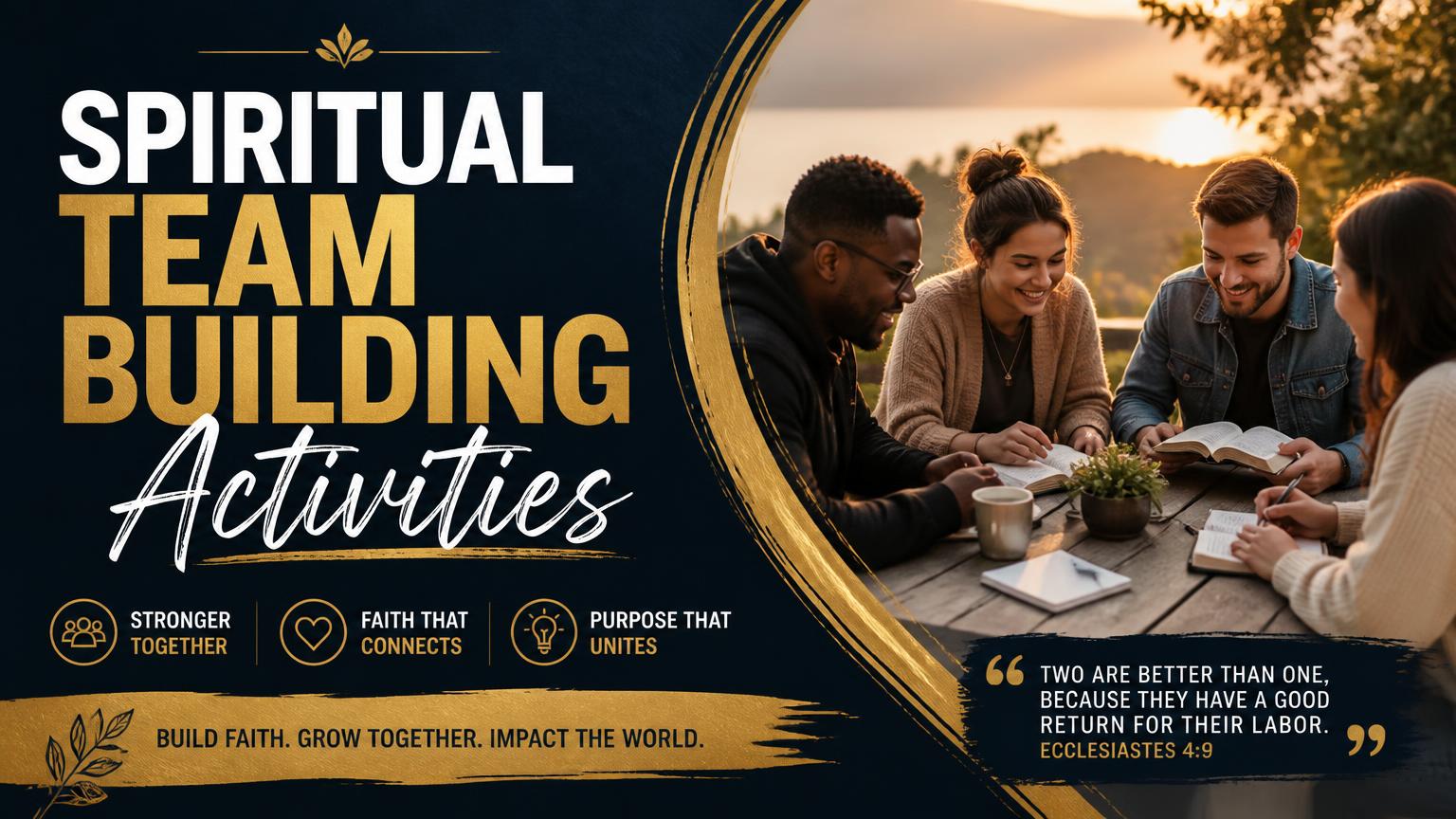
Spiritual team building activities strengthen cooperation by connecting a group’s shared work with deeper values such as trust, service, compassion, purpose, gratitude, and integrity. Unlike ordinary team games, they invite participants to reflect, listen, encourage one another, and practice the principles they want their team to embody. The strongest activities combine personal reflection with a practical group task and a guided discussion.
Spiritual Team Building Activities
The best activity depends on the group’s age, faith tradition, comfort level, and purpose. A church ministry team may use Scripture and prayer, while a school, nonprofit, or interfaith group may prefer shared values, meditation, service, or reflective conversation.
Create a Shared Values Map
A shared values map helps a team identify the principles that should guide its decisions and relationships.
Give each person cards or notes containing values such as honesty, humility, courage, compassion, justice, patience, responsibility, and service. Participants select the five values they believe matter most for the team, then explain their choices in small groups. The entire team compares its selections and agrees on three to five central values.
The important step is translating values into behavior. For example:
- Respect may mean allowing people to finish speaking.
- Service may mean sharing undesirable tasks.
- Integrity may mean addressing mistakes openly.
- Compassion may mean considering how decisions affect people under pressure.
This activity moves values beyond inspirational language. The team creates practical standards it can use when resolving conflict or making difficult decisions.
Share Stories of Purpose
Invite participants to describe a meaningful experience that shaped their sense of purpose, faith, service, or responsibility. Each person might answer one question:
- What experience taught you the importance of serving others?
- Who influenced the way you lead or work with people?
- When have you felt that your contribution mattered?
- What hope do you have for this team?
Participants should share only what they are comfortable discussing. Others listen without interrupting, correcting, or immediately offering advice.
In Christian groups, this activity can connect with the biblical idea that people serve through different gifts and callings. Paul’s image of the church as one body with many members in 1 Corinthians 12 emphasizes both unity and interdependence: people do not all perform the same role, but each person’s contribution matters. The practical lesson is that a team becomes stronger when members understand one another’s motivations rather than viewing one another only through job titles.
Reflect on Scripture and Teamwork
For Christian teams, a short Scripture-based reflection can connect spiritual formation with daily collaboration. Choose one passage, read it slowly, and ask participants to discuss what it reveals about working with others.
Useful passages include:
- Philippians 2:3–4: considering others’ interests and practicing humility
- Romans 12:3–8: using different gifts in service to one body
- Ephesians 4:1–3: practicing patience, gentleness, humility, and unity
- Mark 10:42–45: understanding leadership as service rather than domination
- Galatians 6:2: carrying one another’s burdens
A discussion should move beyond identifying a familiar verse. Ask questions such as:
- What behavior does this passage encourage?
- What behavior does it challenge in our team?
- Where would applying this principle be difficult?
- What one action could we take this week?
For example, Philippians 2 does not call people to ignore boundaries or accept mistreatment. Its emphasis on humility means resisting selfish ambition and considering others; it does not eliminate accountability, wise leadership, or the need to address harmful conduct.
Identify Gifts and Strengths
This activity helps members recognize the abilities they bring to the group and the strengths they may overlook in one another.
Ask participants to write down:
- A task they perform confidently
- A contribution they enjoy making
- A strength others often recognize in them
- An area where they need support
In pairs, participants discuss their answers. The team then creates a strengths inventory, grouping abilities such as organization, encouragement, teaching, creativity, problem-solving, hospitality, empathy, communication, and practical service.
The goal is not to label people permanently. A strengths exercise should expand participation rather than assign fixed identities. Someone who is naturally organized may also need opportunities to develop public communication, while a quiet member may offer careful judgment that the team has previously overlooked.
The activity works especially well before assigning responsibilities. Teams often struggle when the same visible people handle every task while less visible abilities remain unused.
Practice Guided Prayer, Meditation, or Silence
Shared silence can create space for attention, calm, and honest reflection. It is particularly useful for teams that spend most of their time planning, solving problems, or responding to crises.
A facilitator can begin with two or three minutes of quiet breathing, followed by a prompt such as:
- What does this team most need from me?
- Where am I experiencing resistance or anxiety?
- What kind of person do I want to be in this group?
- What should we release before beginning this work?
Christian groups may close with a voluntary prayer for wisdom, unity, courage, or compassion. Secular and interfaith groups can use silent reflection, a brief meditation, or a reading about shared purpose.
Participation should be respectful rather than coercive. Spiritual depth is not created by pressuring people to disclose private beliefs. A clear invitation, a quiet alternative, and permission to pass make the exercise safer and more inclusive.
Complete a Service Project Together
Service turns spiritual principles into visible action. Choose a project that requires cooperation rather than simply dividing people into isolated tasks. Examples include preparing meals, supporting a food pantry, cleaning a community space, assembling care packages, visiting an approved community organization, or helping maintain a shared environment.
Before the project, discuss the need being addressed and the team’s attitude toward the people it serves. Service should preserve dignity; participants are not performing charity for recognition or treating recipients as a project.
Afterward, debrief with questions such as:
- What did we learn about the community?
- Which team behaviors helped us serve well?
- Where did we make assumptions?
- What would responsible service look like beyond today?
Matthew 25:35–40 is often used by Christian groups to connect care for vulnerable people with devotion to Christ. The passage’s practical force lies in making compassion concrete. A service project is most meaningful when it encourages ongoing responsibility rather than becoming a one-time publicity exercise.
Exchange Specific Encouragement
General praise can feel vague, but specific encouragement helps people understand how their actions affect the team.
Give each participant another member’s name, or ask everyone to write one note for each person. Encourage statements that identify observable behavior:
- “You helped the discussion remain calm when disagreement began.”
- “You noticed that a new member had not spoken and invited their perspective.”
- “You completed an unglamorous task without seeking attention.”
- “Your careful preparation made it easier for others to contribute.”
In Christian settings, the practice reflects the biblical instruction to “encourage one another and build each other up” in 1 Thessalonians 5:11. Encouragement is not flattery. It is truthful recognition that strengthens people to continue serving responsibly.
The facilitator should ensure that encouragement does not become a popularity contest. Every participant should receive meaningful recognition, and praise should not be used to avoid necessary feedback.
Solve a Silent Team Challenge
Give the team a practical task that must be completed without speaking, such as arranging objects by size, creating a shape from materials, or transporting items through a defined space. Set clear safety limits and avoid challenges that require physical risk or humiliating participants.
When speech is removed, teams must rely on observation, patience, gestures, and shared attention. Some people may attempt to control the task while others withdraw. Those patterns become useful material for reflection.
Debrief the experience by asking:
- Who took initiative, and how did others respond?
- How did the team include people who communicated differently?
- What happened when someone misunderstood the plan?
- Which behaviors would help us collaborate more effectively at work or in ministry?
The challenge itself is not spiritually transformative. Its value comes from connecting the experience to humility, patience, listening, and shared responsibility.
Hold a Reconciliation and Commitment Circle
This activity is appropriate when a team has experienced tension, provided the facilitator can maintain emotional and physical safety. Each participant completes three prompts:
- A behavior that helps me contribute well is…
- A behavior that makes teamwork harder for me is…
- One commitment I am willing to make is…
Participants speak from personal experience rather than accusing others. The group may establish commitments such as addressing concerns directly, avoiding gossip, clarifying responsibilities, or making room for quieter voices.
Christian teams may connect this practice with Matthew 18:15–17, which emphasizes addressing a conflict directly rather than spreading it through the community. That principle does not require confronting someone alone in every situation; serious misconduct, abuse, or power imbalances may require formal reporting and appropriate support. Reconciliation should never be used to pressure victims into premature forgiveness or restore unsafe relationships.
How to Choose the Right Activity
Choose an activity based on the team’s actual need rather than its novelty.
- New teams benefit from purpose stories, shared values, and low-risk encouragement.
- Divided teams need structured listening, reconciliation, and clear behavioral commitments.
- Overworked teams may benefit from silence, gratitude, prayer, or reflective rest.
- Uncoordinated teams need strengths mapping and cooperative problem-solving.
- Church teams focused inwardly may need a service project that reconnects ministry with community needs.
- Youth groups generally need shorter activities, clear instructions, and active participation.
- Interfaith or mixed-belief groups should emphasize shared ethics and voluntary spiritual practices.
Avoid treating vulnerability as a requirement for spiritual growth. People differ in personality, culture, faith, trauma history, and comfort with public disclosure. A well-designed activity offers meaningful participation without demanding intimate confession.
How to Facilitate Spiritual Team Building Well
Preparation and debriefing usually matter more than the activity itself. Before beginning, explain the purpose, estimated time, participation options, and confidentiality expectations. Establish basic agreements: listen without interrupting, speak from personal experience, avoid ridicule, and respect the right to pass.
During the activity, the facilitator should watch for unequal participation. Invite quieter members without putting them on the spot, prevent dominant members from taking over, and stop exercises that become unsafe or humiliating.
Reserve enough time for reflection. A useful debrief usually asks four kinds of questions:
- What happened? Identify observable events.
- What did you notice? Explore feelings and team patterns.
- What does it mean? Connect the experience to values or spiritual principles.
- What will we do differently? Turn insight into a specific action.
End with one or two concrete commitments and decide how the team will revisit them. Without follow-through, a powerful discussion may produce temporary emotion but little lasting change.
What Spiritual Team Building Cannot Replace
Spiritual activities can improve trust, purpose, and communication, but they do not substitute for sound leadership, fair policies, role clarity, training, or professional conflict management. Prayer cannot compensate for an unsafe environment, and shared values cannot repair repeated dishonesty without accountability.
Teams should also distinguish unity from uniformity. Healthy unity allows disagreement while maintaining respect and a shared mission. It does not require everyone to have the same personality, spiritual practice, political view, or method of serving.
Conclusion
Effective spiritual team building activities connect reflection with action. They help people clarify shared values, recognize one another’s gifts, listen with greater care, serve their community, and turn spiritual principles into daily behavior. The most useful activity is not necessarily the most emotional or elaborate; it is the one that addresses the team’s real need and leads to a specific, sustained change in how members work together.