
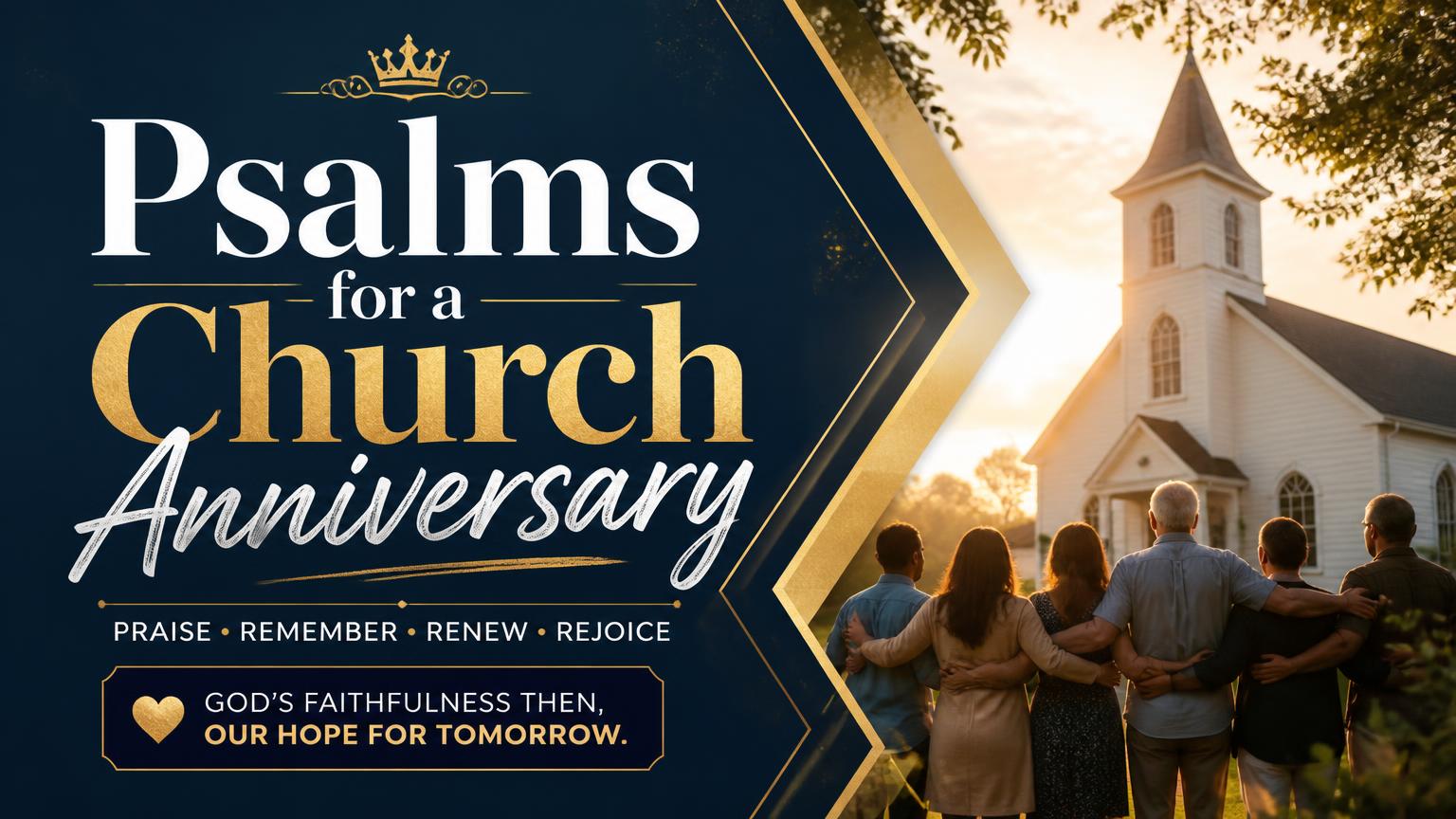
If you need a Psalm for a church anniversary, Psalm 100 is usually the strongest all-purpose choice. It calls the congregation to joyful worship, recognizes that the church belongs to God, and ends by celebrating his enduring love and faithfulness “to all generations” (Psalm 100:5). Other Psalms may be better when the anniversary emphasizes perseverance, church history, unity, or a new season of ministry.
Psalm for Church Anniversary: The Best Choices
A church anniversary is more than a celebration of institutional history. It is an opportunity to thank God for his faithfulness, remember the people and events through which he has worked, confess dependence on him, and seek wisdom for the future. The following Psalms serve those purposes in different ways.
Psalm 100 for Thanksgiving and Public Worship
Psalm 100 is the clearest choice for a general anniversary service. Its five verses move through the essential elements of corporate worship:
- Joyful praise: “Make a joyful noise unto the LORD.”
- Glad service: “Serve the LORD with gladness.”
- Acknowledgment of God’s ownership: “It is he that hath made us, and not we ourselves.”
- Congregational thanksgiving: “Enter into his gates with thanksgiving.”
- Confidence in God’s character: “For the LORD is good; his mercy is everlasting; and his truth endureth to all generations.”
The Psalm does not direct attention toward the congregation’s accomplishments. Instead, it places every achievement within the larger truth that God created, gathered, sustained, and shepherded his people. That makes it especially appropriate for a call to worship, responsive reading, or congregational recitation.
Its reference to God’s faithfulness “to all generations” also connects naturally with an anniversary. Older members can remember God’s work in previous decades, while younger members can hear that the church’s future rests on the same faithful Lord.
Psalm 145 for Generational Faithfulness
Psalm 145 is especially fitting when a church wants to highlight its history and its responsibility to pass faith to future generations. David declares:
“One generation shall commend your works to another, and shall declare your mighty acts” (Psalm 145:4, ESV).
This verse presents testimony as a spiritual responsibility, not merely a historical exercise. An anniversary provides a proper setting for recounting answered prayers, sacrificial service, missionary work, pastoral leadership, and seasons in which God sustained the congregation. Yet the purpose of remembering these events is to make God’s works known.
Psalm 145 also broadens the focus beyond one congregation. It praises God’s greatness, compassion, righteousness, provision, and everlasting kingdom. A church can therefore use it to connect its local story with the universal reign of God.
This Psalm works well when the anniversary theme includes phrases such as “God’s faithfulness through the years,” “passing the faith to the next generation,” or “remembering the works of the Lord.”
Psalm 90 for Remembering the Years and Seeking Wisdom
Psalm 90 is a prayer attributed to Moses in its superscription. It contrasts the shortness of human life with the eternal God, who has been the dwelling place of his people “from generation to generation” (Psalm 90:1).
Several lines make it valuable for a church marking a significant milestone:
- “So teach us to number our days, that we may apply our hearts unto wisdom” (verse 12).
- “Let thy work appear unto thy servants” (verse 16).
- “Let the beauty of the LORD our God be upon us: and establish thou the work of our hands” (verse 17).
Psalm 90 introduces humility into anniversary celebrations. Years of ministry may be worth honoring, but congregations and leaders remain temporary. God alone is permanent. The prayer therefore asks not simply for more years, but for wisdom and for God to establish the work.
This Psalm is a strong choice for anniversaries involving pastoral transitions, memorial observances, church planting, or a renewed commitment to faithful ministry.
Psalm 126 for Celebrating Restoration
Psalm 126 remembers a time when God restored Zion. The worshipers describe their joy and amazement:
“The LORD hath done great things for us; whereof we are glad” (Psalm 126:3).
The Psalm also acknowledges difficulty:
“They that sow in tears shall reap in joy” (verse 5).
That combination makes Psalm 126 suitable for a congregation whose history includes hardship, decline, relocation, persecution, financial strain, conflict, or recovery. It does not portray God’s people as having experienced an uninterrupted period of success. Instead, it gives them language for holding sorrow and gratitude together.
The Psalm’s original setting concerns Zion’s restoration, so it should not be treated as a direct prediction about a particular modern church. Its enduring principle, however, is clear: God’s people may remember painful seasons while giving thanks for his restoring work.
Psalm 126 is particularly meaningful when an anniversary service includes testimonies from different periods of the church’s history.
Psalm 127 for Depending on God to Build the Church
Psalm 127 begins with a warning against self-reliance:
“Except the LORD build the house, they labour in vain that build it” (verse 1).
The “house” may refer to a household, a family, or a broader community, but the principle applies appropriately to church ministry. Buildings, programs, budgets, leadership plans, and human effort cannot produce lasting spiritual fruit apart from God’s blessing.
This Psalm is useful when an anniversary marks a building dedication, expansion, church plant, new ministry initiative, or change in direction. It reminds the congregation that planning and labor are not wrong; they become empty when treated as substitutes for dependence on God.
Psalm 127 also helps correct a common anniversary temptation: measuring faithfulness only through visible growth. A church may have impressive facilities or a long history, yet the central question remains whether its work is being offered to God and carried out under his direction.
Psalm 133 for Unity Among God’s People
Psalm 133 begins, “Behold, how good and pleasant it is when brothers dwell in unity!” (ESV). Its imagery of oil and dew portrays unity as a gracious blessing that brings refreshment and life.
This Psalm is appropriate when an anniversary emphasizes reconciliation, shared service, cooperation among ministries, or gratitude for the congregation’s fellowship. It can also serve as a sober reminder that longevity alone does not prove spiritual health. A church may survive for decades while carrying unresolved divisions. Psalm 133 points toward a deeper anniversary goal: not simply remaining together organizationally, but dwelling together in a way that reflects God’s blessing.
The Psalm should not be used to suppress legitimate concerns or demand artificial agreement. Biblical unity is not the denial of truth or justice. It is the faithful pursuit of peace and shared devotion among God’s people.
How to Match the Psalm to the Anniversary Theme
No single Psalm is prescribed for a church anniversary. The best selection depends on what the congregation most needs to say before God.
- General thanksgiving and worship: Psalm 100
- God’s faithfulness across generations: Psalm 145 or Psalm 90
- Remembering hardship and restoration: Psalm 126
- A new building, ministry, or season: Psalm 127
- Congregational unity and fellowship: Psalm 133
- Praise for God’s mercy and care: Psalm 103
- A communal rehearsal of God’s mighty acts: Psalm 136
Psalm 103 is useful when the service centers on God’s forgiveness, compassion, healing, and provision. Psalm 136 is well suited to a responsive reading because of its repeated refrain, “for his steadfast love endures forever.” Its long review of God’s works also helps a congregation praise God for his acts rather than merely recounting institutional milestones.
The selection should reflect the actual story and spiritual emphasis of the congregation. A church emerging from a difficult season may need Psalm 126 more than Psalm 100. A church celebrating many decades across several generations may find Psalm 145 more pointed. Psalm 100 remains an excellent choice when the service has no narrower theme.
How to Use a Psalm in a Church Anniversary Service
Use the Psalm as a Call to Worship
A Psalm can open the service by directing attention to God before historical presentations, music, or announcements begin. Psalm 100 works particularly well because its commands to shout, serve, know, enter, give thanks, and bless create a natural movement into corporate worship.
The leader may read the Psalm, invite the congregation to read it together, or divide it into leader-and-congregation portions. The goal is not dramatic performance but shared proclamation.
Connect the Psalm to the Church’s Story
A historical presentation becomes more meaningful when it is interpreted through Scripture. For example, after reading Psalm 145:4, members from different generations might briefly testify to God’s faithfulness. After Psalm 126, the congregation might acknowledge both seasons of struggle and occasions of restoration.
The Psalm should guide the testimony rather than serve as a decorative quotation. The question is not merely, “What has our church achieved?” but, “What has God done, and how should that shape our faithfulness now?”
Use the Psalm in the Sermon or Anniversary Prayer
The Psalm can provide the theological center of the service. A sermon on Psalm 127 may call the congregation to depend on God as it begins a new ministry. A prayer based on Psalm 90 may ask for wisdom and for God to establish the church’s work. Psalm 100 can shape a prayer of thanksgiving that moves from God’s goodness to the congregation’s renewed commitment to serve.
When using the text this way, explain its meaning in context rather than treating isolated verses as slogans. Scripture should interpret the anniversary, not merely be used to endorse it.
What a Church Anniversary Psalm Should Emphasize
A fitting Psalm usually brings together four themes:
- Thanksgiving: The congregation recognizes God as the source of its life and ministry.
- Remembrance: The church recalls God’s works and the faithfulness of those who served.
- Humility: The congregation acknowledges that human effort cannot replace God’s blessing.
- Hopeful obedience: The church looks ahead by asking for wisdom, unity, and strength to continue serving.
This balance matters. An anniversary service that focuses only on the past can become nostalgic. One that focuses only on growth can become self-congratulatory. The Psalms redirect both memory and ambition toward God.
A church also does not need to read an entire Psalm if a shorter passage serves the service better. Psalm 100:1–5, Psalm 145:1–7, Psalm 90:1–2 and 16–17, or Psalm 127:1–2 can each function as a focused reading. The selected verses should remain faithful to the Psalm’s overall meaning.
Conclusion
For most church anniversary services, Psalm 100 is the best starting point because it joins joyful worship, humble dependence, thanksgiving, and confidence in God’s faithfulness across generations. Psalm 145 is stronger for generational testimony, Psalm 90 for wisdom and perspective, Psalm 126 for restoration, Psalm 127 for a new season, and Psalm 133 for unity. The right Psalm does more than mark the passing of years: it helps the congregation remember that the church’s history is ultimately a record of God’s grace and calls the church to trust him with its future.