
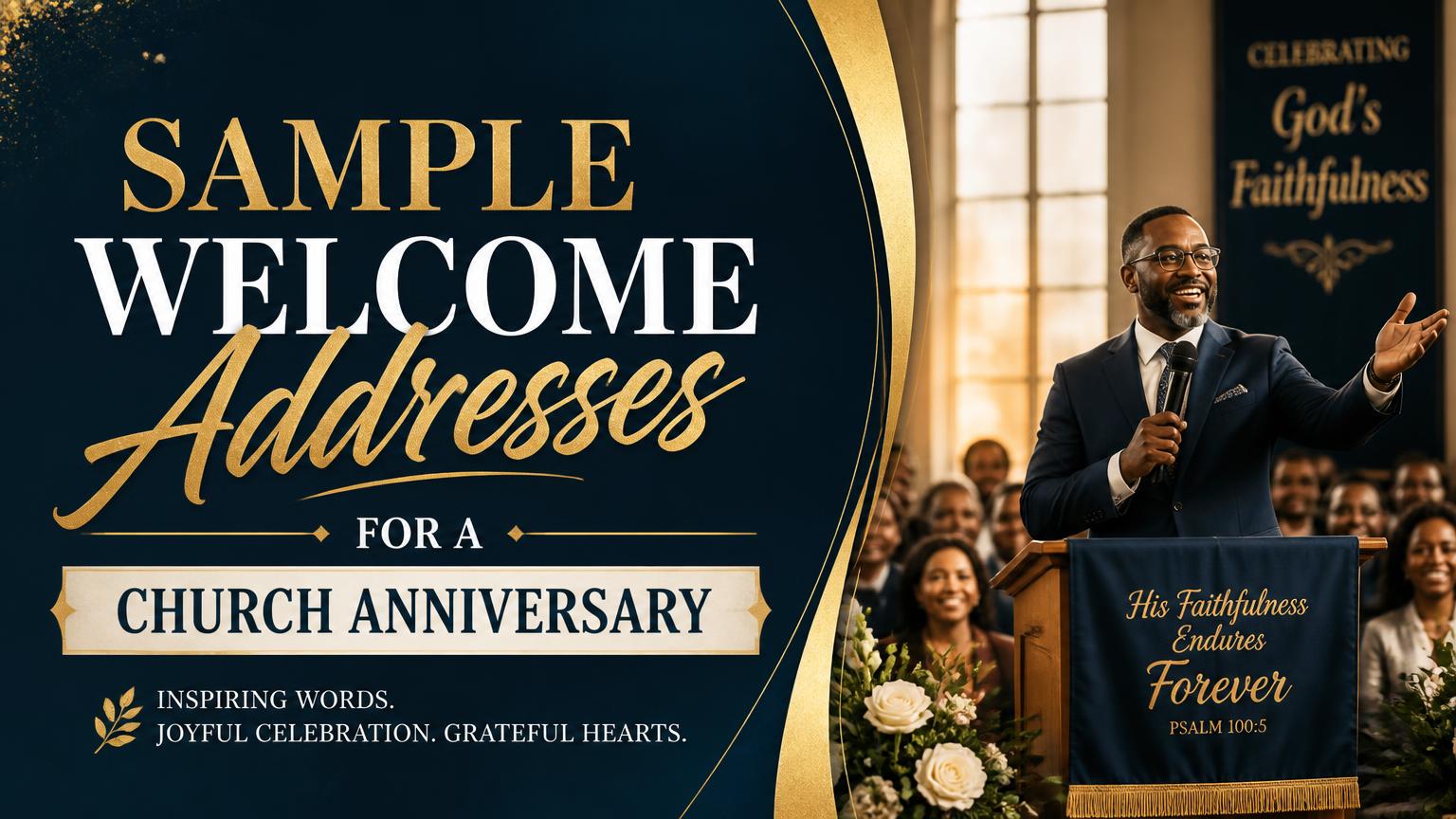
A welcome address for a church anniversary should do more than greet guests. It should acknowledge God’s faithfulness, recognize the congregation’s shared journey, honor visitors and church leaders, and establish a joyful atmosphere for the celebration. The best addresses are sincere, specific, and brief enough to leave room for worship, testimonies, preaching, and fellowship.
Welcome Address for Church Anniversary
The following samples can be adapted for a pastor, church officer, anniversary chairman, ministry leader, or another person chosen to welcome the congregation.
Formal Welcome Address
Good morning, and welcome to [Church Name]’s [number]th church anniversary celebration.
On behalf of our pastor, church leaders, and the entire congregation, I am pleased to welcome our members, visiting ministers, invited guests, former members, friends, and families. We are grateful that you have joined us for this special occasion.
Today, we gather to celebrate God’s faithfulness throughout the history of this church. Every year of ministry represents prayers offered, lives changed, challenges overcome, and opportunities to serve God and our community. We recognize that the strength and progress of this congregation have come ultimately from the Lord.
The words of Psalm 100 remind us to enter God’s presence with thanksgiving and praise. That is the spirit of this anniversary. We are thankful for those who established this church, for the leaders and members who served faithfully, and for everyone who continues to contribute time, gifts, prayers, and resources to its ministry.
We also welcome those who are worshiping with us for the first time. We hope you feel the warmth of this church family and experience the love of Christ through our fellowship today.
As we celebrate our past, may we also look toward the future with faith and courage. May this anniversary renew our commitment to worship God, serve others, proclaim the gospel, and build a church that reflects Christ’s character.
Thank you for being with us. May God bless you richly as we celebrate [Church Name]’s anniversary together.
Warm and Family-Centered Welcome Address
Welcome to our church anniversary celebration.
Today is a joyful day for [Church Name], because we are gathered as one church family to remember God’s goodness and celebrate the work He has allowed us to do together. We warmly welcome our pastor, church leaders, members, former members, visitors, friends, and loved ones.
An anniversary is a time to look back with gratitude. We remember the prayers, sacrifices, worship services, outreach efforts, and acts of kindness that have shaped this congregation. We also remember that the church is not merely a building. It is a community of people seeking to follow Jesus and serve according to God’s purpose.
To our guests, thank you for honoring us with your presence. We hope you feel at home among us. To our members, thank you for your faithfulness and for the many visible and unseen ways you support this ministry.
As we celebrate another year, let us give God the glory for what He has done and trust Him for what lies ahead. May this gathering strengthen our fellowship, encourage our faith, and remind us that every generation has a part to play in the future of the church.
Welcome, and may this anniversary celebration be filled with worship, joy, gratitude, and God’s blessing.
Short Welcome Address
Good morning, everyone, and welcome to [Church Name]’s [number]th anniversary celebration.
We are grateful to God for His faithfulness and for the opportunity to worship together today. We warmly welcome our pastor, church leaders, members, visitors, families, and friends.
This anniversary gives us an opportunity to remember the people and prayers that helped build this congregation, celebrate what God is doing among us now, and look forward to the future with faith.
If you are visiting us, please know that you are sincerely welcome. We are glad you are here and hope you experience the love of Christ through this service and our fellowship.
Thank you for joining us. Let us celebrate with thankful hearts and give God all the glory.
Scripture-Themed Welcome Address
Welcome to the anniversary celebration of [Church Name].
Our theme for this occasion is “[Anniversary Theme],” based on [Bible verse or passage]. This theme reminds us that the church’s story is ultimately a story of God’s grace and faithfulness.
Like Samuel, who set up a stone and called it Ebenezer to remember the Lord’s help, we pause today to recognize how God has sustained this congregation. He has guided the church through seasons of growth, difficulty, change, and opportunity. He has worked through the prayers and service of many people, and He continues to call us to faithful ministry.
We welcome our pastor, leaders, members, visitors, community partners, former members, and everyone who has gathered with us. Your presence makes this celebration especially meaningful.
As we honor the past, may we avoid treating the anniversary as merely a historical event. Instead, may it deepen our commitment to the mission God has given us. May we continue to encourage one another, care for our neighbors, share the gospel, and worship with humility and joy.
Thank you for being part of this celebration. May God use this anniversary to renew our gratitude and strengthen our vision for the years ahead.
What a Church Anniversary Welcome Address Should Include
A strong address usually contains five elements. They do not need to appear as separate paragraphs, but each serves a distinct purpose.
A Clear Greeting
Begin by welcoming people directly. Mention the congregation, pastor, church leaders, visitors, families, former members, and invited guests as appropriate. If prominent guests are present, use their correct titles and names.
Avoid listing so many names and groups that the opening becomes difficult to follow. A general welcome is sufficient when the program includes a separate protocol or acknowledgment of guests.
Recognition of God’s Faithfulness
The central purpose of a Christian anniversary is thanksgiving. Explain briefly what the church is thanking God for: years of worship, ministry, evangelism, service, spiritual growth, or perseverance.
A reference such as Psalm 100:4, Psalm 126:3, Philippians 1:3, or 1 Samuel 7:12 can support this focus. The verse should reinforce the message rather than appear as an unrelated quotation.
Appreciation for People
Church anniversaries provide an opportunity to honor the people who have served the congregation. Depending on the occasion, this may include founding members, former pastors, ministry leaders, volunteers, musicians, teachers, families, or community supporters.
Appreciation should point to specific contributions when possible. For example, “We are grateful for those who taught children, visited the sick, supported missions, and prayed faithfully” is more meaningful than a general statement that “many people helped.”
Acknowledgment of the Present and Future
An anniversary should connect the church’s history with its continuing mission. Briefly mention the work the congregation is doing now and the responsibilities ahead.
This prevents the address from becoming only a memorial to the past. A church may celebrate previous accomplishments while also recommitting itself to worship, discipleship, outreach, compassion, justice, or community service.
A Positive Transition
End by directing attention to the next part of the program. You might invite everyone to participate in worship, listen prayerfully to the message, enjoy the fellowship, or join in the anniversary theme.
The transition should be natural: “With grateful hearts, let us continue in worship” is more effective than ending abruptly after a list of acknowledgments.
How to Personalize the Sample
A sample becomes effective when it reflects the actual church rather than sounding interchangeable.
Replace placeholders with:
- The church’s name and anniversary number
- The official anniversary theme and Scripture
- The names or titles of the pastor and special guests
- A short, verified detail about the congregation’s history
- One or two current ministries or community efforts
- A specific expression of gratitude appropriate to the occasion
Use only historical details that the church has confirmed. If the exact founding year, succession of pastors, or membership history is uncertain, leave it out rather than guessing.
The address should also match the speaker. A pastor may emphasize spiritual reflection and vision. An anniversary chairperson may focus on gratitude and the program. A youth leader may use more direct and energetic language while maintaining respect for the occasion.
How Long Should a Church Anniversary Welcome Address Be?
Most welcome addresses work well at about two to five minutes. A short opening may be appropriate for a crowded worship service, while a formal anniversary program may allow a slightly longer address.
Length should reflect the speaker’s role and the program’s purpose. The welcome should not compete with the sermon, historical presentation, choir ministry, or testimonies. If the speaker has many acknowledgments, those can be placed in the printed program or handled by a designated master of ceremonies.
A useful test is whether every sentence contributes to one of three purposes: welcoming people, giving thanks to God, or preparing the congregation for the celebration.
Common Mistakes to Avoid
A welcome address can lose its effectiveness even when the wording is respectful. Avoid these problems:
- Making it a sermon: A welcome may include Scripture and spiritual reflection, but it should not develop into a full theological message.
- Overloading the opening with names: Include important guests, but do not create confusion through a long, unstructured list.
- Focusing only on the past: History matters, but the church’s present ministry and future calling should also receive attention.
- Using vague praise: Specific gratitude sounds more sincere than repeated claims that the church is “great” or “wonderful.”
- Speaking too long: A lengthy address can weaken the energy of the service and reduce time for the main program.
- Ignoring visitors: Guests should hear a genuine welcome rather than feel like observers at a private family event.
- Using an unsuitable tone: Humor may be appropriate in some congregations, but jokes should never embarrass guests, criticize former leaders, or diminish the sacred purpose of the gathering.
- Reading without preparation: Practice pronunciation, names, Scripture references, and transitions before the service.
A Simple Structure for Writing Your Own Address
When no prepared sample fits the occasion, use this sequence:
- Welcome everyone: Identify the event and greet the congregation and guests.
- State the reason for gathering: Explain that the church is celebrating another year of God’s faithfulness.
- Give thanks: Mention the people, ministries, and experiences that shaped the congregation.
- Connect to Scripture or the theme: Use one relevant passage or idea to frame the celebration.
- Look ahead: State the church’s continuing commitment to its Christian mission.
- Transition: Invite everyone to participate in the service with gratitude and joy.
This structure works because it moves from hospitality to worship, from remembrance to purpose, and from the church’s history to its continuing responsibility.
A welcome address for a church anniversary is most effective when it is sincere, focused, and rooted in gratitude. It should honor the church’s history without glorifying human achievement above God’s grace, welcome guests without losing the congregation’s identity, and celebrate the past while encouraging faithful service in the future.