
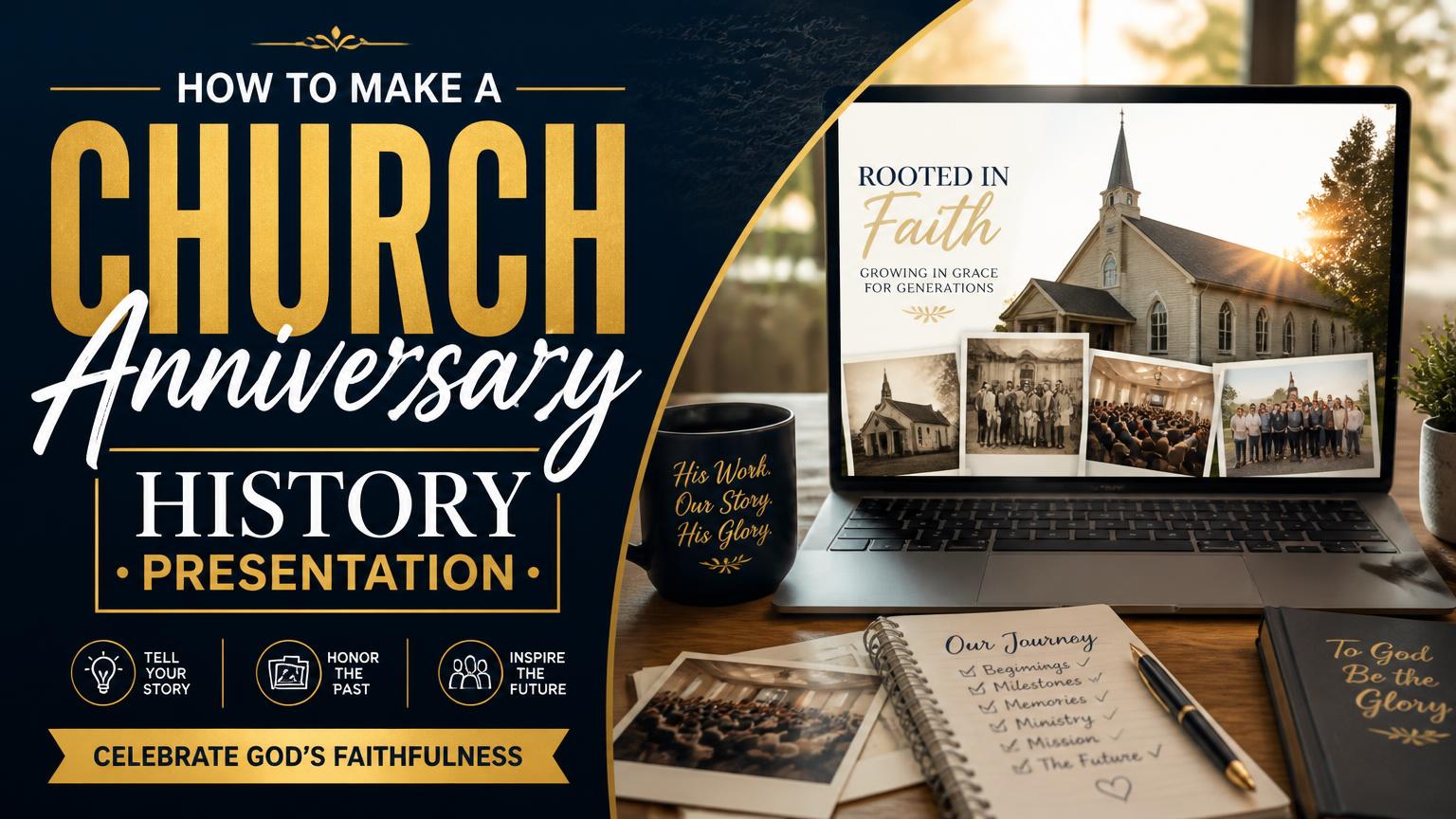
A strong church anniversary history presentation does more than list dates. It explains how the congregation began, identifies the people and ministries that shaped it, acknowledges challenges honestly, and connects the past with the church’s present mission. The best presentations are accurate enough to be trusted, personal enough to be remembered, and focused enough to fit naturally into a worship service or anniversary program.
Church Anniversary History Presentation: A Practical Framework
Define the Purpose and Audience
Begin by deciding what the presentation should accomplish. A presentation for a Sunday worship service may emphasize gratitude and spiritual heritage, while one shown at a formal banquet may include more photographs, interviews, and institutional detail.
Most church anniversary presentations should answer four questions:
- How did the church begin?
- What people, ministries, and events shaped its development?
- How did the congregation respond to challenges and change?
- What does its history suggest about its mission today?
The goal is not to praise every past decision or mention every member. It is to help the congregation remember faithfully and understand the significance of its shared story.
Identify the audience before choosing the format. Longtime members may recognize names and locations that younger attendees do not. Visitors and children may need brief explanations of denominational terms, former buildings, pastoral transitions, or historical circumstances.
Gather and Verify Church Records
Begin research with primary records held by the church. Useful sources include:
- Founding documents and incorporation records
- Church council or board minutes
- Membership registers and directories
- Baptism, wedding, and funeral records, where appropriate
- Annual reports and financial records
- Bulletins, newsletters, and anniversary booklets
- Building plans, deeds, dedication programs, and photographs
- Sermons, ministry reports, and denominational archives
- Newspaper coverage and public records
- Interviews with longtime members, pastors, and community leaders
Do not assume that the most frequently repeated story is automatically the most accurate. Oral history is valuable because it preserves personal experience, but memories can differ about dates, names, and sequence.
Pay special attention to the anniversary date. A church may have several historically meaningful dates: the first prayer meeting, the first worship service, the date of formal organization, the first building dedication, or the date of incorporation. Explain which date the congregation is commemorating and identify other relevant dates when confusion is likely.
When sources conflict, do not quietly choose the most convenient version. Use careful wording such as, “Church records identify 1952 as the year of formal organization, although members had begun meeting the previous year.” This preserves both the documented fact and the congregation’s lived experience.
Build a Meaningful Story, Not Just a Timeline
A timeline tells readers when events happened. A history presentation should also explain why those events mattered.
For example, do not simply write:
- 1964: A new building was constructed.
- 1978: A youth ministry began.
- 1991: The congregation called a new pastor.
Explain the significance:
- The new building provided space for a growing congregation and expanded children’s programs.
- The youth ministry created a sustained way for teenagers to worship, serve, and develop leadership.
- A pastoral transition brought changes in worship and outreach while preserving the church’s central commitments.
Organize the story around a few turning points rather than trying to include every event. A useful narrative may follow this pattern:
- A small beginning
- A period of growth or consolidation
- A significant change in location, leadership, or ministry
- A season of difficulty
- Renewal, expansion, or new outreach
- The congregation’s current mission
This structure gives the audience a reason to remember each section. It also prevents the presentation from becoming a sequence of disconnected names and dates.
Include People Without Making the History Personalistic
Church history is shaped by pastors, founders, teachers, musicians, trustees, volunteers, donors, missionaries, and generations of ordinary members. Recognize their contributions, but avoid suggesting that one individual alone created the church’s identity.
Use groups and ministries as well as prominent leaders. For example, mention the women who organized early relief work, the families who maintained the building, the teachers who established Christian education, or the volunteers who sustained food distribution during a difficult period.
When discussing deceased members or sensitive events, use respectful language and verify names, dates, and preferred titles. Avoid revealing private information that is not necessary to the story. A history presentation should honor people without turning personal loss, family conflict, or confidential pastoral matters into public content.
Choose a Format That Serves the Story
A church anniversary history presentation can be delivered as:
- A live narrated slide presentation
- A short documentary-style video
- A dramatic reading or staged historical presentation
- A printed timeline combined with spoken narration
- A panel of longtime members moderated by a presenter
- A multimedia presentation using photographs, music, interviews, and Scripture
The format should match the available evidence and the audience’s needs. If the church has excellent photographs but limited written records, a visual presentation may work well. If the history contains complex transitions or conflicting memories, a live narrator may explain the context better than a fast-moving video.
Use slides to support the speaker, not replace the speaker. Each slide should communicate one main idea. A photograph with a clear caption is usually more effective than a crowded slide containing several paragraphs.
What to Include in the History
Explain the Church’s Beginning
Introduce the founding circumstances clearly. Identify the early members or organizers, the community they served, the location of the first meetings, and the purpose that brought people together.
If the congregation began in a home, school, rented hall, or another church’s building, explain why that setting mattered. If the church was planted to serve a growing neighborhood, a particular cultural group, or an underserved community, include that context when it is documented.
Avoid presenting the founding as a polished success story if the early years involved uncertainty, disagreement, limited resources, or repeated relocation. Honest difficulty often makes the congregation’s perseverance more meaningful.
Trace Major Ministries and Turning Points
Select ministries that reveal the church’s identity and mission. These might include:
- Sunday school and children’s ministry
- Youth discipleship
- Missions and evangelism
- Music and worship
- Community relief or food programs
- Prison, hospital, or nursing-home ministry
- Racial reconciliation or immigrant support
- Christian education and small groups
- Building projects and accessibility improvements
A ministry belongs in the presentation because it changed the church or served people—not merely because it existed. Explain its purpose, the people it reached, and what it contributed to the congregation’s development.
Address Challenges With Honesty and Care
A credible history includes difficult seasons: declining attendance, financial pressure, building damage, leadership transitions, congregational conflict, social change, or the interruption of ministry during a public crisis.
The presentation does not need to reopen old disputes or assign blame. It should explain the challenge at an appropriate level and show how the church responded. For example, it may describe a relocation, a period of reduced programming, or a leadership transition without naming private disagreements.
In a Christian setting, the congregation may interpret these periods through themes of prayer, repentance, endurance, service, and hope. That interpretation should arise from the church’s documented testimony rather than from unsupported claims about exactly why God allowed a particular event.
Connect the Past With the Present
The history should lead somewhere. End the main narrative by showing how earlier commitments appear in the church’s current ministry.
If the founders emphasized hospitality, explain how the church practices welcome today. If earlier members established a food pantry, describe how present members continue serving neighbors. If the congregation moved from a small gathering to a larger ministry, identify which values remained constant and which methods changed.
This distinction is important: faithfulness does not always mean preserving every former practice. A church can retain its theological convictions and mission while changing its worship style, technology, building use, or outreach methods.
A Sample Church Anniversary Presentation Outline
For a presentation lasting approximately 8 to 15 minutes, the following structure provides enough room for substance without overwhelming the service.
| Segment | Approximate Focus |
|---|---|
| Opening | Welcome, anniversary theme, and central message |
| The Beginning | Founders, first meetings, original purpose, and early setting |
| Growth and Development | Buildings, leaders, ministries, and important transitions |
| Challenges and Faithfulness | Difficult seasons and the congregation’s response |
| People and Legacy | Generations of members, volunteers, and community relationships |
| The Church Today | Current ministries and continuing mission |
| Closing | Gratitude, Scripture or prayerful reflection, and future commitment |
A presentation of this length might use 15 to 30 slides, depending on how much narration accompanies each image. Avoid changing slides so quickly that the audience cannot examine photographs or read captions.
An optional biblical frame can give the presentation spiritual direction. Psalm 78:4–7 emphasizes telling the next generation about God’s works, while 1 Corinthians 3:6–7 distinguishes human labor from God’s role in giving growth. These passages do not replace historical research; they help the congregation interpret its history with humility and gratitude.
How to Write and Deliver the Script
Write for the ear, not the page. Use shorter sentences, explain unfamiliar names, and pronounce places and surnames correctly. A written history booklet can contain extensive detail, but a spoken presentation needs clear transitions and selective emphasis.
A useful narration pattern is:
Fact → Meaning → Connection
For example:
“In 1975, the congregation began meeting in the community center after outgrowing its original building. This change allowed the church to add classrooms and expand children’s ministry. The congregation’s present emphasis on intergenerational discipleship has roots in that period of growth.”
Use captions for names, dates, locations, and photo sources. If an image shows a church building, identify the year and location. If the date is uncertain, say “approximately 1960” or “early 1960s” rather than presenting an estimate as an exact fact.
Practice the presentation with the actual slides, audio, and projection equipment. Check whether photographs are visible from the back of the room, whether recorded interviews can be heard, and whether the presentation still works if the internet connection fails. Keep a copy of the script and media files in more than one location.
Obtain permission for contemporary photographs, recorded interviews, and copyrighted music or video. Avoid displaying private contact information, children’s images without appropriate consent, or documents containing sensitive personal details.
Common Mistakes to Avoid
Trying to Include Everything
A church may have decades of worthy events, but a presentation cannot represent every year equally. Select the moments that explain the congregation’s development. Put additional material in a printed booklet, digital archive, lobby display, or supplementary timeline.
Using Unverified Stories as Established Facts
A memorable story may be meaningful without being fully documented. Introduce it honestly: “Several longtime members recall…” or “An account preserved in the 1980 anniversary booklet states…” This allows the audience to appreciate the testimony without confusing memory with confirmed documentation.
Making the Presentation Only About Past Leaders
Leadership matters, but congregational history also includes worshipers, families, children, volunteers, and community partners. A broader account reflects how churches actually function and prevents the presentation from becoming a succession of pastoral biographies.
Overloading Slides With Text
Dense slides compete with the narrator and encourage the audience to read instead of listen. Use large type, strong contrast, concise captions, and one central image or idea whenever possible.
Treating Growth as the Only Measure of Faithfulness
Attendance, buildings, and budgets may be relevant, but they do not fully describe a church’s ministry. Service to vulnerable people, spiritual formation, reconciliation, perseverance, and faithful care during difficult seasons may be equally important—even when they are harder to quantify.
Final Checklist for a Church Anniversary History Presentation
Before presenting, confirm that:
- The anniversary date and major events have been verified.
- Conflicting information is explained rather than concealed.
- Names, titles, photographs, and captions are accurate.
- The presentation has a clear beginning, development, and conclusion.
- The story includes both achievements and challenges.
- The role of ordinary members and ministries is represented.
- The presentation connects the congregation’s past with its current mission.
- Scripture, if included, supports the theme without replacing historical evidence.
- Images, interviews, music, and personal information are used appropriately.
- The length fits the service or event.
- The equipment and backup files have been tested.
A church anniversary history presentation succeeds when people can see where the congregation came from, understand what shaped it, and recognize their responsibility in carrying its mission forward. Accuracy gives the story credibility; thoughtful interpretation gives it meaning; and a clear connection to present ministry keeps history from becoming mere nostalgia.